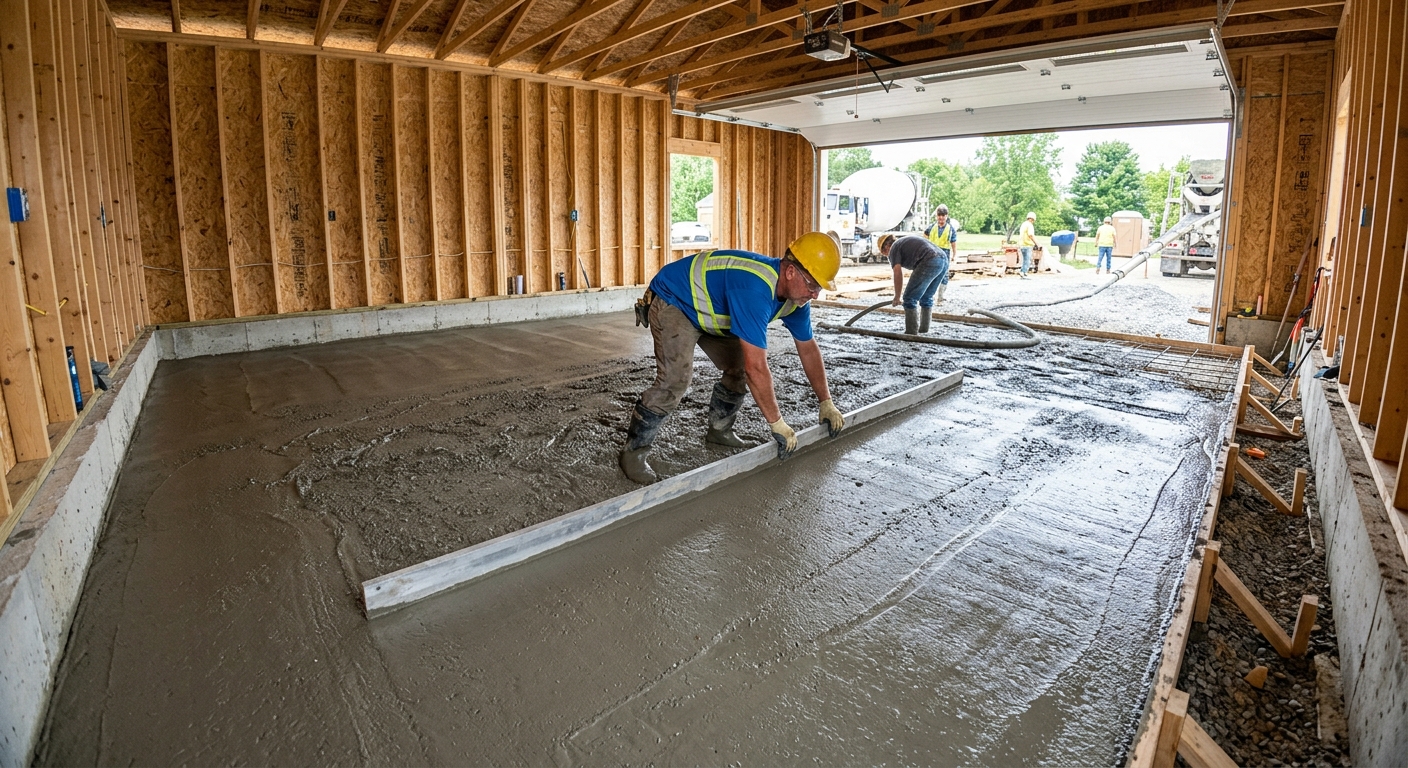
Concrete work options and costs in Thorncliff
Thorncliff, Alberta is a community where concrete flatwork gets tested every winter. With a population of 3,503 (Statistics Canada, 2021 Census), it’s not a huge market, so the best crews tend to book up when homeowners around Calgary move projects from spring into the short fall schedule. Most concrete driveways, patios and walkways in Thorncliff support the typical residential built form—single-family properties where owners want a smooth, low-maintenance surface that can take snowplough traffic and de-icing salt. On top of that, Calgary’s cold continental climate is engineered for frost: the design frost depth is about 1.2 m (roughly 4 ft), so foundation and structural elements must bear on undisturbed soil below that level. For exterior slabs, frequent freeze–thaw cycles drive requirements like air-entrained mixes, granular base prep and properly spaced control joints to reduce cracking and surface scaling.
Pricing also reflects contractor availability and the condensed pour season. Exterior slabs are easiest when temperatures stay favourable for curing; in late fall or early spring, crews may need winter-grade practices (insulation blankets and/or heated enclosures) to protect early strength development. In Thorncliff, concrete is especially in demand around the established residential pockets near schools and main access routes, where homeowners often replace older asphalt with driveways and firm up walkways to entrances.
Below is a practical comparison of common options you’ll see in Thorncliff, using the Calgary regional price bands as the backbone for estimating.
| Application |
Typical Size |
Key Spec |
Finish Option |
Price Range |
| Concrete driveway (standard broom finish) |
500–700 sq. ft. |
Air-entrained exterior mix, compacted base |
Broom finish, control joints |
$12,000–$18,000 |
| Exposed aggregate driveway |
500–700 sq. ft. |
Air-entrained exterior mix, wash/expose method |
Exposed aggregate look |
$14,000–$21,000 |
| Stamped concrete driveway or patio |
350–600 sq. ft. |
Air-entrained mix, integral colour |
Stamped pattern + release + sealer |
$15,000–$26,000 |
| Plain concrete patio or walkway |
200–450 sq. ft. |
Air-entrained mix, thickened edges where needed |
Broom or trowel-float finish |
$5,000–$9,000 |
| Garage floor (interior slab) |
400–650 sq. ft. |
Vapour barrier, reinforcement as specified |
Broom finish |
$7,500–$13,000 |
| Foundation footings (structural, below frost) |
Varies by plan |
Engineered footing depth below design frost |
Structural concrete (forms + rebar) |
$28,000–$45,000 |
Prices are estimates only and vary by project scope, site access and material selection.
What affects the price of concrete work in Thorncliff
In Thorncliff and the broader Calgary region, it’s common to see quotes for the “same” concrete job swing by 30–50%. The main reason is that concrete pricing isn’t just about the slab—it’s the engineered spec (depths, reinforcement, mix requirements) and the amount of site work needed to get concrete out of the freeze–thaw zone. In cold climates, footings must extend below the design frost depth—around 1.2 m here—so excavation is more intensive than in warmer parts of Canada. That alone pushes foundation costs toward the $28,000–$45,000 band, especially when soil conditions require over-excavation, trucking, or more granular replacement.
Freeze–thaw cycles also affect every exterior slab. Driveways and patios need air-entrained concrete to tolerate expanding moisture, plus control joints and sealing to reduce spalling from de-icing salt. In late fall or early spring, cold-weather curing precautions (insulated blankets, sometimes temperature monitoring and heat) can add cost even if the slab size is unchanged. You’ll also see big differences in quotes when one contractor includes granular base prep and compaction testing while another assumes “good soil” and reduces excavation.
Two local examples: (1) a 600 sq. ft. driveway where a contractor has to remove and replace poor near-surface soils can add thousands before a single yard of concrete is poured; (2) upgrading a plain broom finish driveway into exposed aggregate or stamped work can be justified, because the added labour and materials typically move you from the $12,000–$18,000 band toward the $15,000–$26,000 range depending on pattern area, colour, and sealing.
| Price Factor |
Why It Matters |
Cost Impact |
| Frost line depth |
Determines footing depth and form height |
More excavation drives higher foundation totals |
| Site preparation |
Excavation, grading, compacted granular base |
Unstable soils or extra hauling can add thousands |
| Reinforcement |
Rebar or wire mesh requirement |
Material and placement labour affect slab durability |
| Mix design |
Air-entrainment and compressive strength spec |
Exterior specs cost more but reduce freeze–thaw failure |
| Finish type |
Broom vs. stamped vs. exposed aggregate |
Labour intensity increases stamped/exposed totals |
| Pour size and concrete truck access to site |
More volume, pumping/formwork logistics |
Access constraints can increase labour and equipment charges |
| Cold-weather curing precautions |
Heating and blankets to protect strength gain |
Winter measures can raise exterior slab pricing |
| Control joint pattern and sealing cost |
Limits random cracking; sealer protects from salts |
Proper jointing and sealer add line-item cost |
Permits & regulations in Alberta
In Alberta, structural concrete work—such as building footings, foundation walls, and grade beams—typically requires a building permit, and it’s common for engineered drawings to be reviewed as part of the permit process. Concrete flatwork (driveways, patios and walkways) often does not require a permit by itself, unless it affects lot grading, impervious surface coverage rules, or ties into municipal right-of-way drainage. The practical takeaway for Thorncliff homeowners: confirm with the local authority before breaking ground, especially if your project changes drainage patterns, elevation near existing services, or site access.
Before signing, verify your contractor carries liability insurance and has WSIB/WCB coverage in place. Then ask for references from similar-scope jobs in the Calgary area—driveways and exterior slabs that were done under cold-weather constraints are a good sign the company understands proper curing.
Step-by-step checks you can do right away: (1) Ask for the certificate of insurance and make sure the policy covers the type of work being done; the certificate should show your contractor’s name and the coverage limits. (2) Request proof of WSIB/WCB coverage (or the appropriate provincial coverage information the contractor uses). (3) Confirm business details and licensing information through the applicable online registry for Alberta contractors; look for a current status and the correct business entity. (4) Get it in writing: permit responsibility, inspection timing (if applicable), and who handles paperwork if engineered changes are needed.
Getting concrete right in Thorncliff's freeze-thaw climate
Concrete failures in Thorncliff are usually predictable: moisture intrusion, insufficient air-entrainment, or a base that can’t stay stable through freeze–thaw. The job is only as good as the “system” you spec—base prep, mix design, joints, curing and sealing. For exterior slabs in Calgary-area conditions, the base needs a compacted granular sub-base to the correct depth for local soil and frost protection, with well-graded material and proper compaction so the slab doesn’t settle and crack. For the mix, air-entrainment is non-negotiable for freeze–thaw durability; for exterior flatwork, a typical target is about 5%–7% air content, along with a minimum 32 MPa compressive strength (or higher if engineering calls for it). Control joints are also critical—spacing must be planned to limit random cracking.
Curing is where many “cheap” pours go wrong. Plan for at least 7 days of curing under proper conditions, and in cold weather you need curing protection like insulated blankets and temperature management to prevent early-age damage. Finally, sealing should be planned for 28 days after the pour when the concrete has adequately cured, to help repel de-icing salts and reduce surface scaling.
Ask better questions to avoid spalling: “What air content are you targeting?” “How will you protect the slab during the first week if temperatures drop?” “What’s your joint spacing plan?” A real-world cost example: if you’re choosing between a plain driveway ($12,000–$18,000 band) and a stamped driveway ($15,000–$26,000 band), the decorative upgrade is often worth it only if the contractor is also keeping the correct exterior specs (air-entrained mix, correct base, curing protection). If the fundamentals are cut, the higher finish cost won’t protect you from salt-driven surface damage.
| Spec |
Why It Matters in Thorncliff |
What to Ask For |
Impact if Skipped |
| Compacted granular base (depth?) |
Helps keep the slab stable through freeze–thaw around Thorncliff |
Documented base depth and compaction method/testing |
Settlement and cracking, especially near edges |
| Air-entrained concrete mix (target air %?) |
Resists freeze–thaw moisture expansion and reduces spalling |
Target 5%–7% air for exterior flatwork |
Premature scaling/spalling after winters |
| Compressive strength (MPa rating) |
Ensures the concrete reaches adequate strength for service |
Minimum 32 MPa (or higher if engineered/required) |
Reduced durability and higher risk of surface damage |
| Control joints (spacing per ACI guidelines) |
Controls where cracks form as concrete shrinks |
Joint spacing and sawcut timing plan |
Random cracking that can open pathways for water |
| Minimum 7-day curing period |
Cold snaps can harm early-age strength development |
Protection plan if temperatures fall (blankets/heating) |
Weakened surface and long-term performance issues |
| Penetrating sealer (when applied after cure) |
Repels de-icing salts and reduces surface deterioration |
Apply after adequate cure (commonly around day 28) |
Faster spalling and stained, salt-damaged surfaces |
How to choose a concrete work contractor in Thorncliff
Choosing the right contractor in Thorncliff is mostly about verification and scope control. Start with Alberta compliance: ask for their proof of liability insurance, then request WSIB/WCB coverage confirmation. To check, look for an active certificate of insurance showing the contractor’s name and coverage limits that correspond to your job type. For WSIB/WCB, you should receive documentation that matches their registration and indicates they’re in good standing for worker coverage. Next, verify licensing/business status through the applicable Alberta online registries for contractors—ensure the company name matches the quote and the invoices.
Then get 2–3 written, itemised quotes. You want labour and materials breakdowns (base prep, reinforcement, concrete supply, finishing, sealing, excavation/hauling/disposal). Avoid lump-sum quotes that don’t show what’s included—especially for exterior work where drainage, removal of old asphalt, and disposal can swing the total. Ask whether a permit pull is included when required, and confirm who’s responsible for inspections if the scope touches structural or engineered components.
On warranty, ask for both: a workmanship warranty length and what happens if there’s premature cracking, scaling, or joint failure. Also confirm the product/manufacturer warranty (for sealers/admix products) and whether it’s transferable if you sell your home. Payment schedule matters: never pay more than 10%–15% upfront, and hold back a portion until final cleanup, sealing (if included), and final walkthrough completion. Get a start date and completion estimate in writing, with weather contingencies for cold snaps common around Calgary.
- Ask what air content they target for exterior concrete (and how they confirm it).
- Confirm frost-depth considerations for any structural scope (footings).
- Request base depth and compaction method, not just “we prep the base.”
- Ensure control joints are included and you get a joint spacing plan.
- Ask about cold-weather curing practices (blankets/heating/temperature monitoring).
- Verify reinforcement details: where mesh/rebar is placed and why.
- Get a written finish schedule (broom vs trowel, stamp pattern, exposure plan).
- Confirm whether sealing is included and when it will be applied (timing after cure).
- Check disposal, trucking, and grind-up/asphalt removal are explicitly listed.
- Review access requirements: concrete truck route, pump needs, and protection for landscaping.
- Ask for a detailed schedule with contingency dates for temperature swings.
- Don’t accept vague allowances—insist on measured quantities and line items.
Red flags I see too often in Thorncliff: “We’ll just pour it and it’ll be fine” without cold-weather curing plans; no mention of air-entrainment for exterior work; quotes that omit base prep depth or compaction; payment terms asking for large upfront deposits; and finishing/jointing details that aren’t described clearly in writing.
Frequently asked questions — concrete work in Thorncliff
Concrete vs pavers for a patio in Thorncliff?
In Thorncliff, both concrete and pavers can perform well, but they fail differently. Concrete patios are usually engineered as a monolithic slab with control joints, and they’re typically lower maintenance in terms of weed control and routine surface leveling. If the contractor uses air-entrained concrete and correct curing, you’re protecting the slab against freeze–thaw spalling. Pavers can be easier to repair in isolated spots because individual units can be lifted and reset, and they can handle some movement without the same “single slab” cracking pattern. The key cost driver for either option is site prep and base: poor base prep will create problems quickly in Calgary-area freeze–thaw. If you’re comparing budgets, a plain concrete patio often lands in the $5,000–$9,000 band depending on size and access, while pavers tend to rise with edging, base thickness and labour.
How long does a concrete driveway last?
With the right spec, a concrete driveway in Thorncliff commonly lasts 20–30 years or more. Longevity depends on exterior-grade mix design (especially air-entrainment), a properly compacted granular base, correct joint spacing, and curing that isn’t rushed during cold snaps. The Calgary climate adds stress because freeze–thaw cycles and de-icing salts attack the surface over time. Sealing—applied after the concrete has cured (commonly around day 28)—helps reduce salt penetration and surface scaling. A driveway that’s placed when temperatures are too cold without proper blanket protection can show early surface damage, shortening its service life. If your contractor’s quote points to air-entrainment and cold-weather curing measures, that’s a good sign you’re buying durability, not just a price.
What is air-entrained concrete and why does it matter here?
Air-entrained concrete is mixed with tiny, evenly distributed air bubbles that give freezing water a place to expand. In Thorncliff and the Calgary region, the freeze–thaw cycle is frequent, so air-entrainment is a core durability requirement for exterior flatwork like driveways, patios and walkways. Without it, the water in concrete pores can expand during freezing and break the surface, leading to scaling and spalling over successive winters. That’s why quotes can differ: a lower-priced option may cut corners on the mix spec, curing protection, or air content targeting. When a contractor specifies exterior air content (often in the 5%–7% range) and plans for curing, you’re aligning the job with the climate demands. It’s one of the best “value protections” you can ask for—especially if you’re spending toward the $12,000–$18,000 driveway band or higher.
How do I prepare the base for a concrete slab?
Base preparation is the foundation of the concrete performance in Thorncliff. The contractor should excavate to a planned depth based on frost protection and soil conditions, then place compacted granular material in lifts and achieve proper compaction. You should expect documented base thickness and confirmation that drainage and grading slopes are correct before any rebar/mesh goes in. For exterior slabs, poor base compaction is a common reason for edge settling and early cracking when seasonal ground movement occurs. Ask who is responsible for removing unsuitable soils and how disposal/hauling is handled. Also confirm whether they’re planning for a thickened edge, reinforcement placement, and control joints. Even for a smaller patio or walkway (often in the $5,000–$9,000 range), good base prep prevents the slab from becoming a “cracked and uneven” repair job in a few winters.
How do I compare concrete quotes?
To compare concrete quotes in Thorncliff, insist on itemised pricing and clear scope. Compare the thickness of concrete (and whether it matches engineering or local practice), reinforcement type and placement (rebar vs wire mesh, and coverage), and the base depth plus compaction requirements. For exterior work, check that the mix is described as air-entrained and that the contractor addresses cold-weather curing—this can be a major hidden cost in Alberta. Make sure control joints are included with a stated spacing plan and sawcut timing. Review whether sealing is included and when it will be applied after cure. Also confirm site access details: disposal, trucking, and whether equipment like a pump is required. Finally, compare payment schedules and warranty terms, not just totals. A quote that’s “low” but missing these essentials can create far more expense later, especially when freeze–thaw and salt take their toll.
Can concrete be poured in cold weather in Thorncliff?
Yes, concrete can be poured in cold weather in Thorncliff, but it must be done correctly. In Calgary-area winters and shoulder seasons, the concern is protecting early-age strength gain. Contractors typically use cold-weather procedures such as winter-grade mixes, temperature monitoring, and insulating blankets or temporary heat to maintain curing conditions. The goal is to prevent freezing of the concrete before it reaches sufficient strength. A good contractor will explain their curing plan in writing and may advise a pour schedule that aligns with temperature forecasts rather than just “getting it done.” If they don’t discuss curing precautions, that’s a risk factor for surface scaling and long-term durability problems. Exterior flatwork pricing can also shift because those winter measures add labour and materials—even if the project size looks the same as a normal-season pour.