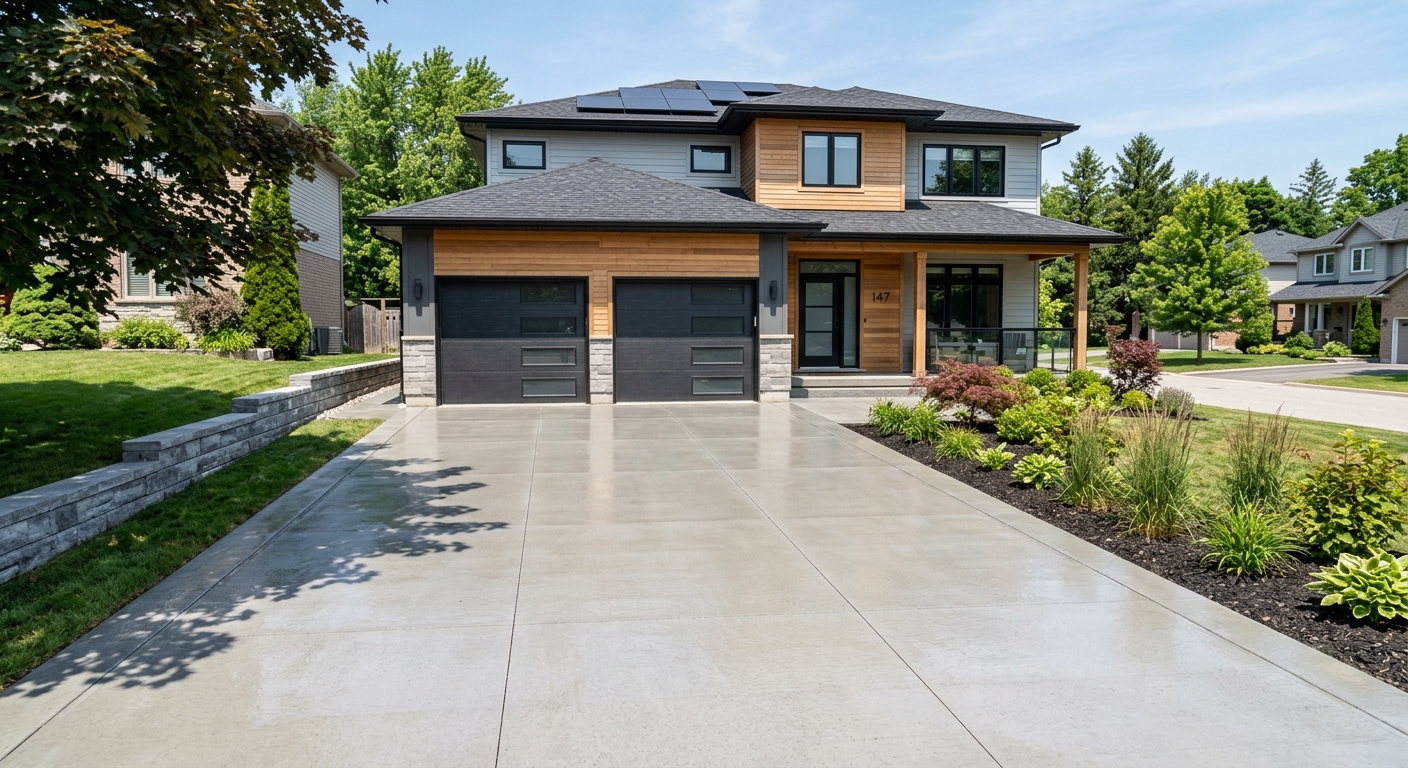
Concrete work options and costs in The Hamptons
The Hamptons, Alberta is seeing steady demand for concrete flatwork, especially as more homeowners upgrade driveways, add patios and refresh ageing garage floors. In the wider Calgary economic region, many residents live in single-detached housing (Statistics Canada, 2021 Census), which typically means more exterior concrete—driveways, walkways, and backyard patios—than in denser neighbourhoods. With a population of 9,405 (Statistics Canada, 2021 Census), The Hamptons also has enough repeat work that crews and finish specialists tend to focus on quality upgrades around established residential pockets, not just new builds. In practice, availability can tighten in spring and early summer, which is why quotes for the same scope can move quickly.
Calgary’s cold continental climate drives the cost structure. You’re not just paying for concrete; you’re paying for frost-engineered excavation to place foundations and structural elements below the local design frost depth (about 1.2 m, roughly 4 ft) and for freeze–thaw durability specs on exterior slabs. For driveways and patios, air-entrained mixes, granular base preparation, and well-planned control joints are non-negotiable here. And because the exterior pour season is shorter, cold-weather curing precautions—insulating blankets and, in some cases, temporary heat—can add real labour and equipment costs if you’re scheduling near fall or early spring.
Where this trade is especially in demand is the established residential areas around the more mature streets of The Hamptons—homeowners there tend to replace cracked slabs and build additions at the same time. Below is a practical comparison of options you’ll see in local quotes, using the standard price bands for this Calgary tier.
| Application |
Typical Size |
Key Spec |
Finish Option |
Price Range |
| Concrete driveway (standard broom finish) |
24 ft x 10 ft (240 sq. ft.) |
Air-entrained exterior mix; granular base; control joints |
Broom finish; basic edge forms |
$12,000 – $18,000 |
| Exposed aggregate driveway |
24 ft x 10 ft (240 sq. ft.) |
Air-entrained exterior mix; decorative stone exposure process |
Exposed aggregate with seal-ready surface |
$15,500 – $22,500 |
| Stamped concrete driveway or patio |
300 sq. ft. driveway pad or patio |
Air-entrained mix; thicker pour to support stamping; integral colour |
Stamp pattern + colour; border details |
$15,000 – $26,000 |
| Plain concrete patio or walkway |
12 ft x 12 ft (144 sq. ft.) walkway pad |
Air-entrained mix; compacted granular sub-base |
Float/steel-trowel and light broom; simple edges |
$5,000 – $9,000 |
| Garage floor (interior slab) |
24 ft x 24 ft (576 sq. ft.) |
Vapour barrier (if specified); engineered thickness; fibre or mesh |
Steel-trowel finish or light broom; option for densifier |
$10,500 – $16,500 |
| Foundation footings (structural, below frost) |
Typical detached home footing perimeter |
Excavation to design frost depth; rebar cage; structural concrete |
Cast-in-place concrete (no decorative finish) |
$28,000 – $45,000 |
Prices are estimates only and vary by project scope, site access and material selection.
What affects the price of concrete work in The Hamptons
In The Hamptons and across Calgary, it’s common to see quotes for the “same” concrete project vary by 30–50%. The reason isn’t just markup—it’s engineering and execution choices driven by frost depth, freeze–thaw cycles and how the site is built. Two contractors can both say “concrete driveway,” but one may price a proper granular base with the right compaction, air-entrained mix, and jointing plan, while another underprices excavation and assumes easier site conditions. Labour rates, scheduling, and equipment availability in peak season also shift costs between spring placements and late-fall scheduling.
Frost depth is the big driver. In this region, footings and structural supports must extend below the design frost depth of about 1.2 m (roughly 4 ft) to reduce frost heave and seasonal movement risk. Exterior slabs also need air-entrained concrete mixes to withstand repeated freeze–thaw cycles that can promote scaling and spalling if the mix isn’t specified correctly. Calgary’s colder conditions also shrink the comfortable pour season and raise the likelihood of cold-weather curing precautions—insulating blankets, tenting, and sometimes heat—especially if you’re pouring near the shoulder months. Add in de-icing salts (common on driveways and entry paths) and the case for sealing becomes practical, not optional.
Concrete examples from The Hamptons: replacing a cracked broom-finished driveway often falls into the $12,000–$18,000 band when the base is verified and removed to the right depth; costs climb toward the higher end if the existing base is failing and needs re-excavation and re-compaction. Stamped or decorative work tends to justify premiums in the $15,000–$26,000 band when you’re adding integral colour, deeper decorative detailing and extra finishing time—rather than when the stamp is “thin” and can’t hide surface issues. Housing age also matters: older properties can have less ideal drainage or previous patchwork, which can add excavation and disposal costs—sometimes several thousand dollars—before a contractor even gets to the concrete.
| Price Factor |
Why It Matters |
Cost Impact |
| Frost line depth — determines footing depth and form height |
Footings must be placed below the design frost depth to prevent movement |
Can raise foundation scope significantly; excavation is a major cost item |
| Site preparation — excavation, grading, compacted granular base |
Proper sub-base reduces settlement and limits water-driven damage |
Underpricing here leads to failures; correct work adds labour and hauling/disposal |
| Reinforcement — rebar or wire mesh requirement |
Helps control cracking and supports load paths |
Material + placement labour can add noticeable cost on larger slabs |
| Mix design — air-entrainment and compressive strength spec |
Freeze–thaw durability depends on air-entrainment and strength |
Proper exterior mixes usually cost a bit more but prevent costly deterioration |
| Finish type — broom vs. stamped vs. exposed aggregate |
Decorative finishes require extra processes, timing and attention |
Stamped/exposed options typically push pricing toward the higher driveway/patio bands |
| Pour size and concrete truck access to site |
Access determines pumping distance, labour and time |
Poor access can add charges for pump/placement equipment and longer labour time |
| Cold-weather curing precautions — heating and blankets |
Maintains adequate curing in colder temperatures |
Can add equipment and labour costs if placement is scheduled outside the ideal window |
| Control joint pattern and sealing cost |
Joints control cracking locations; sealing helps manage salt exposure |
Neglecting either can shorten lifespan; including both adds line-item cost |
Permits & regulations in Alberta
In Alberta, concrete work is treated differently depending on whether it’s structural or just site flatwork. Structural concrete—such as footings, foundation walls, grade beams and other load-bearing elements—typically requires a building permit, and in many cases it involves engineered drawings that the municipality reviews. Concrete flatwork like patios, walkways and standard driveways often does not require a permit, unless it affects lot grading/drainage, triggers impervious surface coverage limits, or changes municipal right-of-way or setbacks. Before you break ground in The Hamptons, confirm requirements with the local authority—especially if you’re changing elevations, redirecting drainage, or building a retaining structure.
Regardless of permit needs, verify the contractor is properly insured and accountable. For homeowners, do it step-by-step: (1) ask for a current certificate of insurance showing liability coverage that matches the job size and includes your property as required; (2) confirm workers are covered under WSIB/WCB for workplace injury protection; and (3) request references for similar-scale projects in the Calgary area (driveways and flatwork in particular, since freeze–thaw performance is execution-driven).
To check contractor details, look online for the Alberta licensing/registry information relevant to their trade scope, then compare that against what’s on their certificate of insurance. Don’t accept expired documents. If they can’t provide clear proof of insurance, WSIB/WCB coverage and relevant references, treat that as a red flag and move on.
Getting concrete right in The Hamptons's freeze-thaw climate
The concrete that performs best in The Hamptons is the concrete specified and built for Calgary’s freeze–thaw cycle—not the “standard mix” poured on a random schedule. The most common failures come from poor base preparation, inadequate air-entrainment, weak jointing and rushing curing. When water enters a slab and freezes, it expands—pushing at the surface and creating spalling, scaling and random cracks. That’s why base preparation has to match local soil conditions and frost considerations, and why exterior mixes must be air-entrained.
To spec the job correctly: (1) base prep should include compacted granular sub-base to the required depth for the frost/soil conditions, with proper grading for drainage. (2) mix design for exterior flatwork should target about 5–7% air content (typical exterior range for freeze–thaw durability) and a minimum 32 MPa compressive strength, so the slab can handle both winter exposure and loading. (3) control joints must be cut or formed to a spacing pattern that limits random cracking. (4) curing should be at least 7 days under proper conditions—if you pour late fall or early spring, cold-weather curing precautions can be required to prevent surface damage. (5) sealing should be scheduled after cure (commonly around 28 days) with a penetrating sealer that helps repel de-icing salt intrusion.
Ask the technical questions up front: “What air content are you targeting for this exterior slab?” and “What’s your joint spacing plan?” If a contractor can’t answer, you’re more likely to see the exact failure homeowners fear—spalling from insufficient air-entrainment. As for dollars: if you’re choosing between a plain broom-finish patio and stamped concrete, a plain patio often lands in the $5,000–$9,000 range, while stamped options can run $15,000–$26,000. The price difference is justified when the decorative job still includes proper base prep, correct exterior mix and jointing—not when the decoration is used to mask shortcuts.
| Spec |
Why It Matters in The Hamptons |
What to Ask For |
Impact if Skipped |
| Compacted granular base (depth?) |
Controls settlement and protects against water movement under freeze–thaw |
Confirm excavation depth, base thickness and compaction testing method |
Premature cracking, uneven settling, voids and drainage-related failures |
| Air-entrained concrete mix (target air %?) |
Improves freeze–thaw durability in Calgary-area winters |
Ask for target exterior air content (commonly 5–7%); confirm it’s air-entrained |
Higher risk of scaling and spalling during winter cycles |
| Compressive strength (MPa rating) |
Strength affects wear resistance and long-term durability |
Minimum 32 MPa for typical exterior flatwork (confirm spec in writing) |
Faster surface wear, cracking and reduced performance under loads |
| Control joints (spacing per ACI guidelines) |
Limits where cracks occur as the slab moves |
Request planned joint spacing and whether saw-cut timing is followed |
Random cracking that’s harder to repair and more likely to leak water |
| Minimum 7-day curing period |
Ensures concrete develops strength before it’s exposed to winter stress |
Confirm cure method; ask how cold weather is handled (blankets/heat) |
Surface scaling, weakness at the top and longer-term deterioration |
| Penetrating sealer (when applied after cure) |
Repels water and helps manage de-icing salt exposure |
Schedule after proper cure (often at/after 28 days) with a penetrating product |
Faster salt-driven surface damage and more frequent maintenance |
How to choose a concrete work contractor in The Hamptons
Choosing the right contractor in The Hamptons starts with verification. In Alberta, confirm the company holds the proper licensing for their trade scope (based on the work being performed) and—crucially—has current liability insurance. Ask for a certificate of insurance and ensure it covers the project location and has enough liability limits for the total contract value. Next, verify WSIB/WCB coverage so you’re not exposed to risk if a worker is injured on-site. Don’t just ask “are you covered?”—ask for documentation and make sure the documents aren’t expired.
Then get 2–3 itemised written quotes. Ideally, your quote should break out labour and materials (excavation/grading, base rock supply and compaction, reinforcement, concrete supply, forming, finishing, sawing joints, and sealing if included). Avoid “all-in” numbers that don’t show what’s excluded—like disposal of excess soil, permit pulls (if needed for structural work), pump charges for difficult access, or base repairs if the existing slab is failing.
Warranty matters too. Ask for the workmanship warranty length, what it covers (cracking due to settlement versus defective work), and whether it’s tied to proper maintenance like sealing. Product/manufacturer warranties are separate. A good contractor will also offer clear scheduling, a start date, and a completion estimate in writing.
- Request written scope: thickness, air-entrainment, strength spec and joint plan
- Confirm permit responsibilities (structural vs. flatwork) in writing
- Provide COI (certificate of insurance) and verify liability limits
- Provide proof of WSIB/WCB clearance for the crew
- Use itemised quotes with labour + materials, not only a lump sum
- Ask what base depth and compaction method they will use
- Confirm reinforcement type (mesh/rebar/fibre) and placement details
- Get the curing plan for colder schedules (blankets/heat if needed)
- Ask about disposal: excess soil hauling included or extra
- Confirm truck access and whether a pump is included
- Request a payment schedule: limit upfront payment to 10–15%
- Hold back a reasonable portion until completion and cleanup
In The Hamptons, 4–5 concrete contractor red flags include: (1) vague specs like “regular concrete” without confirming air-entrainment and strength, (2) no clear plan for frost-safe base prep, (3) missing or expired insurance/WSIB/WCB documents, (4) quotes that don’t mention jointing or sealing expectations, and (5) pressuring you for a large upfront payment or refusing to put scope details in writing.
Frequently asked questions — concrete work in The Hamptons
What is a concrete overlay and is it suited to The Hamptons?
A concrete overlay is a thin cementitious topping applied over an existing concrete slab (after preparation). In The Hamptons, it can be suited to some driveways and patios when the base is still sound—meaning the old slab isn’t moving, heavily spalled, or full of active settlement. Overlays typically won’t fix structural problems like frost-driven movement, failed sub-base drainage, or widespread cracking that’s still reflecting through. Because Calgary-area freeze–thaw cycles can push moisture through the surface, overlays must be installed with proper surface profiling, bonding, and an exterior-grade mix designed for durability. In pricing terms, if your replacement would land in the $12,000–$18,000 driveway band, an overlay might reduce excavation costs, but only if the existing slab is genuinely stable. Always ask for a site assessment before choosing overlay versus full removal.
How do I seal concrete to protect it in The Hamptons?
Sealing in The Hamptons is mainly about protecting against de-icing salt and water intrusion during winter freeze–thaw cycles. The key is timing: don’t seal too early. In practice, many contractors apply a penetrating sealer after the concrete has fully cured—often around 28 days—so it can develop strength and avoid trapping moisture. Before sealing, the surface should be clean, dry and free of curing compounds or contaminants. Ask your contractor whether they’re using a penetrating sealer (common for salt protection) versus a film-forming coating, and what the surface prep method is (pressure wash, etching, or mechanical cleaning). If you have a newly poured driveway that sits in a high-salt area, sealing is one of the more cost-effective durability steps that helps extend the service life beyond what you’d get from concrete alone.
What is the difference between concrete and cement?
Cement and concrete are related, but they’re not the same thing. Cement is one ingredient—typically Portland cement—that acts as the binder. Concrete is the complete engineered mixture: cement plus water, aggregate (sand and gravel), and often additives like air-entrainment for exterior freeze–thaw durability in Alberta. In The Hamptons, this distinction matters because the “spec” you care about—air content for exterior slabs and compressive strength like the typical 32 MPa minimum—is determined by the entire concrete mix, not by cement alone. That’s why a contractor quote should state the concrete mix requirements (air-entrained for driveways, patios and walkways) and not just mention “cement” generically. When you see proper mix specs in writing, it’s easier to compare quotes fairly and reduce the risk of spalling or scaling.
How much does concrete work cost in The Hamptons?
Concrete costs in The Hamptons align closely with the Calgary pricing tier because the same frost depth and freeze–thaw durability requirements apply across the region. Typical ranges you’ll see: concrete driveways generally fall around $12,000 – $18,000 for standard broom-finished work, while stamped concrete driveways or patios often land in $15,000 – $26,000 depending on size and detailing. Plain patios and walkways are commonly $5,000 – $9,000 for typical residential scopes. For foundation footings (structural, below frost), local pricing often sits in $28,000 – $45,000 depending on excavation volume and reinforcement complexity. Costs can swing if you need additional excavation/disposal, if truck access requires pumping, or if cold-weather curing precautions are required near the edge of the pour season.
How deep must footings be for The Hamptons's frost line?
For The Hamptons and the broader Calgary region, footings are engineered to sit below the design frost depth. The design frost depth used in local practice is about 1.2 m (roughly 4 ft). That depth is important because it reduces frost heave and seasonal movement risk—especially where moisture and freeze–thaw cycles can affect soils at shallow levels. That said, the exact footing depth on your property should come from your engineered drawings or the structural design for the home and soil conditions. If you’re building a detached garage, adding a deck/retaining element, or doing structural foundation work, your drawings should specify excavation depth and structural details. If someone is vague about footing depth or doesn’t reference engineered requirements, don’t sign off—this is one of the places where shortcuts can cost far more later.
Why does concrete crack in The Hamptons and how is it prevented?
Concrete cracks in The Hamptons mostly because slabs and foundations naturally move as they gain/lose moisture and as temperatures drop and rise—then freeze and thaw add extra stress. In Calgary-area conditions, winter cycles can also intensify cracking if water infiltrates through joints or if the slab sits on an inadequately prepared base. Prevention starts with correct base prep and frost-aware excavation, proper reinforcement where required, and a control joint plan that directs cracking to predictable locations. For exterior slabs, air-entrainment is critical—insufficient air content raises the chance of surface scaling and spalling, which then accelerates deterioration around cracks. The practical steps to ask for are: the air-entrained mix spec, control joint spacing, curing time (minimum 7 days under proper conditions), and sealing after cure to repel salt and water. With those in place, cracking risk drops dramatically and stays mostly cosmetic rather than structural.