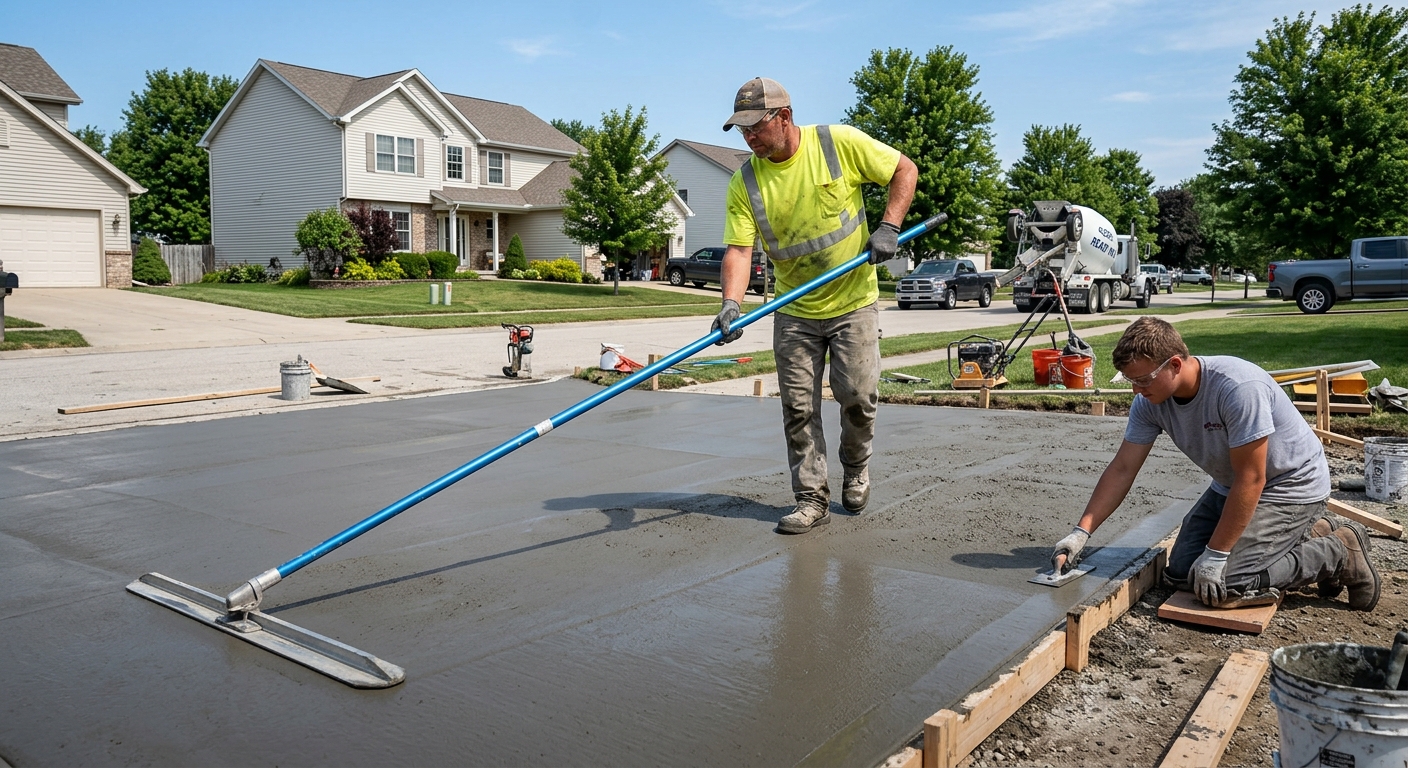
Concrete work options and costs in Coventry Hills
Concrete work in Coventry Hills typically falls into three buckets: exterior flatwork (driveways, patios, walkway slabs), interior slabs (like garage floors), and structural concrete (foundation footings and related work). Coventry Hills has a population of 17,350 (Statistics Canada, 2021 Census), and that steady family-oriented growth keeps demand strong for durable flatwork that can handle Alberta winters. In the Calgary economic region, most homeowners are planning and rebuilding around long service life—especially for driveways and backyard patios that see heavy vehicle traffic and regular de-icing.
Because Calgary sits in a cold continental climate, concrete here is engineered around frost and repeated freeze–thaw cycles. Local practice targets a design frost depth of about 1.2 m (roughly 4 ft), meaning excavation is deeper and footing volumes are higher than in milder areas. Exterior slabs also require air-entrained concrete mixes, and crews must manage curing carefully—winter-grade mixes, insulated blankets, and sometimes temporary heat—so the concrete reaches proper strength instead of scaling at the surface.
In Coventry Hills, trade demand is especially noticeable around the newer residential pockets near the northwest edge of the community where lots are still being developed and flatwork is often completed shortly after the home shell is finished. Contractors also see seasonal clustering: late spring and summer pours for driveways and patios, and foundation-related work timed around schedule and soil conditions. With those variables in mind, you can compare options more fairly using the ranges below.
| Application |
Typical Size |
Key Spec |
Finish Option |
Price Range |
| Concrete driveway (standard broom finish) |
20 ft x 10 ft (200 sq. ft.) |
Air-entrained, 32 MPa, granular base + joints |
Broom finish, light edging |
$12,000–$18,000 |
| Exposed aggregate driveway |
20 ft x 10 ft (200 sq. ft.) |
Air-entrained, 32 MPa, polished/controlled exposure |
Exposed aggregate with proper curing |
$14,500–$21,500 |
| Stamped concrete driveway or patio |
20 ft x 10 ft (200 sq. ft.) or 300 sq. ft. patio |
Air-entrained, 32 MPa, integral color or overlay |
Stamp pattern + release agent + sealer |
$15,000–$26,000 |
| Plain concrete patio or walkway |
300 sq. ft. patio or 4 ft x 40 ft walkway |
Air-entrained, 32 MPa, base + control joints |
Float + broom/smooth trowel |
$5,000–$9,000 |
| Garage floor (interior slab) |
24 ft x 24 ft (576 sq. ft.) |
32 MPa, vapor barrier, proper thickness |
Vented trowel or steel trowel (per spec) |
$10,500–$16,500 |
| Foundation footings (structural, below frost) |
Typical house footprint (engineered) |
Below design frost depth, reinforced per drawings |
Structural formed footings |
$28,000–$45,000 |
Prices are estimates only and vary by project scope, site access and material selection.
What affects the price of concrete work in Coventry Hills
In Coventry Hills, two quotes that both sound like “about the same concrete slab” can differ by 30–50% because the real cost drivers aren’t the concrete itself—they’re excavation, base preparation, reinforcement, and the cold-weather curing plan. In the Calgary region, contractors also price in schedule risk: winter placement can compress the workable window, and the crew that can guarantee curing quality (or can mobilize heat and blankets) will price that capability accordingly.
Frost line depth and freeze–thaw cycles dictate every major spec. Local engineering practice uses a design frost depth of about 1.2 m, so footings for houses, garages and retaining structures must bear below that depth to prevent frost heave and seasonal movement. Exterior slabs also need air-entrained concrete to survive repeated freeze–thaw; without that, the surface can spall and scale. On top of that, colder regions like Alberta have a shorter pour season and require cold-weather curing precautions—insulated blankets, sometimes temporary heaters, and stricter temperature monitoring—so concrete reaches strength rather than formulating surface defects.
De-icing salts add another wrinkle. Sealing helps repel chloride and reduces surface breakdown, but the sealing plan adds labour and timing (it’s commonly applied after cure). In practical Coventry Hills terms, a standard broom-finished driveway often lands closer to the $12,000–$18,000 band when excavation, base thickness, and joints are straightforward. A stamped driveway or patio tends to push toward the $15,000–$26,000 band because you’re paying for stamping labour, colour work, additional finishing steps and higher material handling. Costs can also lower when access is easy (short truck distance and minimal haul-off), but rise quickly when you need deeper excavation for drainage, larger granular base, or a more demanding reinforcement plan tied to soil conditions and engineered footing geometry.
| Price Factor |
Why It Matters |
Cost Impact |
| Frost line depth — determines footing depth and form height |
Footings must extend below design frost to prevent heave and movement. |
Major increase on foundation-related scopes; deeper excavation and more concrete/steel. |
| Site preparation — excavation, grading, compacted granular base |
Proper base prevents settlement and helps drainage during freeze–thaw. |
Can swing 15–30% depending on soil type, haul distance and access. |
| Reinforcement — rebar or wire mesh requirement |
Controls cracking and provides capacity for vehicle loads. |
Moderate-to-high; costs rise with steel quantity and placement labour. |
| Mix design — air-entrainment and compressive strength spec |
Air-entrainment protects against freeze–thaw; strength supports long-term durability. |
Small material premium but higher total cost if cold weather requires winter-grade. |
| Finish type — broom vs. stamped vs. exposed aggregate |
Finishes require extra labour, tools and timing control. |
Stamped/exposed typically add significant labour and finishing steps. |
| Pour size and concrete truck access to site |
Smaller pours or limited access can require extra staging/time. |
Can add labour and equipment rentals; also affects the crew schedule. |
| Cold-weather curing precautions — heating and blankets |
Correct curing prevents scaling and ensures strength gain. |
Often increases costs during shoulder seasons. |
| Control joint pattern and sealing cost |
Joints manage crack locations; sealing reduces salt-driven surface damage. |
Moderate add-on that can prevent expensive premature repairs. |
Permits & regulations in Alberta
In Alberta, the permit conversation is mainly about structural concrete. Structural concrete work—such as house footings, foundation walls, grade beams, and other load-bearing foundation elements—typically requires a building permit and, in many cases, engineered drawings that the municipality reviews. Concrete flatwork like patios, walkways, and driveways usually does not require a permit on its own, unless your project affects lot grading, stormwater handling, impervious surface coverage limits, or the municipal right-of-way (for example, driveway approaches). Before you break ground in Coventry Hills, confirm requirements with the local authority so you don’t get stuck mid-schedule.
For contractor verification, keep it practical and written. Step 1: ask for a clearance letter and/or documentation showing the contractor is compliant with Alberta requirements. Step 2: request their liability insurance certificate—make sure it covers your project (and that the coverage is current). Step 3: confirm workers’ coverage: in Alberta, contractors need appropriate WCB/WSIB-equivalent coverage for employees (provide proof on request; most will hand you a current clearance/status document). Step 4: verify the company’s credentials and trades experience with references on similar-scale Coventry Hills jobs (think driveways in active freeze–thaw conditions, plus foundations with similar footing geometry). Finally, ask for the permit responsibility in writing: who pulls it, who covers revisions if the engineer’s footing plan changes, and what’s excluded from the quote.
Getting concrete right in Coventry Hills's freeze-thaw climate
Concrete failures in Coventry Hills usually come from three root causes: poor base prep, a mix that isn’t properly air-entrained for freeze–thaw, and rushing curing in cold weather. When water gets into small surface pores and then freezes, it expands and breaks down the surface—leading to spalling and scaling. That’s why exterior specs must be engineered around local frost depth and repeated winter cycling. The right approach starts with a properly compacted granular sub-base to the correct depth for the soil and frost condition, not just “dump and pour.”
Next is mix design: for exterior flatwork, a common target is 5–7% air content (measured and managed) with a minimum 32 MPa compressive strength. Then the control joint pattern matters. Joints give concrete a planned place to crack rather than letting it crack randomly under thermal contraction. Curing is the part homeowners most often underestimate: aim for minimum 7 days under proper conditions, and in cold snaps use winter curing methods (insulation blankets and temperature control) so the surface doesn’t freeze too early. Finally, add sealing. A penetrating sealer applied after full cure (commonly around 28 days) helps repel de-icing salts and slows salt-related deterioration.
To see where money is justified: if you’re deciding between a basic broom finish and a stamped finish, the stamped option might cost more (often aligning with the $15,000–$26,000 band for larger areas). That premium pays for colour work, stamping labour and additional steps—not for skipping base or curing. If a contractor tries to “save money” by reducing air-entrainment or base thickness, it’s not a bargain; it’s a future repair bill waiting for the next winter.
| Spec |
Why It Matters in Coventry Hills |
What to Ask For |
Impact if Skipped |
| Compacted granular base (depth?) |
Correct base thickness and compaction reduce settlement and improve drainage through freeze–thaw. |
Ask for granular type, compacted depth, compaction method and proof of grading. |
Settlement cracks, rocking slabs, water pooling and faster deterioration. |
| Air-entrained concrete mix (target air %?) |
Air bubbles provide space for freezing expansion, reducing surface scaling. |
Ask for target air range (commonly 5–7% for exterior flatwork) and testing/records. |
Spalling and scaling in winter, even if the slab initially looks fine. |
| Compressive strength (MPa rating) |
Strength gain supports load capacity and long-term durability. |
Ask for minimum 32 MPa at the specified age and confirm winter mix requirements. |
Higher risk of surface wear, micro-cracking and reduced lifespan. |
| Control joints (spacing per ACI guidelines) |
Helps control crack locations caused by temperature changes. |
Ask for joint spacing, saw-cut timing and alignment plan. |
Random cracking, uneven appearance and moisture ingress at cracks. |
| Minimum 7-day curing period |
Proper curing prevents early freeze damage and enables strength development. |
Ask how curing will be protected during cold nights (blankets/heaters if needed). |
Surface scaling, reduced strength and costly rework risk. |
| Penetrating sealer (when applied after cure) |
Reduces salt and water penetration during Alberta winter conditions. |
Ask for sealer type and timing (commonly around 28 days post-pour after cure). |
Accelerated spalling and staining; earlier surface breakdown. |
How to choose a concrete work contractor in Coventry Hills
Start by verifying credentials the right way in Alberta. Ask for (1) liability insurance certificate showing your address/project location and coverage limits, and (2) proof of appropriate workers’ coverage status for their employees (the common documentation contractors provide, such as clearance/status letters). If they can’t supply current paperwork, pause the decision—concrete is a high-risk trade, with saws, heavy pours and excavation equipment.
Next, get 2–3 itemised written quotes. You want a breakdown that separates labour, concrete supply, excavation and hauling, granular base, reinforcement, forming, joints, finishing, curing protection (especially in shoulder seasons), and sealing if included. Avoid “lump sum with nothing else” unless the scope is extremely clear. Carefully check exclusions: Is permit support included (for structural work)? Is disposal of concrete and overburden included? Who supplies traffic control or protects landscaping? Are there allowances for extra excavation if soil is softer than expected?
Warranty matters too: request the workmanship warranty length and what’s covered (for example, spalling related to mix/air-entrainment vs. surface aesthetics). Confirm whether the product/manufacturer warranty applies to your slab, and whether it’s transferable if you sell the home. Payment schedule should protect you: never pay more than about 10–15% upfront; hold back a portion until the job is complete and surfaces are cured and accepted. Finally, request a start date and completion estimate in writing, because in Coventry Hills the pour season and cure protection schedule can shift timelines quickly.
- Ask for a written scope that states excavation depth, granular base thickness, and compaction approach.
- Confirm air-entrainment and minimum compressive strength (32 MPa minimum for exterior flatwork).
- Request reinforcement details (mesh vs. rebar, placement depth and chairing).
- Make sure control joint spacing and saw-cut timing are documented.
- Ask how they handle curing in cold snaps (blankets/heating, curing temperature monitoring).
- Confirm whether de-icing salt exposure is planned and whether sealing is included (typically after full cure).
- Require haul-away and disposal information for removed material.
- Check what’s included for site protection (silt fencing, landscaping protection, patching of disturbed areas).
- Verify truck access plan and whether pumping/extra hoses or mini-pump is included if needed.
- Get photos of comparable Coventry Hills projects (driveways/patios with winter performance).
- Review warranty terms in writing—workmanship and any manufacturer coverage.
- Use a payment schedule with a holdback until final inspection and close-out documentation.
Concrete red flags to watch for: they can’t produce current liability insurance or workers’ coverage documentation; they avoid discussing air-entrainment and curing protection; they suggest reducing base thickness to “match neighbours’ slabs” without engineering/soil notes; they start pouring without a clear joint plan and saw-cut schedule; or they push for a large upfront payment and won’t define exclusions and completion milestones.
Frequently asked questions — concrete work in Coventry Hills
How do I compare concrete quotes?
To compare concrete quotes in Coventry Hills, focus on scope and specifications—not just the total price. Ask each contractor to break down excavation and granular base, reinforcement (mesh vs. rebar), concrete strength and air content, and finishing/jointing details. For exterior slabs in Calgary’s freeze–thaw climate, confirm they’re using air-entrained concrete and a minimum 32 MPa spec; those two items strongly affect durability and usually explain part of the variation between a standard driveway band and a decorative one. Also verify cure protection for cold nights and whether sealing is included (often applied after full cure around 28 days). If one quote is near $12,000–$18,000 for a driveway while another is close to $15,000–$26,000, ask what’s changed: stamping labour, colour work, base thickness, steel quantity, or curing/heating provisions.
Can concrete be poured in cold weather in Coventry Hills?
Yes, concrete can be poured in cold weather in Coventry Hills, but it must be engineered for curing. In the Calgary area, crews typically avoid “late fall without protection,” because freeze conditions can freeze surface moisture before strength gain. A reputable contractor will use winter-grade mix where required, manage concrete placement temperature, and protect the slab with insulated blankets and, in some cases, temporary heat to keep curing on track. Ask what temperature thresholds they follow and how they’ll monitor curing conditions. Also confirm they allow the minimum curing period (often 7 days under proper conditions) before exposing the slab to traffic and de-icing. When cold-weather precautions aren’t included in the quote, the low price can translate into scaling and spalling risks in the next freeze–thaw cycle.
How do I maintain concrete in Coventry Hills's freeze-thaw climate?
Maintenance in Alberta is mostly about keeping water and salts away from vulnerable surfaces. Start by waiting for full cure before heavy use, and then use a penetrating sealer around 28 days after the pour (if your contractor includes it or if you choose to add it later). During winter, remove snow promptly and avoid overloading with salt; excess chloride accelerates spalling on exterior slabs. If you see minor surface roughness early, don’t ignore it—small defects can widen if water infiltrates through control joint edges. Keep landscaping drainage directed away from the slab so runoff doesn’t pool. Finally, inspect joints: if caulking or joint maintenance is part of the finish plan, re-check it seasonally so the slab can cope with thermal movement without letting water sit in cracks.
What causes concrete to spall in Coventry Hills winters?
Spalling usually happens when freezing water damages the surface paste and concrete has insufficient freeze–thaw protection. In Coventry Hills, the most common causes are poor air-entrainment (air content not in the required range for exterior exposure) and rushing curing so the slab doesn’t reach strength before cold weather hits. Water also has to be able to get in—so inadequate base prep, poor drainage, or weak sealing can contribute by increasing moisture exposure. De-icing salts add to the problem by accelerating deterioration where water repeatedly freezes and thaws. If a contractor didn’t plan control joints and the slab cracks randomly, moisture finds those paths too. That’s why quotes should specify air-entrained mix and curing precautions—not just “we use concrete.”
What is rebar and when is it required in Alberta?
Rebar is reinforcing steel embedded in concrete to handle tensile forces and to control cracking under load and temperature movement. In Alberta, when and how much rebar is required depends on engineering and the design intent, not just habit. For structural foundation elements like footings and foundation walls, reinforcement is typically required by drawings (and those drawings are reviewed through the permit process for structural work). For exterior slabs like driveways and patios, reinforcement can be required depending on thickness, soil conditions, vehicle loading, and the slab design. Some slabs use wire mesh; others use rebar depending on the structural demands. Ask your contractor to show the reinforcement type, placement, spacing, and cover depth so you’re not paying for concrete without the steel that makes it perform.
How long does a concrete project take in Coventry Hills?
Timeline depends on scope and weather, but you can estimate it in phases. Site prep (demolition, excavation, grading, and compacted granular base) often takes 1–3 days for driveways and patios depending on access and soil conditions. The pour day is usually faster—often 1 day—but multiple pours or rework for form adjustments can extend it. Curing time is the real limiter: even though concrete “sets” quickly, you typically need at least 7 days of proper curing before fully loading and treating it as finished for durability, especially in freeze–thaw conditions. If cold-weather protection is used, the schedule may stretch based on blanket/heating duration. Decorative finishes (stamped/exposed aggregate) can add a day for finishing and sealing coordination. For a driveway in the $12,000–$18,000 band, a straightforward schedule can be quicker; stamped concrete in the $15,000–$26,000 range may take longer due to finishing steps.