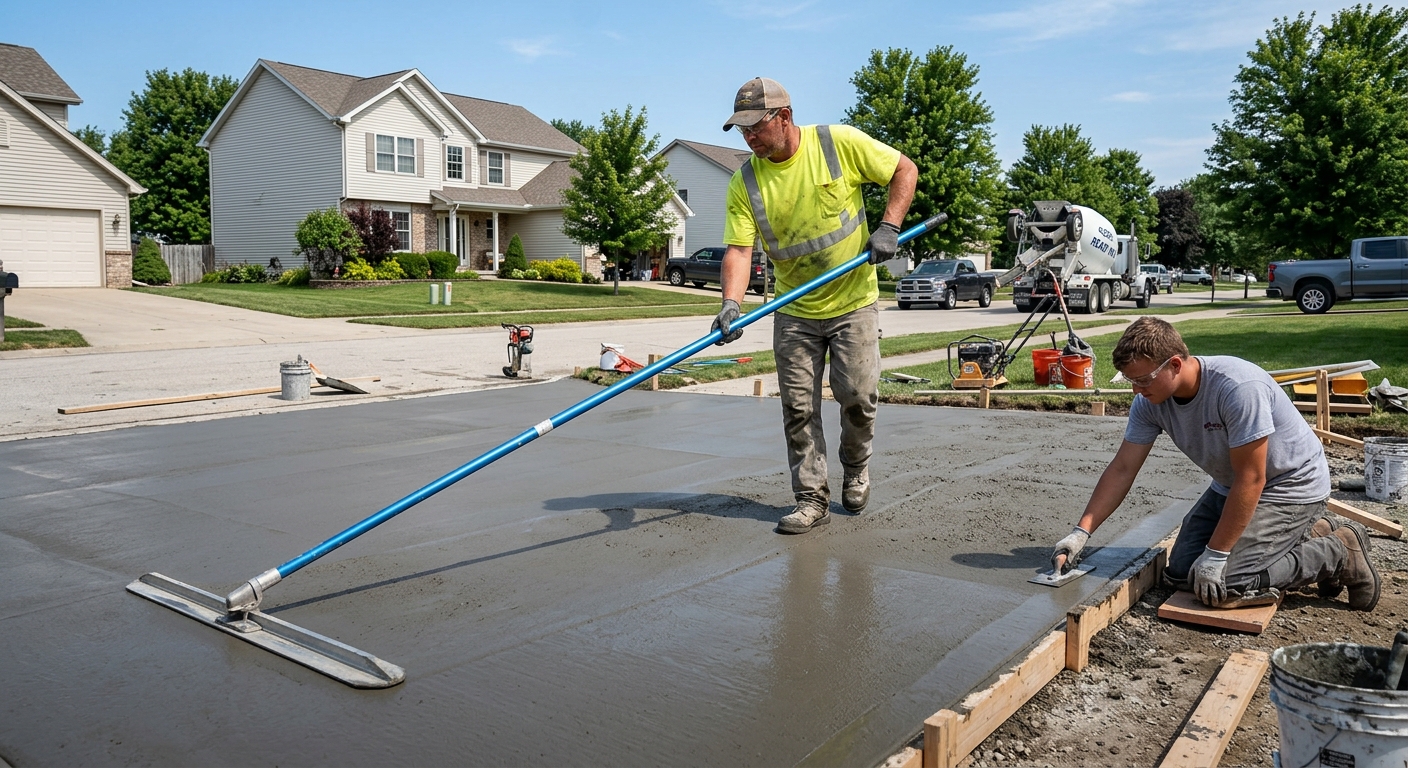
Concrete work options and costs in Dovercourt
In Dovercourt, Alberta, homeowners typically look at three concrete categories first: driveways, patios/walkways, and foundation-related work. With a total population of 2,030 (Statistics Canada, 2021 Census), Dovercourt is small enough that contractor availability can swing with the Calgary-area construction cycle, especially during the exterior pour season. That matters because flatwork and many site sub-trades depend on tight scheduling around cold nights and freeze–thaw swings. For many households in this part of the Calgary region, existing driveways and walkways need replacement or major repairs, while new builds and additions create a steady demand for footings and slabs. Concrete flatwork is also a key upgrade for older housing stock—giving you a faster, more durable surface than gravel, and a cleaner look for street appeal—particularly in neighbourhoods around the Dovercourt core where lots tend to be actively improved.
Calgary’s cold continental climate is the reason pricing here isn’t “one size fits all.” Frost depth drives excavation and footing volume, while frequent freeze–thaw cycles require air-entrained concrete, proper granular base prep, and well-spaced control joints. In late fall or early spring, cold-weather curing precautions (insulated blankets, sometimes temporary heat) can add cost, but they protect the finish from scaling and long-term deterioration. As a result, your final price often tracks both engineering requirements and how quickly the crew can safely place and cure the concrete in current conditions. Below is a practical cost comparison to help you line up apples-to-apples items before you request quotes.
| Application |
Typical Size |
Key Spec |
Finish Option |
Price Range |
| Concrete driveway (standard broom finish) |
24 ft x 10 ft (240 sq. ft.) |
Air-entrained mix, control joints, compacted granular base |
Broom finish |
$12,000–$18,000 |
| Exposed aggregate driveway |
24 ft x 10 ft (240 sq. ft.) |
Air-entrained mix, shaker/delayed wash, jointing plan |
Exposed aggregate (light wash or uniform reveal) |
$15,500–$22,500 |
| Stamped concrete driveway or patio |
20 ft x 12 ft (240 sq. ft.) |
Air-entrained mix, proper release agents, curing protection |
Stamped (patterned colour options) |
$15,000–$26,000 |
| Plain concrete patio or walkway |
12 ft x 10 ft (120 sq. ft.) |
Air-entrained mix, slope to drain, control joints |
Plain (broom or smooth-trowel edge) |
$5,000–$9,000 |
| Garage floor (interior slab) |
22 ft x 20 ft (440 sq. ft.) |
Vapour barrier, compacted base, joints/flatness |
Plain (steel trowel surface) |
$9,500–$16,000 |
| Foundation footings (structural, below frost) |
Per engineered foundation plan (typ. 400–700 sq. ft. of perimeter/isolated pads) |
Below design frost depth, reinforcement per engineering |
Structural concrete only (engineered finish) |
$28,000–$45,000 |
Prices are estimates only and vary by project scope, site access and material selection.
What affects the price of concrete work in Dovercourt
In Dovercourt and across the Calgary region, you can see 30–50% swings for what looks like the “same” concrete job. The difference usually isn’t the slab surface—it’s the hidden variables: how deep you must excavate for frost protection, how much granular base is needed for proper compaction, what reinforcement the engineer requires, and how careful the crew is with finishing and curing under cold conditions. In Alberta, design frost depth is a major driver, and exterior footings must bear on undisturbed soil below the design frost depth (often up to around 2.4 m in Alberta). When that depth increases, excavation time and footing volume rise quickly, which is why foundation work can sit closer to the higher end of the foundation/footings band ($28,000–$45,000) rather than the low end.
Freeze–thaw cycles also force specific specifications for durability. For driveways, patios, and walkways, contractors typically use air-entrained concrete to survive repeated wetting and freezing, plus a joint and sealing plan to control cracking and spalling. Calgary’s shorter exterior pour window means cold-weather curing precautions—insulated blankets, heating where feasible, and stricter cure protection—can add labour and equipment costs if a pour starts near the shoulder seasons. And because de-icing salts are common in winter, sealing isn’t a “nice-to-have” if you want the surface to hold up.
Two local examples: (1) a broom-finished driveway might come in near the lower end of the $12,000–$18,000 range when excavation is straightforward and the crew can place and cure in stable temperatures; (2) switching to stamped or exposed options can add material and labour, pushing the project toward the $15,000–$26,000 band when patterns, releases, and extended finishing time are included. Site conditions—like soil type and how accessible the formwork area is—can push either direction. Even an older lot with more seasonal moisture can require extra base stabilization, which shows up as higher line-item scope rather than “mystery” markups.
| Price Factor |
Why It Matters |
Cost Impact |
| Frost line depth |
Determines footing depth and form height; must extend below design frost to reduce heave risk |
Higher excavation and concrete volume; can significantly increase foundation totals |
| Site preparation |
Excavation, grading and compacted granular base determine settlement control |
More truck loads and labour if soil removal is deeper or base is thicker |
| Reinforcement |
Rebar or wire mesh controls cracking and supports engineered loading |
Material and labour costs rise with heavier reinforcement or tighter placement |
| Mix design |
Air-entrainment and compressive strength spec improve freeze–thaw durability and strength gain |
Winter-grade materials and stricter testing can raise per-cubic-yard costs |
| Finish type |
Broom vs. stamped vs. exposed aggregate changes labour time and tooling complexity |
Stamped/exposed typically costs more due to extra steps and careful cure protection |
| Pour size and concrete truck access to site |
Short access can mean longer carries, smaller placements, or additional pumps |
Delays and equipment (or pumps) increase labour and scheduling costs |
| Cold-weather curing precautions |
Heating and insulated blankets help meet cure requirements in freezing conditions |
Added equipment, labour monitoring, and material for protection |
| Control joint pattern and sealing cost |
Correct joint spacing reduces random cracking; sealing helps protect against salt scaling |
More saw-cuts and sealing material/time if included properly |
Permits & regulations in Alberta
In Alberta, structural concrete work generally needs oversight before you start. Footings, foundation walls and grade beams are typically part of the structural system, so they usually require a building permit and often engineered drawings that are reviewed through the municipal process. For concrete flatwork—driveways, patios and walkways—permits are typically not required unless the work affects lot grading, drainage, impervious surface coverage limits, or municipal right-of-way requirements. Even when a permit isn’t expected, you should still confirm with the local authority before breaking ground because conditions and drainage details can trigger requirements.
For Dovercourt homeowners, verify the contractor properly in three practical steps. First, ask for their liability insurance and request a current certificate of insurance showing appropriate coverage for the project scope. Second, confirm worker coverage by asking for proof of WSIB/WCB coverage (as applicable). Third, verify licensing/registration where required for your project type; a reputable contractor will provide clear documentation without pressure. Also ask for references on similar-scale Alberta projects—especially exterior flatwork where air-entrainment and winter curing were handled correctly.
Action checklist: (1) request the project permit/engineering details they will rely on (for foundations), (2) obtain certificate of insurance directly from their policy provider if possible, (3) request WSIB/WCB clearance proof, (4) confirm they will manage disposal and any required barricading/safety plan, and (5) get everything in writing before the first excavation day.
Getting concrete right in Dovercourt's freeze-thaw climate
Concrete failures in Dovercourt are usually climate-driven: water enters through small cracks or weak surfaces, freezes, expands, and then chips away the top layer (spalling) and scales the surface. In a cold continental climate like Calgary’s, the cure and durability specs matter as much as the finish. To spec the job correctly, start with base preparation: compacted granular sub-base to the right depth for local soils and frost considerations so the slab doesn’t settle or heave. Next is mix design: exterior flatwork should use air-entrained concrete (commonly target 5–7% air content) and a minimum compressive strength of 32 MPa so strength gain and freeze–thaw resistance meet expectations.
Control joints are another big item. If joints are too wide or too far apart, the slab cracks randomly—often where water can collect and accelerate freeze–thaw damage. Plan joint spacing early and coordinate it with the finish and saw-cut timing. Then protect curing: aim for a minimum 7-day cure under suitable conditions. When cold weather hits, crews need curing precautions like insulated blankets and/or temporary heat to prevent early freezing at the surface.
Finally, sealing: apply a penetrating sealer after the slab has cured—commonly around 28 days post-pour—to help repel de-icing salt intrusion. This is where you can prevent “premium-looking” work from deteriorating early.
Ask the right technical questions. If a contractor can’t clearly explain air-entrainment and curing protection, that’s a warning sign. For cost context, the jump from plain patio/walkway ($5,000–$9,000) to stamped options ($15,000–$26,000) is justified when it includes proper engineering of the sub-base, correct air-entrainment, and careful curing protection—because the extra finishing effort only lasts if the concrete is protected from freeze–thaw.
| Spec |
Why It Matters in Dovercourt |
What to Ask For |
Impact if Skipped |
| Compacted granular base (depth?) |
Reduces settlement and supports the slab through seasonal moisture and freeze–thaw |
Base depth and compaction testing method (e.g., lift thickness and compacted to specified density) |
Cracking, uneven slabs, and accelerated deterioration |
| Air-entrained concrete mix (target air %?) |
Helps concrete resist freezing and thawing cycles without spalling |
Target air content (commonly 5–7% for exterior flatwork) and supplier documentation |
Surface scaling and early freeze–thaw damage |
| Compressive strength (MPa rating) |
Strength gain supports durability and loading |
Minimum 32 MPa compressive strength (or higher if engineered) |
Weakened surface, higher risk of damage under traffic and salt exposure |
| Control joints (spacing per ACI guidelines) |
Controls where cracking happens and limits water pathways |
Joint layout plan and planned saw-cut timing |
Random cracking and increased water infiltration |
| Minimum 7-day curing period |
Proper cure helps achieve strength and reduces surface defects |
Minimum cure duration and weather-protection plan if temperatures drop |
Scaling, surface weakness, and long-term performance loss |
| Penetrating sealer (when applied after cure) |
Repels de-icing salts and slows down chloride-related deterioration |
Sealer type and application timing (commonly around 28 days post-pour) |
Faster salt scaling and shorter service life for exterior surfaces |
How to choose a concrete work contractor in Dovercourt
Choosing the right contractor in Dovercourt is about proof, not promises—especially in Alberta’s freeze–thaw climate where details like air-entrainment and cure protection separate good concrete from “looks fine today” concrete. Start by verifying Alberta coverage. Request a certificate of liability insurance (current dates and project coverage) and confirm WSIB/WCB clearance proof for workers. If the contractor won’t provide documents promptly, that’s a red flag. For licensing/registration, ask what applies to your scope (structural foundation work versus flatwork) and verify through the appropriate online registry if available for that trade category.
Next, get 2–3 itemised written quotes—not just lump sums. You want a breakdown that shows labour and materials and clearly lists inclusions like excavation, granular base depth, reinforcement type, concrete mix type/spec, finishing method, jointing, sealing (if included), disposal, and any traffic protection. Carefully review the scope for what’s excluded: Is permit pulling included for foundation work? Is removal of old concrete included? Is compacted base included to a specified depth, or just “allowance”? Is cold-weather curing included if the forecast turns?
For warranty, ask for both workmanship warranty length and any manufacturer warranty tied to materials. Confirm whether warranty terms are transferable if you sell your home. For payment, never agree to pay more than about 10–15% upfront; hold back a portion until the final surface, joints, and cleanup are complete.
Finally, demand a timeline in writing: a start date target, curing/weather contingencies, and completion estimate. In Calgary-area schedules, weather can shift start times—good contractors build that into the plan.
- Ask for concrete mix details: air-entrainment target and 32 MPa minimum (or higher if engineered).
- Confirm base scope: excavation depth, granular type, and compaction process.
- Require a joint layout plan (pattern and spacing) for driveways and patios.
- Check whether cold-weather curing is included (blankets/heating plan if needed).
- Get a written finish spec: broom, stamped pattern, or exposed aggregate process.
- Ensure sealing is included if it’s an exterior slab (especially for driveways/walkways).
- Ask who manages disposal and whether permits/barricades are included if required.
- Verify liability insurance and WSIB/WCB coverage documents before scheduling.
- Request references on similar Dovercourt/Calgary projects (not just any past job).
- Review warranty details in writing, including transferability if you sell.
- Use an itemised quote with line items for materials, labour, and equipment.
- Agree on a payment schedule with a holdback until complete cleanup and final inspection.
Red flags I see too often in Dovercourt: crews skipping or “estimating” base depth; vague talk about mix (“standard concrete” without air-entrainment); no plan for winter curing protection; quotes that don’t mention joint spacing or sealing on exterior slabs; and contractors demanding most payment upfront before any excavation or steel/rebar is inspected.
Frequently asked questions — concrete work in Dovercourt
How long does a concrete driveway last?
In Dovercourt (Calgary region), a well-built concrete driveway often lasts 20–30 years, and longer when the contractor specifies air-entrainment, proper base compaction, correct joint spacing, and appropriate curing. The biggest longevity factors in our freeze–thaw climate are whether the concrete resists spalling (air-entrainment and mix spec) and whether water gets controlled at cracks (control joints) and blocked at the surface (sealer and good drainage). If your driveway is near the low end of the price band (for example, a broom-finished driveway often starts around $12,000–$18,000 depending on size and prep), you still want those durability elements included—otherwise “cheap” can become early scaling. Salt use matters too: don’t skip a penetrating sealer if it’s an exterior driveway.
What is air-entrained concrete and why does it matter here?
Air-entrained concrete is made with tiny, evenly distributed air bubbles that give freezing water a place to expand without breaking the cement paste. In the Dovercourt/Calgary area, freeze–thaw cycles are frequent, and de-icing salts can intensify surface wear. That’s why exterior flatwork should target air content commonly in the 5–7% range and include the right mix design for durability. If a contractor uses non-air-entrained mix (or can’t provide the spec), you’ll often see surface scaling, flaking, and early spalling—even if the slab looks fine initially. For homeowners comparing quotes, ask directly what air content is targeted and whether the mix is designed for exterior exposure in Alberta winter conditions.
How do I prepare the base for a concrete slab?
Base prep is where concrete performance is won or lost in Dovercourt. A proper base includes excavation to the engineered depth, removal of unsuitable soil, placement of compacted granular base in lifts, and grading for correct drainage away from the house. The goal is to keep the slab stable through seasonal moisture and frost action—especially because the design frost depth in Alberta is deeper than in milder provinces, meaning excavation and base support must be deliberate. For driveways and patios, insist on a specified granular base depth and a compaction method rather than vague language like “we’ll grade it and pack it.” If cold weather is approaching, ask how they’ll protect the sub-base and maintain proper conditions during placement and curing. A good base is part of why exterior slabs in this market can sit inside the typical bands (like driveways around $12,000–$18,000).
How do I compare concrete quotes?
Comparing concrete quotes in Dovercourt means looking past the total and matching the scope line by line. Get itemised quotes with the same assumptions: excavation scope, granular base type and depth, reinforcement (mesh vs. rebar, as required), concrete mix spec (including air-entrainment for exterior), finishing method (broom vs. stamped/exposed), joint layout, disposal, and sealing (if included). Also compare what’s included for timing and weather—especially winter-grade curing precautions. If one quote includes a penetrating sealer and another doesn’t, the difference can be real even if the concrete price per cubic yard seems similar. For example, you might see a stamped driveway move toward $15,000–$26,000 because of extra finishing steps, while a standard broom driveway typically lands closer to $12,000–$18,000 when base prep and durability specs are consistent. Always ask for clarification on exclusions and any allowances.
Can concrete be poured in cold weather in Dovercourt?
Yes, concrete can be poured in cold weather in Dovercourt, but it must be engineered for the conditions. Cold snap pouring without proper protection can lead to surface scaling and poor strength development because the concrete freezes before it gains enough strength. Contractors should plan for curing protection such as insulating blankets, wind protection, and sometimes temporary heat so the slab reaches the needed curing conditions. In our Calgary-region freeze–thaw climate, rushing curing in late fall or early spring increases risk, so ask the contractor what the weather plan is if temperatures drop below safe placement/curing ranges. A solid contractor will factor this into the schedule and quote rather than treating it as optional. If you’re comparing options, remember that cold-weather precautions are part of the durability value, not an upsell—especially for exterior work like patios, walkways, and driveways.
How do I maintain concrete in Dovercourt's freeze-thaw climate?
Maintenance in Dovercourt is mainly about protecting the surface from water and de-icing salt. Start with sealing: a penetrating sealer applied after proper cure (commonly around 28 days post-pour) helps reduce salt and moisture penetration and slows deterioration. Keep drainage clear—if water runs onto the slab and freezes repeatedly, that increases stress on joints and edges. Use de-icing practices carefully: avoid over-salting and consider low-corrosion products where possible. Inspect seasonally for early signs like flaking, pitting, or widening joints; addressing small repairs sooner is cheaper than replacing a whole section later. Also, don’t ignore joint function—if joints are sealed improperly or not maintained, water can migrate and freeze. If your driveway sits in the typical exterior range (for example, $12,000–$18,000), plan for preventative maintenance so you get the service life that air-entrainment and correct jointing are meant to provide.