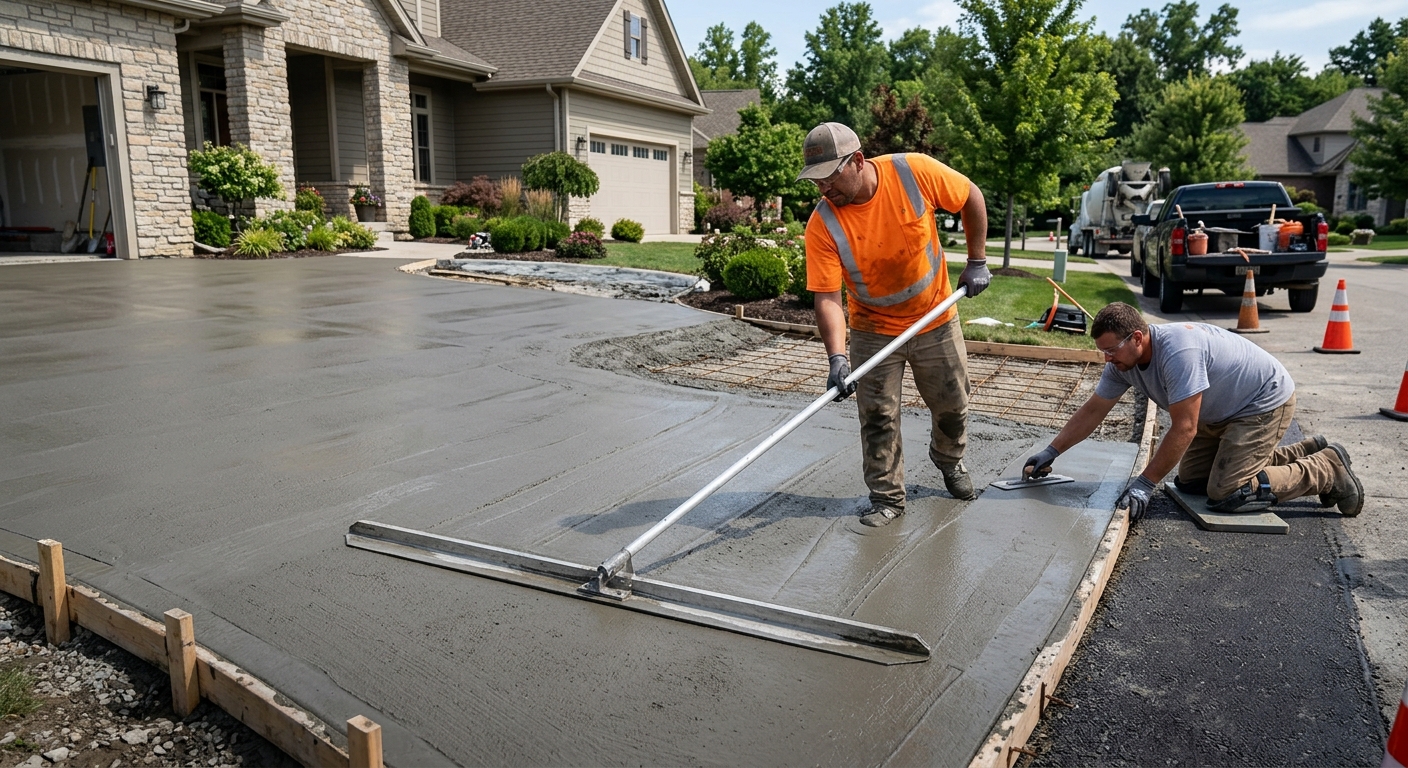
Concrete work options and costs in Lac La Biche
Lac La Biche is a small community where concrete flatwork is a practical upgrade for everything from driveways to walkways, and the demand is strong because residents maintain homes year-round. With a population of 2,314 (Statistics Canada, 2021 Census), the market is tight and contractor scheduling can matter as much as the price. Also, the housing base is dominated by single-detached neighbourhood patterns that typically include at least a driveway and a patio or entry pad—projects that are closely tied to how the local soils handle frost. Calgary’s broader market context influences Lac La Biche pricing because it shares the same cold-continental engineering expectations, labour pool, and material supply channels.
In this region, the design frost depth drives excavation volume and footing height. Exterior concrete also has to be detailed for repeated freeze–thaw cycles—using air-entrained mixes, proper granular base prep, and control joints to keep cracking from turning into moisture pathways. For driveways and patios, cold-weather placement adds cost through winter-grade curing practices (insulated blankets and, sometimes, temporary heat) to protect strength gain and prevent surface scaling. In areas like downtown Lac La Biche and the residential edges along Highway 55, concrete flatwork tends to be in higher demand because of ongoing home access improvements and frequent sidewalk/driveway rebuilds after seasonal heaving.
Below are typical cost bands for common concrete scopes, so you can compare quotes apples-to-apples before you choose a finish or timing.
| Application |
Typical Size |
Key Spec |
Finish Option |
Price Range |
| Concrete driveway (standard broom finish) |
400 sq. ft. |
Air-entrained exterior mix, compacted granular base, control joints |
Broomed surface |
$12,000–$18,000 |
| Exposed aggregate driveway |
400 sq. ft. |
Air-entrained exterior mix, base compaction, consistent wash timing |
Exposed aggregate |
$14,500–$21,500 |
| Stamped concrete driveway or patio |
300 sq. ft. |
Air-entrained mix, reinforced as required, release system and stamping plan |
Stamped pattern (weathering seal optional) |
$15,000–$26,000 |
| Plain concrete patio or walkway |
200 sq. ft. |
Air-entrained mix, compacted base, expansion/control joints |
Plain broom or light trowel finish |
$5,000–$9,000 |
| Garage floor (interior slab) |
500 sq. ft. |
Vapour barrier as needed, control joints, minimum slab thickness per design |
Float-and-trowel with light broom finish |
$9,500–$14,500 |
| Foundation footings (structural, below frost) |
Typical 1–2 storey house footprint |
Excavation to below design frost depth, reinforcement, engineered formwork |
Structural only (no decorative finish) |
$28,000–$45,000 |
Prices are estimates only and vary by project scope, site access and material selection.
What affects the price of concrete work in Lac La Biche
In Lac La Biche, it’s not unusual to see quotes for the “same” concrete idea swing by 30–50% once you compare how contractors handle frost depth, site prep, reinforcement, and curing. The differences aren’t just profit—here in Alberta (and across the Calgary economic region), concrete is engineered to resist frost heave and freeze–thaw damage, so labour time and material specs change the outcome.
First, footing and foundation work must account for design frost depth. In Alberta, you should expect engineered footings to extend to undisturbed soil below the design frost depth (often up to about 2.4 m in Alberta), which means deeper excavation and more concrete volume than in warmer provinces. Second, exterior slabs and flatwork need air-entrained concrete mixes to survive freeze–thaw cycling, and that mix design is a real cost driver. Third, cold-weather placement has a shorter practical pour season. When temperatures drop, contractors may need insulated blankets, winter-grade mixes, and sometimes temporary heat to maintain curing—miss those steps and you pay later with scaling or spalling.
De-icing salt is another local reality: it accelerates surface deterioration, so sealing becomes essential for driveways and patios. In Lac La Biche, I commonly see cost differences like this: a driveway over poorly compacted clay base can require deeper granular replacement, while a site with good access for concrete trucks can avoid extra pumping and labour. For homeowners, it often helps to align expectations with the market bands—standard broom driveways typically sit near $12,000–$18,000, while decorative options like stamped concrete commonly land in the $15,000–$26,000 band when reinforcement, finishing time, and sealing are included.
| Price Factor |
Why It Matters |
Cost Impact |
| Frost line depth |
Determines footing depth and form height |
Higher excavation and concrete volume; can move foundation pricing by tens of thousands |
| Site preparation |
Excavation, grading, compacted granular base |
Poor soil or limited access increases granular hauling and labour hours |
| Reinforcement |
Rebar or wire mesh requirement |
Steel and labour for placement/tie-in; often required in drives/garage slabs and for structural footings |
| Mix design |
Air-entrainment and compressive strength spec |
Air-entrained exterior mixes and engineered strengths cost more, but they reduce spalling risk |
| Finish type |
Broom vs. stamped vs. exposed aggregate |
Decorative finishing adds skilled labour time and material allowances |
| Pour size and concrete truck access to site |
Determines equipment needs and pour method |
Long carries/pumping or multiple loads increase overall labour and coordination |
| Cold-weather curing precautions |
Heating and blankets |
Winter-grade curing can add significant day rates and materials in shoulder seasons |
| Control joint pattern and sealing cost |
Controls cracking; sealing protects from salt and moisture |
Better joint planning reduces random cracks; sealing adds a separate line item |
Permits & regulations in Alberta
In Alberta, the permitting approach depends on what you’re building. Structural concrete work—such as footings, foundation walls, and grade beams—typically requires a building permit, and engineered drawings are commonly reviewed as part of the approval process. Concrete flatwork like driveways, patios, and walkways usually does not require a permit by itself unless it changes lot grading, touches stormwater/servicing considerations, or affects impervious surface/coverage rules and municipal right-of-way limits. Because each site can be unique, confirm requirements with the local authority before you break ground.
For contractor compliance in Lac La Biche, don’t rely on verbal assurances. Here’s how a homeowner should verify a contractor step-by-step:
- Ask for the contractor’s liability insurance certificate and verify the coverage limits match the scale of the job.
- Request proof of WSIB/WCB coverage (or confirm the appropriate coverage status based on their business type).
- Check they have the relevant Alberta business licensing/registration where applicable and any concrete-related registrations the municipality expects.
- Request a clearance letter if their coverage provider issues one for active accounts.
- Look for references on similar scopes (for example, cold-weather flatwork or foundation work), and ask for photos from the same season the job was performed.
When in doubt, require proof before signing, especially for structural scopes where the permit and inspection trail matters.
Getting concrete right in Lac La Biche's freeze-thaw climate
Concrete fails in Lac La Biche when the job is detailed for “good days” instead of repeated freeze–thaw cycles. The main issues I see are inadequate base preparation, weak/incorrect mix design, poor control joint planning, and rushing the curing window in cold weather. In this Calgary-influenced region, the design frost depth is deep enough that footings and any frost-sensitive transitions must bear on undisturbed soil below the engineered depth. For exterior slabs—driveways, patios, and walkways—specifying air-entrained concrete is non-negotiable because it gives the slab room to expand during freeze–thaw, reducing spalling.
To spec the job correctly, focus on five things. (1) Base prep: compacted granular sub-base to the right depth and profile for the local soil; this is where many “cheap” bids quietly cut corners. (2) Mix design: air-entrainment typically targets 5–7% air for exterior flatwork, with a minimum 32 MPa compressive strength for many residential applications. (3) Control joints: place them at a spacing that limits random cracking—especially on driveways that see thermal movement. (4) Curing: plan for at least 7 days of proper curing conditions; cold weather may require insulating blankets or temperature management. (5) Sealing: apply a penetrating sealer after cure (often around 28 days) so de-icing salt and moisture don’t feed surface deterioration.
Here’s a practical cost example: if a homeowner chooses a standard broom finish, they might target the $12,000–$18,000 driveway band. Paying a bit more for proper air-entrainment and a sealed finish can be worth it—an unsealed broom driveway in salt season can start looking rough much sooner, which means future patching and resurfacing costs that often exceed the difference between a basic and a well-managed build.
| Spec |
Why It Matters in Lac La Biche |
What to Ask For |
Impact if Skipped |
| Compacted granular base (depth?) |
Supports the slab and helps manage frost-related movement |
“What is the granular sub-base depth and compaction method?” |
Settlement, edge failure, and premature cracking |
| Air-entrained concrete mix (target air %?) |
Reduces freeze–thaw spalling and surface scaling |
“Confirm exterior mix air content (typically 5–7% for flatwork).” |
Spalling and rapid surface deterioration after winters |
| Compressive strength (MPa rating) |
Ensures strength gain for load and durability |
“What minimum MPa design strength are we using (e.g., 32 MPa)?” |
Weak slab that chips/cracks under normal use |
| Control joints (spacing per ACI guidelines) |
Controls where cracks will occur |
“Show the joint layout and spacing plan.” |
Random cracking and moisture intrusion |
| Minimum 7-day curing period |
Critical for proper strength development in cold weather |
“How will you protect curing temperatures during the first 7 days?” |
Surface scaling, low strength, and long-term performance issues |
| Penetrating sealer (when applied after cure) |
Helps repel salt and moisture through winter cycles |
“Confirm sealer type and application timing after cure (around 28 days).” |
Faster staining, surface breakdown, and increased patchwork |
How to choose a concrete work contractor in Lac La Biche
Choosing the right concrete contractor in Lac La Biche is mostly about verification and details. Start with compliance: ask for the contractor’s proof of liability insurance and their WSIB/WCB coverage. For Alberta jobs, you should also ensure they’re in good standing with their business registration and can provide documentation on request. Then check how they quote—solid bids separate labour and materials rather than using a vague “lump sum” number that hides the assumptions.
Next, get 2–3 itemised written quotes. I recommend you ask for a breakdown that lists excavation/grading, granular base, reinforcement (if applicable), concrete supply, finishing, saw cutting/control joints, disposal, and any sealing or curing blankets. Make sure the scope includes what’s usually forgotten: disposal of excess soil, whether permit pulls are included when required, and whether truck access/pumping is accounted for.
Warranty is another differentiator. Ask for the workmanship warranty length, whether product/manufacturer warranties apply to admixtures/sealer, and whether anything is transferable to future homeowners. For payment scheduling, protect yourself: never pay more than 10–15% upfront; hold back until the job is fully complete and any punch-list items are addressed. Finally, insist on a written timeline with a start date and completion estimate, especially because shoulder-season pours can require extra curing steps.
- Confirm liability insurance certificate (and ask for the coverage limits).
- Verify WSIB/WCB status with documentation before scheduling.
- Request 2–3 recent photos of similar-size jobs in cold-weather conditions.
- Get itemised quotes: labour, materials, reinforcement, concrete supply.
- Ask what’s included for excavation depth and granular base compaction.
- Confirm air-entrained mix and minimum strength in the spec.
- Review reinforcement plans (mesh/rebar) for the slab thickness and use case.
- Ask for the control joint layout and saw-cut timing.
- Ensure cold-weather curing method is described (blankets/heating if needed).
- Clarify disposal: topsoil/soil hauling included or extra?
- Confirm sealing plan and application timing after cure if you want longevity.
- Use a payment schedule with a holdback until the final walkthrough.
Red flags in Lac La Biche include contractors who won’t show proof of insurance/coverage, vague scopes that don’t mention air-entrainment or curing protection, bids that ignore frost-depth excavation realities, “too-good-to-be-true” decorative pricing without reinforcement and joint plans, and crews that pressure you to pay most of the invoice before forms are stripped and curing steps are done.
Frequently asked questions — concrete work in Lac La Biche
What is rebar and when is it required in Alberta?
Rebar is steel reinforcement bars embedded in concrete to help control cracking and carry tensile stresses—especially in slabs that see movement, heavy loads, or higher risk of shrinkage cracks. In Alberta, rebar requirements aren’t decided by frost depth alone; they come from the engineered design for the specific application. For example, structural scopes like footings and foundation elements are usually engineered and include reinforcement requirements. For exterior flatwork (driveways, patios), many residential designs use wire mesh or rebar tied to support bars depending on thickness, soil conditions, and expected loads. Because Lac La Biche experiences freeze–thaw cycles that stress slabs, reinforcement is often paired with proper base prep and air-entrained mixes. A reliable contractor will describe the reinforcement plan in your proposal and match it to the slab thickness and use.
How long does a concrete project take in Lac La Biche?
Typical timelines in Lac La Biche depend on weather, excavation depth, and how much curing protection is needed. For many residential flatwork jobs (driveways, patios, walkway pads), the placement day is usually just hours, but the total schedule includes demo/excavation, forms, base compaction, concrete delivery, finishing, saw cutting, and curing time. Practically, you should plan for at least a few days of active site work and more time for the slab to reach strength. Cold weather can extend the schedule significantly because contractors may need insulating blankets and temperature management to maintain curing conditions. For foundation work, excavations and inspections can add time, especially when engineered drawings are involved. If you’re comparing options, decorative finishes might add a finishing day or two. For planning, ask your contractor for a written start date and the “first cure” plan—especially if you’re pouring outside the warmer season.
What is a concrete overlay and is it suited to Lac La Biche?
A concrete overlay is a new layer placed over an existing slab to improve appearance and extend service life, but it only works well when the original concrete is still structurally sound. In Lac La Biche’s freeze–thaw climate, overlays can fail if the existing slab has active spalling, lifting, or major settlement—new concrete can’t “fix” movement created by frost or poor base support. A proper overlay usually requires detailed surface preparation: cleaning, profiling, patching, crack assessment, and sometimes bonding additives or mechanical roughening. If your existing driveway or walkway has minor cosmetic wear, small cracks that aren’t heaving, and good drainage, an overlay may be cost-effective. If there’s frost-related movement, you’ll often get better long-term value by removing and rebuilding with proper air-entrained mix and base depth planning. Since pricing varies widely, use a quote that specifies prep scope and overlay thickness—don’t assume it replaces the need for engineered base work.
How do I seal concrete to protect it in Lac La Biche?
Sealing helps protect concrete from moisture and de-icing salt exposure, which matters in Alberta winters. The key is timing: sealing should be applied after the concrete has properly cured—often around 28 days—so you don’t trap moisture in the slab. In Lac La Biche, we typically use a penetrating sealer designed to repel water rather than simply film over the surface. Before sealing, the surface should be clean, free of curing compounds (if any were used), and dry. If the slab is already spalled or heavily stained, sealing won’t fully reverse damage; you may need patching first. In your contract, ask for the sealer type and the application plan. Also confirm whether your quote includes sealing as an add-on, since it can impact total price depending on driveway size and the number of coats.
What is the difference between concrete and cement?
Concrete and cement are related, but they’re not the same thing. Cement is one ingredient—typically Portland cement—that acts as the binder. Concrete is the finished building material made by combining cement, water, sand, gravel (or crushed stone), and sometimes admixtures like air-entraining agents to improve freeze–thaw performance. In Alberta’s cold climate, contractors focus on the concrete mix design because that blend determines durability—especially for exterior work exposed to repeated freeze–thaw cycles and de-icing salts. For example, exterior slabs typically require air-entrained concrete to help prevent spalling, and many residential builds use a minimum strength spec such as 32 MPa (depending on design). When you ask for a quote in Lac La Biche, ensure the proposal references mix specifications, not just “concrete” in general. That’s where true performance decisions live.
How much does concrete work cost in Lac La Biche?
Costs in Lac La Biche follow the same cold-climate realities as the Calgary region: deeper excavation for frost considerations, air-entrained mixes, and careful curing can push budgets higher than in milder parts of Canada. For a reality check, driveway and flatwork prices typically land within established local bands. A standard broom-finished driveway is often around $12,000–$18,000 depending on size, base preparation, and access. A stamped driveway or patio commonly falls in the $15,000–$26,000 range because of extra finishing time and material handling. For foundation footings (structural and below frost), budgeting generally sits around $28,000–$45,000 for typical residential scopes, because excavation and engineering-driven specs drive volume and labour. Always ask for an itemised quote so you can see what’s included—especially reinforcement, disposal, and curing precautions—since omissions can make a low number look attractive but lead to higher repair costs later.