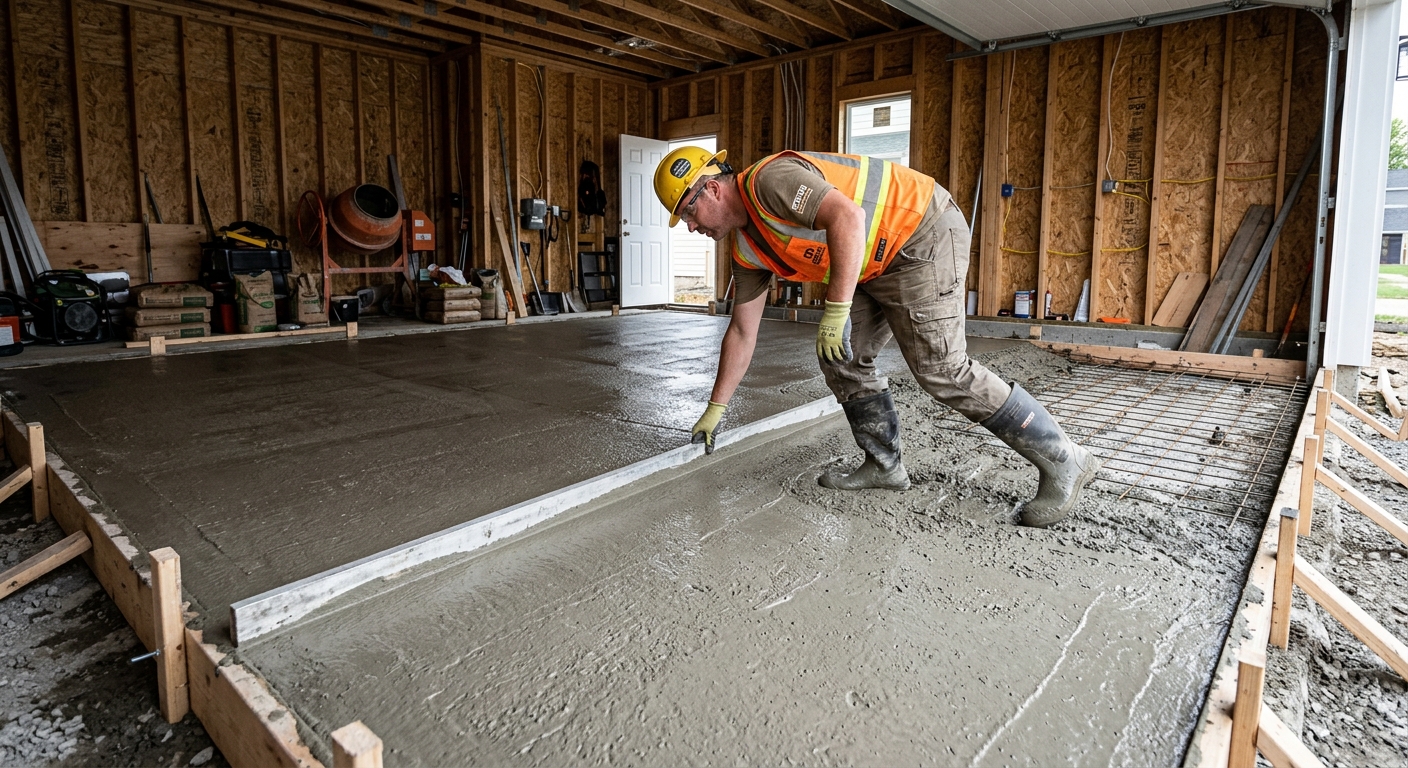
Concrete work options and costs in Bowden
In Bowden, Alberta, concrete work is largely driven by the reality of prairie freeze-thaw cycles and a construction season that’s shorter than in southern Ontario. With many households housed in single-detached homes (62.1% of dwellings) and a strong owner-occupant base (75.0% of households own), homeowners typically invest in driveways, patios, walkways, and foundations rather than small “cosmetic” upgrades. That matters because durable concrete flatwork isn’t just poured—it’s detailed with the right base prep, air-entrained mix, consolidation, control joints, and curing protection.
In the Red Deer economic region, pricing tends to be higher than milder areas because footings and foundations must be installed below local frost depth, and crews often need more excavation, re-handling of materials, and weather protection for cold pours. Freeze-thaw exposure also makes air-entrained concrete and proper consolidation non-negotiable, especially for exterior slabs that see ploughing, tire wear, and de-icing salt. On top of that, schedule pressure can add mobilization cost when multiple bids compete for the same weeks of suitable weather.
If you’re in a neighbourhood with lots of replacement work—like the West End of Bowden—driveway and walkway repairs tend to be especially in demand as older homes reach the point where surface scaling and minor settlement become visible. From there, the best way to compare options is to look at how finish level and structural requirements change your budget, as shown in the table below.
| Application |
Typical Size |
Key Spec |
Finish Option |
Price Range |
| Concrete driveway (standard broom finish) |
480 sq. ft. (24' x 20') |
Air-entrained exterior mix, compacted granular base |
Broom finish, common control joints |
$7,200–$10,000 |
| Exposed aggregate driveway |
480 sq. ft. (24' x 20') |
Air-entrained mix, proper surface retarder + wash timing |
Exposed aggregate texture, sealed after cure |
$9,600–$13,800 |
| Stamped concrete driveway or patio |
360 sq. ft. (18' x 20') |
Air-entrained exterior mix, reinforcement as required |
Stamped pattern + integral or color hardener |
$8,300–$14,000 |
| Plain concrete patio or walkway |
240 sq. ft. (12' x 20') |
Air-entrained mix, compacted base, proper edge forms |
Float/trowel then light broom or smooth finish |
$2,000–$3,900 |
| Garage floor (interior slab) |
400 sq. ft. (20' x 20') |
Minimum strength spec, vapor considerations if required |
Steel-trowel or broom finish, perimeter control joints |
$6,000–$9,200 |
| Foundation footings (structural, below frost) |
~400 sq. ft. footprint perimeter |
Engineered rebar schedule, excavate below frost, drainage |
Structural concrete to spec (no decorative finish) |
$14,000–$26,000 |
Prices are estimates only and vary by project scope, site access and material selection.
What affects the price of concrete work in Bowden
It’s common to see quotes for the “same” concrete job swing by 30–50% across the Red Deer region and Alberta. The difference usually isn’t the concrete itself—it’s excavation difficulty, base preparation quality, reinforcement choices, how much finishing and detailing you want, and what weather protection the contractor must plan for. For exterior slabs, the freeze-thaw reality drives spec changes that directly affect material handling, crew time, and curing method.
Start with frost depth and freeze-thaw cycles: exterior footings must extend below the design frost depth to help prevent frost heave, and in Alberta that often means deeper excavation and higher formwork/material costs than milder provinces. Next, every exterior slab should use air-entrained concrete mixes so the concrete can tolerate repeated freezing and thawing without rapid scaling. Cold conditions also shorten the window for finishing, sometimes requiring insulating blankets and/or temporary heat to protect early strength gain—an expense that’s real when you pour outside the warm-season stretch.
In Bowden, older housing stock (57.8% built before 1981) can also mean more underground obstacles during demo or base prep—old service trenches, uneven subgrades, and unknown fill—each of which can push costs up. By contrast, if you’re replacing a straight, accessible driveway with minimal grade change, your spend can stay closer to the typical concrete driveway band (often referenced around $10,000–$18,000 per typical project size). If you upgrade to stamped & decorative concrete, the labour and material/time for formwork and colouring commonly moves you toward the stamped band (around $16,000–$28,000 depending on size and detailing).
| Price Factor |
Why It Matters |
Cost Impact |
| Frost line depth |
Determines footing depth and form height |
More excavation and concrete volume; can add several thousand dollars on structural work |
| Site preparation |
Excavation, grading, compacted granular base |
Uneven soils or limited access increase labour and granular disposal/bring-in |
| Reinforcement |
Rebar or wire mesh requirement |
Material + time; needed more often for garage slabs, thick driveways, and structural footings |
| Mix design |
Air-entrainment and compressive strength spec |
Exterior air-entrainment and strength requirements are non-negotiable in freeze-thaw climates |
| Finish type |
Broom vs. stamped vs. exposed aggregate |
Higher for decorative finishes due to colour systems, timing, and extra labour |
| Pour size and concrete truck access to site |
Long carry distances slow crews and increase labour |
Hard-to-access lots or multiple small pours can raise mobilization and handling cost |
| Cold-weather curing precautions |
Heating and blankets |
Protecting early strength can add costs when temperatures drop quickly at night |
| Control joint pattern and sealing cost |
Controls cracking and protects the surface from salt exposure |
Often a small line item compared to repairs later; skipping it can trigger earlier spalling |
Permits & regulations in Alberta
In Alberta, structural concrete work typically requires a building permit and—often—engineered drawings that are reviewed through the municipal process. This includes foundation walls, grade beams, and footings when they’re part of a foundation system for a house or addition. Concrete flatwork (driveways, patios, and walkways) usually does not require a permit by itself, unless it affects lot grading, impervious surface coverage limits, or the municipal right-of-way/sidewalk considerations. Even when a permit isn’t normally required, it’s still smart to confirm with the local authority before breaking ground, particularly if you’re changing drainage paths or raising finished elevations.
Before you sign in Bowden, verify the contractor can legally and safely perform the work. Step one: ask for proof of liability insurance (a Certificate of Insurance showing the contractor’s coverage and your name as additional insured if offered). Step two: confirm WSIB/WCB coverage in writing—coverage status should be clear on their documentation. Step three: check Alberta credentials through the appropriate provincial registry/record search available online for contractors (and ask your contractor for their current business info exactly as shown in their registration). If they can’t provide insurance or coverage documents promptly, treat it as a red flag.
Finally, request references on similar-scale projects—driveways and slabs completed in similar winter exposure conditions—so you can judge finish quality and durability, not just speed.
Getting concrete right in Bowden's freeze-thaw climate
Concrete failures in Bowden usually show up as surface scaling, cracking, or spalling within the first few winters—especially where de-icing salt, tire spray, and freeze-thaw cycling hit the same spots repeatedly. The biggest driver is inadequate freeze protection in the spec: thin or poorly prepped bases, non-air-entrained mixes, missed consolidation, or control joints placed without a plan. For the Red Deer market, that means you should treat exterior flatwork like a system—sub-base, drainage, mix, finishing, joints, curing, and sealing all have to work together.
Here’s how to spec correctly. First, base prep: install a compacted granular sub-base to the required depth for local soils and frost considerations, with proper grading so water doesn’t pond. Second, mix design: exterior concrete should typically target 5–7% air content and a minimum 32 MPa compressive strength, so it can handle repeated freezing and thawing. Third, control joints: plan spacing so shrinkage cracking happens at the joint line, not randomly. Fourth, curing: plan for at least 7 days of proper curing conditions; in cold weather, that often means insulating blankets or other protection to prevent early freezing and excessive moisture loss. Fifth, sealing: apply a penetrating sealer about 28 days post-pour to help repel de-icing salts.
As an example, a stamped patio may cost more than a plain broom-finished patio—often because of the colouring, stamping tools, and extra timing. If the price difference is a few thousand dollars but includes the same air-entrained mix, proper base thickness, joints, curing protection, and sealing, that premium is justified. But if a quote cuts corners on those freeze-thaw durability items, you’re paying twice—once for the finish, again for early repair.
| Spec |
Why It Matters in Bowden |
What to Ask For |
Impact if Skipped |
| Compacted granular base (depth?) |
Controls drainage and settlement under freeze-thaw cycling |
Confirm base depth, compaction method, and grading plan |
Premature cracking, uneven slab, and faster loss of surface integrity |
| Air-entrained concrete mix (target air %?) |
Improves freeze-thaw durability for exterior slabs |
Ask for a mix design targeting 5–7% air content for exterior work |
Higher risk of spalling and scaling during Bowden winters |
| Compressive strength (MPa rating) |
Ensures strength gain and long-term load resistance |
Confirm minimum 32 MPa compressive strength spec |
Surface wear, deeper cracking, and reduced long-term durability |
| Control joints (spacing per ACI guidelines) |
Directs shrinkage cracking and limits random cracks |
Ask for the joint spacing plan and saw-cut timing |
Random cracking patterns and potential water infiltration |
| Minimum 7-day curing period |
Cold weather slows strength gain and increases damage risk |
Confirm curing method and what happens if temperatures drop |
Weaker early-age concrete and increased risk of surface deterioration |
| Penetrating sealer (when applied after cure) |
Helps resist de-icing salt damage and moisture ingress |
Ask for a sealer and timing about 28 days post-pour |
Faster spalling and staining, especially on salt-exposed driveways |
How to choose a concrete work contractor in Bowden
Start with Alberta compliance and jobsite safety. Ask the contractor for: (1) their current liability insurance certificate, (2) WSIB/WCB proof, and (3) their business registration details that match their documents. For checking, look at their insurance certificate for effective/expiry dates and coverage details, then verify their WSIB/WCB clearance/status through the appropriate online process or written clearance letter they provide. For licensing/registration, use the provincial registry search available online for contractors and match the business name and address—don’t rely on verbal assurances.
Next, get 2–3 itemised written quotes rather than a lump sum. You want a breakdown showing labour, concrete supply, base prep/granular, reinforcement (if any), forms, finishing, sealing, and cleanup/disposal. Specifically ask whether permits are included (when required for structural work), whether truck access constraints are accounted for, and whether removal and disposal of old concrete are included. If a quote says “as required” for excavation depth or reinforcement, ask for a clear allowance or an engineered requirement.
Warranty matters. Look for a workmanship warranty length in writing, and confirm whether there’s also a product/manufacturer warranty for materials like sealers. Payment schedule: avoid large upfront payments—typically cap deposits around 10–15% and hold back until substantial completion. Finally, demand a written start date and realistic completion timeline that reflects Bowden weather planning and cold-weather curing provisions.
- Request insurance and WSIB/WCB documents before signing.
- Confirm whether the quote includes excavation, hauling, and disposal.
- Ask for concrete mix details: air-entrainment and strength spec.
- Confirm base prep depth and compaction method (not just “granular base”).
- Clarify reinforcement: rebar placement plan or mesh thickness/coverage.
- Get the joint plan: type, spacing, and saw-cut timing.
- Ask how they handle cold nights (blankets/heating/curing method).
- Confirm sealing product and when it will be applied after cure.
- Make sure finish matches what you want (broom vs stamped vs exposed aggregate).
- Require a cleanup and protection plan for surrounding landscaping and walkways.
- Verify truck access and pour logistics (short pours, pump use, or placement method).
- Ensure the warranty and exclusions are in writing and understandable.
Red flags in Bowden: quoting a low price without discussing air-entrainment for exterior slabs; saying “we’ll pour whenever it warms up” without a cold-weather curing plan; vague scope language like “base prep included” with no depth/compaction details; skipping control joint planning; and requesting large upfront payments or refusing to provide proof of insurance/WSIB/WCB.
Frequently asked questions — concrete work in Bowden
Can concrete be poured in cold weather in Bowden?
Yes, concrete can be poured in cold weather in Bowden and across Alberta, but it depends on temperature conditions, wind, and how the contractor protects the pour. In freeze-thaw areas, the risk isn’t just a delayed finish—it’s early-age freezing and insufficient strength gain. A competent crew will plan for cold-weather curing using protective blankets/insulation and, when needed, temporary heating, plus they’ll manage finishing timing so the surface isn’t damaged by temperature swings. Ask whether they will maintain curing conditions for at least 7 days and how they’ll prevent moisture loss. Pricing can increase because protection materials and extra labour are real factors; it’s one reason exterior projects can land above the mid-range concrete driveway band when weather protection is required.
How do I maintain concrete in Bowden's freeze-thaw climate?
Maintenance in Bowden is about slowing moisture and salt damage. Start with sealing: a penetrating sealer applied around 28 days after the pour helps repel de-icing salt and reduces moisture ingress. For routine care, sweep sand/grit off the surface and avoid chipping at joints with metal blades; use plastic shovels to protect edges. If you see hairline cracking at joints, keep those areas clean and monitor rather than letting water pond on the slab. In winter, use de-icing products in moderation—too much salt accelerates spalling on exterior concrete. The reason older homes (57.8% built before 1981 in the Bowden area) often need more frequent attention is that freeze-thaw cycling and prior drainage issues compound over time, especially if sealing was never applied or was applied incorrectly.
What causes concrete to spall in Bowden winters?
Spalling is usually caused by a combination of freeze-thaw stress and water getting into the concrete pores, then expanding during freezing. In Bowden’s climate, the most common technical cause is insufficient air-entrainment, which prevents the concrete from safely accommodating freeze-thaw expansion. Other drivers include poor base drainage that allows water to pond, inadequate curing, and weak or inconsistent finishing that leaves the surface vulnerable. De-icing salt intensifies the problem because it drives moisture in and increases chemical exposure at the top layer. When you’re comparing quotes, a stamped or exposed aggregate finish doesn’t eliminate the need for the right exterior mix; durability still comes from air-entrainment (often targeting 5–7% air) and proper consolidation plus curing.
What is rebar and when is it required in Alberta?
Rebar (reinforcing steel) is steel bar that strengthens concrete by helping it resist tension and control cracking, especially in structural elements. In Alberta, whether rebar is required depends on the design and the loads—thicker slabs, heavier driveways, garage floors, and structural foundation systems often need reinforcement. For structural concrete work like footings, foundation walls, and grade beams, engineered drawings typically specify the rebar size, spacing, and placement. For flatwork (driveways/patios), contractors may use wire mesh or rebar based on thickness, subgrade support, and expected loads; thicker or higher-load areas usually get more reinforcement. If your quote doesn’t clearly state whether reinforcement is included and where it’s placed, ask directly—on older Bowden lots and some variable soils, reinforcement decisions can change the total price meaningfully.
How long does a concrete project take in Bowden?
Timing depends on weather, curing protection, and how complex the prep and finishing are. For typical exterior flatwork, the visible work may take a day, but the full project timeline includes excavation and base prep, then concrete placement and finishing, and finally curing time—commonly at least 7 days before you treat it as fully serviceable. Decorative work (like stamped concrete) can take longer due to staging, pattern prep, and colour steps. Cold-weather curing can extend the calendar because blankets/heating must stay in place and crews often schedule more conservatively. For many homeowners, the fastest “turnaround” still isn’t immediate use; it’s planning for curing. That’s one reason scheduling pressure during short prairie seasons can affect mobilization cost and why some quotes fall at the higher end of concrete patio/walkway pricing (within the $8–$16 per sq. ft. band).
What is a concrete overlay and is it suited to Bowden?
A concrete overlay is a new concrete layer placed over an existing slab (usually after preparation like grinding/removal of weak surface material and repairing spalled areas). It can be suited to Bowden when the existing concrete is still structurally sound and drainage hasn’t caused major undermining; otherwise, overlaying weak or moving slabs often leads to repeating cracks and spalling. Overlays are most effective when the old slab has stable base support, minimal differential settlement, and good adhesion preparation. In freeze-thaw climates, the key question is why the old slab failed—if water is entering the system, an overlay may not fix the root cause. In practical terms, ask the contractor what preparation is included, how they test/assess adhesion, and whether sealing will be applied after cure. If you’re comparing an overlay vs. full replacement, price bands for patios/driveways often help benchmark expectations, but durability in Bowden depends more on base drainage and preparation than on the surface look.