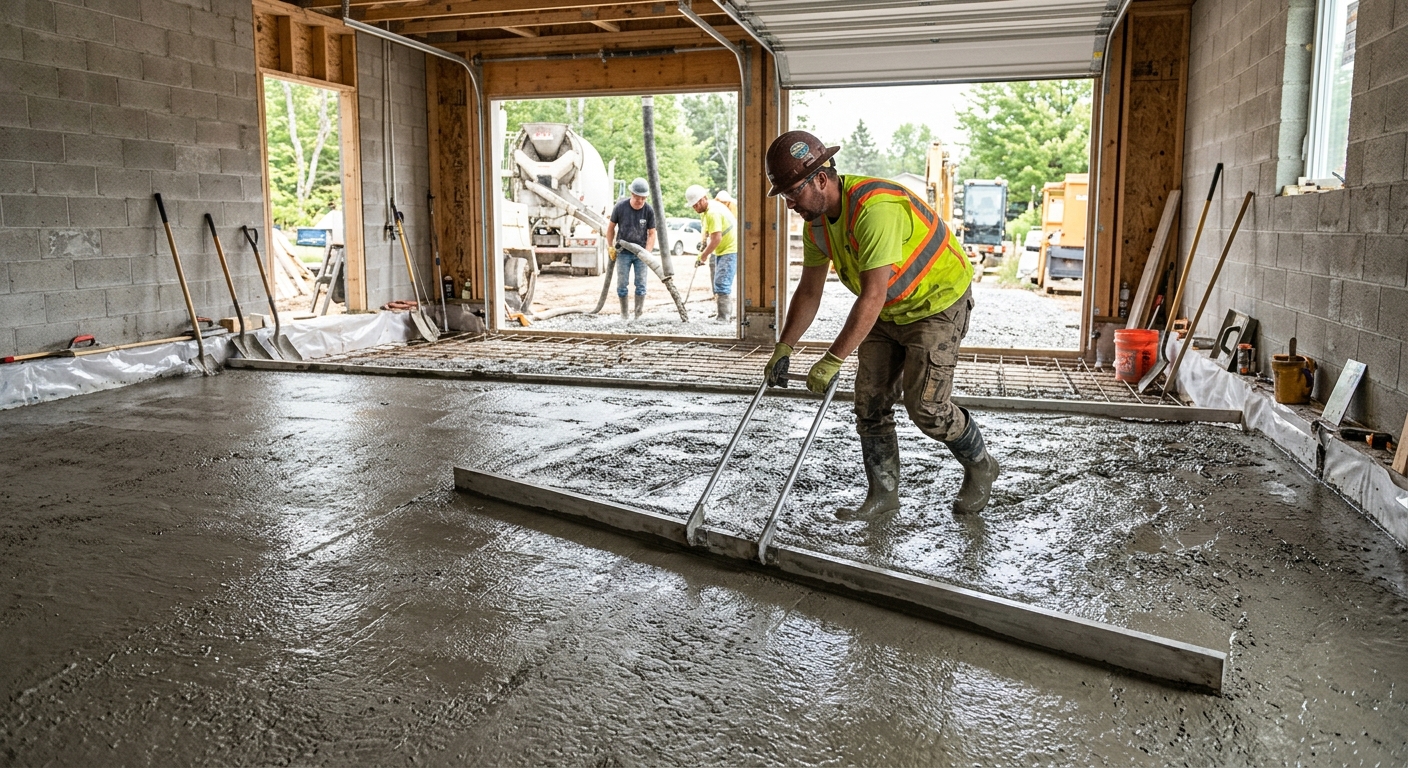
Concrete work options and costs in Crossfield
Crossfield homeowners typically choose concrete flatwork because it holds up well when it’s engineered for the cold continental conditions around Calgary. With 78.2% of dwellings in the area being single-detached homes, most projects we see are driveways, patios, walkways, garage slabs, and foundation footings. In a town of 3,599 residents (Statistics Canada, 2021 Census), there’s steady demand, especially in newer pockets where households are updating entrances and adding backyard living space.
Pricing in the Calgary economic region reflects frost and freeze–thaw demands more than in milder parts of Alberta. In this climate, the design frost depth is about 1.2 m (roughly 4 ft), so exterior work that interfaces with soil—like footings and retaining edges—requires deeper, larger excavations and properly prepared granular bases. Freeze–thaw cycles also push contractors to specify air-entrained concrete, plan more careful control joint layouts, and use curing methods that keep concrete warm and protected in cooler seasons. That reduces failures like scaling and spalling, but it adds labour and materials.
In Crossfield’s Walsh Avenue / downtown core area and the busier family neighbourhoods near schools and parks, driveway and patio work tends to be in highest demand because lots are accessed through tighter yards and equipment logistics matter. Once we know the scope—surface prep, reinforcement, finishes, and access—we can compare the most common options below.
| Application |
Typical Size |
Key Spec |
Finish Option |
Price Range |
| Concrete driveway (standard broom finish) |
20 ft x 9 ft (180 sq. ft.) |
Air-entrained exterior mix, granular base, control joints |
Broom finish |
$12,000–$18,000 |
| Exposed aggregate driveway |
20 ft x 9 ft (180 sq. ft.) |
Air-entrained exterior mix, base prep, wash/retard method |
Exposed aggregate |
$15,000–$22,000 |
| Stamped concrete driveway or patio |
20 ft x 9 ft driveway or 12 ft x 20 ft patio |
Air-entrained exterior mix, higher finishing labour |
Stamped pattern |
$15,000–$26,000 |
| Plain concrete patio or walkway |
12 ft x 16 ft (192 sq. ft.) or 4 ft x 20 ft |
Air-entrained mix, proper drainage slope, joints |
Broom or smooth trowel (as specified) |
$5,000–$9,000 |
| Garage floor (interior slab) |
22 ft x 24 ft (528 sq. ft.) |
Fibres or mesh/wire as required, vapour barrier, joints |
Broom finish or smooth float |
$10,000–$16,000 |
| Foundation footings (structural, below frost) |
Typical house system (varies by plan) |
Excavate to undisturbed soil below design frost depth |
Structural concrete |
$28,000–$45,000 |
Prices are estimates only and vary by project scope, site access and material selection.
What affects the price of concrete work in Crossfield
In Crossfield and across the Calgary region, quotes for the “same” concrete job can differ by 30–50% because the price isn’t just the concrete. It’s the excavation volume, granular base thickness, reinforcement requirements, finish complexity, and the time needed to cure properly in a cold continental climate. Also, winter-grade logistics and the short exterior pour window in spring and fall affect scheduling and labour availability, which can push pricing up when crews are booked.
The biggest driver is frost performance. Calgary-area engineering practice uses a design frost depth of about 1.2 m (roughly 4 ft). That means exterior elements tied to soil—especially foundation footings, grade-beam edges, and retaining details—must bear on undisturbed soil below this depth to prevent frost heave and seasonal movement. On top of that, freeze–thaw cycles are hard on surfaces, so exterior slabs and driveways are typically built with air-entrained concrete and well-spaced control joints. Finally, cold-weather curing precautions (insulated blankets, tenting, or temporary heat) help concrete reach the early strength it needs; delaying or skipping these steps increases the risk of scaling over time—then you pay later for repairs.
Here are common Crossfield examples that raise or lower cost. (1) If the driveway must be rebuilt after improper base prep, excavation and hauled-in granular material can add thousands, even if the final slab size is unchanged. (2) A 20 ft x 9 ft standard broom driveway often falls around the $12,000–$18,000 range, while stamped styles with deeper finishing labour and upgraded mix scheduling can land in the $15,000–$26,000 band. (3) If your lot has tight access near the sidewalk or requires pump/short-haul coordination, labour time increases.
| Price Factor |
Why It Matters |
Cost Impact |
| Frost line depth |
Determines footing depth and form height |
Greater excavation volume and higher labour/materials; can add several thousand on foundation work |
| Site preparation |
Excavation, grading, compacted granular base |
More trucking and base material increases cost; poor base prep typically forces later repairs |
| Reinforcement |
Rebar or wire mesh requirement |
Rebar cages, chairs, and installation time can materially raise slab and footing pricing |
| Mix design |
Air-entrainment and compressive strength spec |
Exterior air-entrainment and engineered strength specs are essential in freeze–thaw; cost is usually higher but prevents failure |
| Finish type |
Broom vs. stamped vs. exposed aggregate |
Stamped and exposed finishes require extra labour and materials; finishes often drive the largest upsell |
| Pour size and concrete truck access to site |
Distance from truck, lifts, and staging time |
Tighter sites near fences or rear yards can increase labour and equipment coordination time |
| Cold-weather curing precautions |
Heating and blankets |
Winter-grade procedures add direct cost and scheduling overhead, especially for late-season pours |
| Control joint pattern and sealing cost |
Controls random cracking and protects the surface |
Joint saw-cutting timing and sealant/penetrating sealer add cost, but reduce cracking and surface deterioration |
Permits & regulations in Alberta
In Alberta, structural concrete work such as footings, foundation walls, and grade beams generally requires a building permit, and it’s common to see engineered drawings reviewed during the permit process. Concrete flatwork—like driveways, patios, sidewalks, and walkways—often does not require a permit by default, but it can if your project affects lot grading, stormwater handling, or impervious surface coverage rules, or if any work touches a municipal right-of-way/sidewalk area. Always confirm with the local authority before breaking ground, especially if you’re changing drainage or lowering/raising the finished grade.
For Crossfield homeowners, a practical, step-by-step verification approach helps you avoid contractors who can’t legally or safely complete the job. First, ask the contractor for their Alberta licence details (and any relevant trade registration) and check their standing using the applicable online business/trade resources available in Alberta. Second, request an updated certificate of liability insurance showing adequate coverage for your project; verify the certificate dates align with your job window. Third, ask for proof of WSIB/WCB coverage for workers doing the work and confirm coverage is current—don’t accept “we’ll cover it” verbal assurances. Finally, ask for references on similar concrete work volumes, then follow up with those homeowners about workmanship and cold-weather handling.
Getting concrete right in Crossfield's freeze-thaw climate
Concrete failures in Crossfield usually come down to three things: base and drainage, mix design, and curing. In a freeze–thaw environment, the most common long-term issue is spalling and surface scaling, which often traces back to inadequate air-entrainment, rushed finishing, or poor curing—especially when temperatures swing in shoulder seasons. To spec your project correctly, start with base preparation: a properly excavated and compacted granular sub-base to the required depth helps prevent settlement and trapped water under slabs. Next, require an air-entrained exterior mix with the right air target and durability spec for exterior exposure. For exterior slabs, you’ll typically want air-entrainment around 5–7% and a minimum 32 MPa compressive strength rating.
Then address cracking and protection. Use control joints at spacing that limits random cracking and schedule saw-cuts correctly. Concrete should cure under suitable conditions; plan for at least 7 days before you treat it as fully “set up” for durability (longer is better for strength gain). Finally, add a penetrating sealer after full cure—commonly 28 days post-pour—to help repel de-icing salts and reduce freeze–thaw damage at the surface.
Ask your installer: “What air content are you targeting for the mix?”, “How deep is the compacted base?”, “When will you cut control joints?”, and “Will you use blankets/heat if temperatures drop?” A quick dollar reality check: a broom-finish driveway in the $12,000–$18,000 band can last a long time if the base and air-entrainment are right. If you choose stamped concrete in the $15,000–$26,000 band, the extra cost is often justified by higher labour and finishing complexity—but only if the contractor still does the same cold-weather durability work underneath.
| Spec |
Why It Matters in Crossfield |
What to Ask For |
Impact if Skipped |
| Compacted granular base (depth?) |
Controls drainage and reduces movement during freeze–thaw cycles |
Confirm excavated depth, base thickness, and compaction method for your soil |
Settlement, uneven cracking, and premature surface failure |
| Air-entrained concrete mix (target air %?) |
Prevents freeze–thaw damage like scaling and spalling |
Request a target air content of about 5–7% for exterior flatwork |
Surface scaling, spalling, and faster deterioration with de-icing salts |
| Compressive strength (MPa rating) |
Ensures durability and structural capacity in Calgary-area conditions |
Minimum 32 MPa compressive strength spec (or higher if engineered) |
Lower strength gain and higher long-term cracking and wear |
| Control joints (spacing per ACI guidelines) |
Limits random shrinkage cracking and reduces pathways for water |
Ask for planned joint layout and saw-cut timing |
Random cracks, water ingress, freeze–thaw expansion damage |
| Minimum 7-day curing period |
Strength development is critical before cold snaps and moisture cycles |
Confirm curing protection; require blankets/heating when cold-weather conditions occur |
Reduced strength, increased scaling risk, and weaker surface durability |
| Penetrating sealer (when applied after cure) |
Helps repel salts and moisture during winter exposure |
Penetrating sealer applied after cure—commonly 28 days post-pour |
Salt-driven surface breakdown and quicker deterioration |
How to choose a concrete work contractor in Crossfield
Choosing the right contractor in Crossfield is mainly about confirming accountability and workmanship details, not just picking the lowest number. Start by verifying Alberta licensing/trade registration where applicable, then request a current certificate of liability insurance. For safety and coverage, ask for proof of WSIB/WCB for the workers who will be on your site. When they provide documents, check dates and that the coverage is active during your planned start and completion window. If they refuse or can’t produce paperwork quickly, that’s a major risk on a project where excavation and heavy pours are involved.
Next, request 2–3 itemised written quotes instead of one lump-sum number. The quote should separate labour and materials (concrete, rebar/mesh, forms, granular base, joints, saw-cutting, sealing) and list what’s included for disposal and site access. Carefully read exclusions: Are you responsible for patching after saw-cuts? Is permit assistance included if required for grading changes? Will they handle sidewalk tie-ins or right-of-way considerations?
Warranty should be explicit: ask for workmanship warranty length and whether it covers labour-only or materials too. Also confirm any manufacturer warranty on products (like sealers) and whether it transfers to you after purchase. For payment terms, avoid paying more than 10–15% upfront; keep a holdback until the job is complete and surfaces are cured and finished as specified. Finally, get a written timeline with start date and completion estimate—cold-weather conditions can affect curing, and you want clarity on how they’ll protect the slab if temperatures dip.
- Ask for a detailed scope: excavation depth, granular base thickness, and compaction expectations.
- Confirm reinforcement details (mesh vs. rebar, chairs/spacing, and where it’s placed).
- Require air-entrainment for exterior work and a stated target air range.
- Get joint layout and saw-cut timing in writing.
- Confirm curing approach for the forecast (blankets/tenting/heat if needed).
- Ask whether sealing is included and the planned sealer type.
- Request a materials list and concrete spec (strength rating) per the quote.
- Clarify truck access and pumping/short-haul assumptions.
- Check if disposal is included (spoils haul-away, clean-up, and site restoration).
- Verify insurance certificate dates and coverage limits match your project.
- Confirm WSIB/WCB coverage for workers on site.
- Review warranty terms in plain language before signing.
Concrete contractor red flags in Crossfield include vague scopes that don’t mention air-entrainment, promises to pour and “finish fast” in cold weather without blankets or heating plans, quotes that omit joint layout and sealing, refusal to show insurance/WSIB paperwork, and change orders that aren’t documented in writing as the work progresses.
Frequently asked questions — concrete work in Crossfield
How do I seal concrete to protect it in Crossfield?
In Crossfield, sealing is one of the best defences against winter damage because de-icing salts plus freeze–thaw cycles accelerate surface breakdown. For exterior flatwork, plan for a penetrating sealer applied after the concrete has fully cured—typically around 28 days post-pour—so the surface isn’t still releasing moisture. Before sealing, the slab should be clean and fully dry; contractors usually do a wash and remove any contaminants so the sealer can penetrate. Ask what sealer type they’re using (penetrating vs. film-forming) and whether they’ll re-check surface dryness before application. If you’re budgeting, sealing is usually much less than a re-pour, especially compared with a driveway rebuild that’s often in the $12,000–$18,000 range.
What is the difference between concrete and cement?
Homeowners in Crossfield often use the words “cement” and “concrete” interchangeably, but they’re not the same. Cement is one ingredient in concrete—essentially the binding material that reacts with water. Concrete is the full mix: cement plus water plus aggregate (sand and gravel) and, for exterior work, often air-entrainment admixtures and other durability components. That’s why you’ll hear contractors talk about the “concrete spec” (like air content and compressive strength) rather than only cement. In Calgary-area freeze–thaw conditions, the concrete design matters most—especially ensuring exterior slabs use air-entrained concrete so they can handle winter cycling without scaling or spalling.
How much does concrete work cost in Crossfield?
Concrete costs in Crossfield depend on slab size, base prep, reinforcement, finish type, and how cold the pour window is. For a common example, a concrete driveway (standard broom finish) is often estimated in the $12,000–$18,000 band for typical single-car or modest double-car sizes once excavation, granular base, and control joints are included. If you want a stamped or more decorative look, that can move into the $15,000–$26,000 range because labour and finishing steps increase. Exterior patios and walkways commonly fall around $5,000–$9,000. When quotes differ, it’s frequently because of more thorough excavation and granular base, better reinforcement, or proper cold-weather curing precautions—those are the items that protect the slab long-term in freeze–thaw cycles.
How deep must footings be for Crossfield's frost line?
For Crossfield, Alberta, the key rule is that footings must be placed below the design frost depth to prevent frost heave and seasonal movement. In this region, the design frost depth used in practice is about 1.2 m (roughly 4 ft). That depth drives how deep excavations go and how tall forms must be, which is why foundation pricing often sits in the $28,000–$45,000 range for typical footing scopes. Exact footing depth can vary depending on soil conditions, engineered design, and the foundation system shown on your permit drawings. Your engineer or permit documents should specify the required bearing depth, but you can always ask the contractor to show how they’ll excavate to undisturbed soil below the frost line.
Why does concrete crack in Crossfield and how is it prevented?
Concrete cracking is common in Crossfield because slabs expand and contract with temperature swings and moisture changes, and shrinkage happens as concrete cures. In a freeze–thaw climate, cracks are also a pathway for water and de-icing salts, which can worsen surface damage over time. Prevention focuses on correct base prep, proper concrete mix design (including exterior air-entrainment), and a planned control joint strategy. Control joints “tell” the slab where to crack instead of letting random cracks happen. To reduce risk, require air-entrained concrete for exterior slabs, correct compaction of the granular base, and joint spacing/timing appropriate for your slab size. Sealing after curing helps repel salts. Even with good methods, some cracking is expected—what you want to prevent is uncontrolled cracking and surface deterioration.
Stamped vs broom-finish concrete — cost difference?
Stamped concrete typically costs more than a broom finish because it requires additional labour, set-up, stamping tools, and careful finishing to get consistent patterning—especially important in Calgary-area weather transitions. A broom-finished driveway commonly lands around $12,000–$18,000, depending on size and base prep. Stamped concrete driveways or patios often fall in the $15,000–$26,000 band because finishing steps are more intensive and the schedule needs to stay on track for curing and protection. The cost difference is usually justified when the contractor also does the durability basics: proper air-entrainment, control joints, and curing under the right conditions. If a contractor cuts corners on base or curing to “fund” the stamp, you’ll pay later through cracking or scaling.