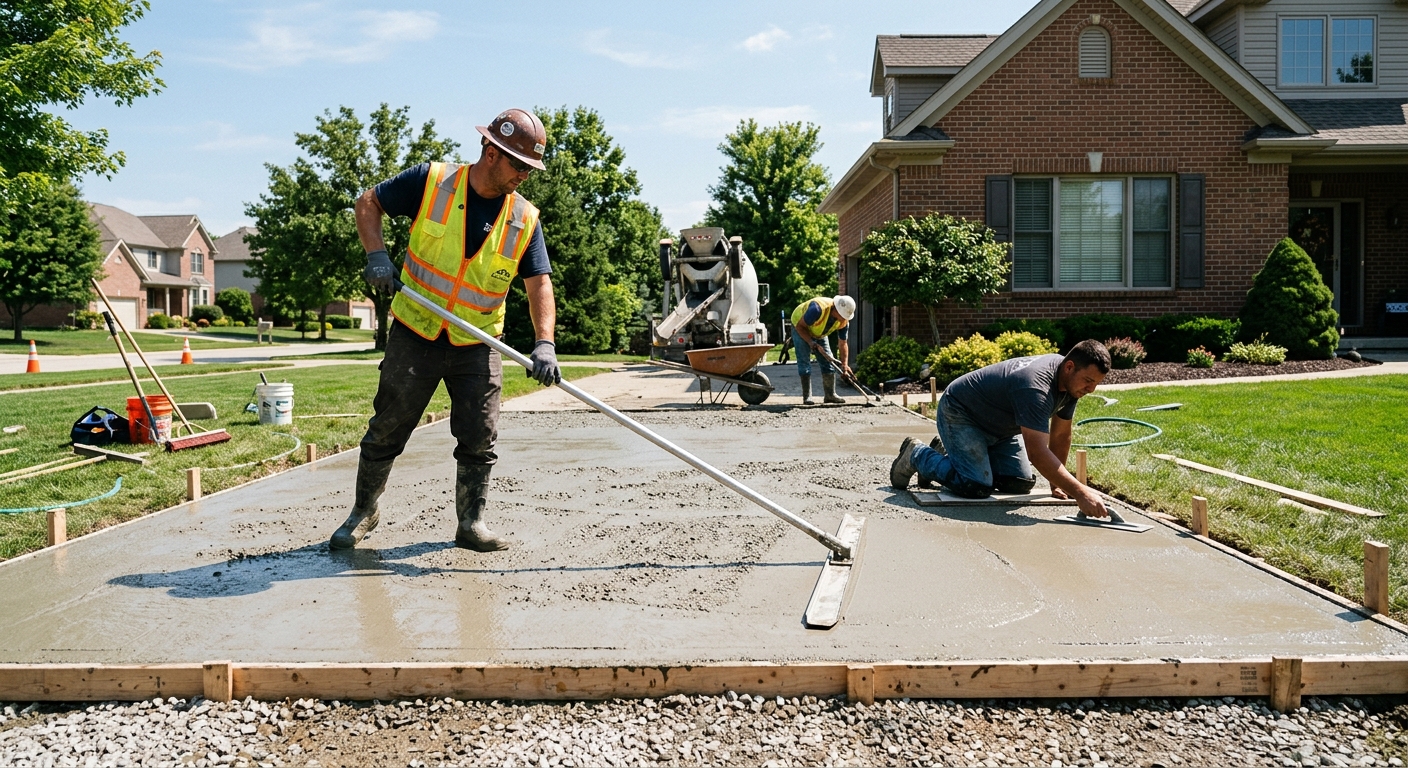
Concrete work options and costs in Collingwood
Collingwood buyers often start with a simple question—what does it cost to pour concrete—and the answer usually depends on how much frost protection and freeze–thaw durability the job needs. In a community as small as Collingwood (population 2,290, Statistics Canada, 2021 Census), most concrete work is driven by homeowners replacing aging driveways and adding exterior flatwork. That market is tightly linked to typical residential plans that include concrete driveways, patios and walkways, plus structural foundations for new builds and additions.
In the Calgary economic region, quotes can swing because cold continental winters change how contractors engineer every step. Frost depth drives footing design, while freeze–thaw cycles affect mix design, granular base preparation and joint layout. Calgary-area crews also work within a shorter exterior pour season, so cold-weather concrete placement often requires winter-grade mixes, insulated blankets and sometimes temporary heat to protect curing—costs that show up in your estimate. If you’re near a busier in-demand pocket like Downtown Collingwood and the surrounding established residential blocks, scheduling can also affect price because crews are pulled between full replacements, repairs and new slab pours.
Below is a practical way to compare options side-by-side for Collingwood, Alberta. Use it to frame calls with contractors and to sanity-check any quote you receive before you approve excavation, forms and reinforcing.
| Application |
Typical Size |
Key Spec |
Finish Option |
Price Range |
| Concrete driveway (standard broom finish) |
400 sq. ft. (about 20’ x 20’) |
Air-entrained exterior mix, proper base compaction |
Broom finish + control joints |
$12,000–$18,000 |
| Exposed aggregate driveway |
400 sq. ft. (about 20’ x 20’) |
Air-entrained exterior mix; wash exposure process |
Exposed aggregate finish |
$14,500–$21,500 |
| Stamped concrete driveway or patio |
500 sq. ft. (about 25’ x 20’) |
Air-entrained exterior mix; release agent + colouring |
Stamped pattern + integral colour (or stain) |
$15,000–$26,000 |
| Plain concrete patio or walkway |
200 sq. ft. (about 10’ x 20’) |
Air-entrained exterior mix; edge restraints |
Plain broom finish + joints |
$5,000–$9,000 |
| Garage floor (interior slab) |
500 sq. ft. (about 20’ x 25’) |
Vapour barrier, mesh or rebar per design |
Steel trowel + broom or light texture finish |
$10,000–$15,500 |
| Foundation footings (structural, below frost) |
Typical single-house footing perimeter + pads |
Engineered reinforcement; concrete below design frost |
Structural concrete (not a finish) |
$28,000–$45,000 |
Prices are estimates only and vary by project scope, site access and material selection.
What affects the price of concrete work in Collingwood
Even when two homeowners describe the “same” concrete project in Collingwood, Alberta, you’ll still see quote gaps of 30–50% across the Calgary region. The reason isn’t just the concrete itself—it’s the engineered earthwork, frost-protection requirements and the labour time needed to get curing right in cold weather. A small change in footing depth, reinforcement needs, or whether the contractor has to heat and protect fresh concrete can quickly move you from the lower end of a price band to the higher end.
In this climate, the design frost depth is about 1.2 m (roughly 4 ft), so footings for houses, garages, decks and retaining structures must bear on undisturbed soil below that depth to prevent frost heave. Exterior slabs also need air-entrained concrete (for durability through freeze–thaw cycles) and a robust granular base prep with correct compaction. Calgary’s pour season is shorter, so in late fall or early spring, proper cold-weather curing often requires insulating blankets and sometimes temporary heat—both are extra line items. Finally, de-icing salt accelerates surface scaling, making sealing an important step for driveways and exposed flatwork.
In Collingwood specifically, cost commonly rises when the site is tight (more labour for forming and moving materials), when excavation hits wetter soils (extra granular replacement and drainage work), or when there’s a need to rebuild edges for water control. It can be lower when the existing base is sound and removal is minimal, especially for small patios. As a rule of thumb, a basic broom-finish driveway typically lands around the middle of the $12,000–$18,000 range, while stamped projects often justify their higher labour and materials overhead that fit the $15,000–$26,000 band—when you’re comparing the same slab size.
| Price Factor |
Why It Matters |
Cost Impact |
| Frost line depth — determines footing depth and form height |
Footings must extend below design frost to prevent heave and seasonal movement |
Higher excavation and concrete volume; can push foundation pricing toward the top end |
| Site preparation — excavation, grading, compacted granular base |
Correct sub-base compaction reduces settlement and cracking over freeze–thaw cycles |
More removal/replace increases labour and granular material; access issues add cost |
| Reinforcement — rebar or wire mesh requirement |
Controls cracking and improves slab performance where loads or spans demand it |
Additional steel weight, tie-wire labour and placement time |
| Mix design — air-entrainment and compressive strength spec |
Air void system is critical for exterior durability in Alberta’s freeze–thaw environment |
Winter-grade or higher-spec mixes can raise per-yard concrete costs and pour logistics |
| Finish type — broom vs. stamped vs. exposed aggregate |
Finishing complexity affects crews, timing and material systems |
Stamped/exposed finishes add labour steps and product; broom finishes cost less |
| Pour size and concrete truck access to site |
Big pours need efficient staging; limited access means smaller loads and more handling |
Reduced productivity and more truck trips can noticeably increase labour and overhead |
| Cold-weather curing precautions — heating and blankets |
Maintains proper strength gain when temperatures drop |
Insulated covers, heaters, and extra supervision add direct costs |
| Control joint pattern and sealing cost |
Joints reduce random cracking; sealing helps slow salt-driven surface damage |
Extra saw cutting and sealer material/labour; improves longevity |
Permits & regulations in Alberta
In Alberta, structural concrete work generally triggers permitting and engineering expectations, especially where it supports the building’s load path. For homeowners in Collingwood, the work that typically does require a permit includes foundation footings, foundation walls, grade beams and other structural elements that are part of the engineered structure. In many cases, engineered drawings are reviewed as part of the permit process to confirm reinforcement, footing elevations and frost-protection details.
Concrete flatwork such as patios, walkways and driveways usually do not require a permit on their own—unless the project affects lot grading, creates changes to impervious surface coverage, alters drainage in a way that impacts the right-of-way, or requires work near municipal services. Because rules vary by situation, confirm with the local authority before you break ground.
To verify a contractor in Alberta step-by-step, start by asking for their licence details (and any applicable trade registration information) and checking the contractor’s business presence through the appropriate online registry. Next, request a current certificate of liability insurance showing coverage for the project period and ensure the limits are appropriate for the scope. For worker coverage, confirm they have WSB/WCB coverage (or the correct Alberta worker protection documentation for their business). Finally, ask for clearance paperwork where applicable and references from similar-scale concrete jobs—especially exterior pours that were protected for curing in cold weather.
Getting concrete right in Collingwood's freeze-thaw climate
Concrete failures in Collingwood are usually tied to how the slab or footing interacts with Alberta’s freeze–thaw cycles. The common culprits are inadequate base preparation, poor curing, missing/incorrect air-entrainment for exterior concrete, and poor jointing. If the sub-base isn’t properly compacted to the correct depth and profile, water can sit in the wrong places and expand when it freezes, creating movement that turns into cracking. If the mix lacks the right air void system, surface scaling and flaking (“spalling”) become more likely after repeated de-icing cycles.
To spec the job correctly, focus on five areas. First is base preparation: compacted granular sub-base to the depth needed for frost and good drainage, then correct edge support. Second is mix design: exterior slabs should target an air content in the 5–7% range and meet at least 32 MPa compressive strength requirements. Third is control joints: they should be planned to limit random cracking to predictable locations. Fourth is curing: plan for a minimum 7 days of proper curing conditions, and in cold weather you may need curing blankets or heat so strength gain happens on schedule. Fifth is sealing: apply a penetrating sealer after curing (commonly around 28 days post-pour) so de-icing salt has less direct access to the concrete surface.
Here’s where money is either well-spent or wasted. For example, choosing a properly air-entrained exterior mix and correct granular base for a driveway typically fits within the $12,000–$18,000 band. If you try to “save” by skipping air-entrainment or underbuilding the base, you might stay near the low end, but the cost usually comes back later as surface repairs and joint crack remediation—often far more than the difference between good-spec and cut-corners.
| Spec |
Why It Matters in Collingwood |
What to Ask For |
Impact if Skipped |
| Compacted granular base (depth?) |
Supports the slab and prevents frost-related movement during freeze–thaw |
Confirm target excavation depth, granular type, and compaction method (and drainage provisions) |
Settlement and cracking; premature joint failures |
| Air-entrained concrete mix (target air %?) |
Air voids protect against freeze–thaw damage in Alberta’s exterior exposure |
Request air content target (commonly 5–7% for exterior flatwork) |
Higher risk of scaling/spalling after winters and salt exposure |
| Compressive strength (MPa rating) |
Strength gain supports durability and load capacity |
Minimum 32 MPa (and winter-grade plan if temps drop) |
Reduced long-term performance and higher surface wear |
| Control joints (spacing per ACI guidelines) |
Prevents random cracking by giving the slab a controlled “break point” |
Ask for joint layout and spacing tied to slab dimensions and thickness |
Random cracks that allow water ingress and freeze damage |
| Minimum 7-day curing period |
Curing enables proper strength development despite cold nights |
Confirm curing conditions, coverage method and any cold-weather heating plan |
Surface weakness, poor bond and increased scaling risk |
| Penetrating sealer (when applied after cure) |
Repels salt water and reduces surface deterioration |
Penetrating sealer applied after cure (often around 28 days post-pour) |
Faster salt-driven spalling and more frequent refinishing |
How to choose a concrete work contractor in Collingwood
Choosing the right concrete contractor matters in Alberta because the “right mix” and the “right cure” protect your slab through winters, not just through the first season. Start by verifying Alberta licensing for the specific work they’re doing, then request a certificate of liability insurance that matches the project start/end dates and includes coverage for concrete-related risks. For worker coverage, confirm their WSB/WCB documentation (and that it’s valid for active work). If you can’t get clear proof quickly, that’s a red flag.
Next, get 2–3 itemised written quotes (not just one lump sum). You want a labour + materials breakdown showing concrete supply, reinforcement, excavation, granular base, forming, finishing, saw cutting and—if needed—cold-weather curing items like blankets or heaters. Carefully read what’s excluded: disposal of excavated material, permit pull (if applicable to your structural scope), protection of landscaped areas, and any drainage adjustments. A strong contractor will spell these out.
Ask about warranties too. You should receive a clear workmanship warranty length, the manufacturer warranty terms for any products used (like sealers or admixtures), and whether anything is transferable to the next owner. For payment, don’t pay more than 10–15% upfront. Hold back a portion until the job is complete and you’ve inspected base prep, reinforcement placement (where visible), finishing quality, curing/protection steps, and joint sealing.
- Ask for references from similar exterior concrete projects in Alberta’s freeze–thaw climate.
- Request proof of liability insurance and confirm policy dates match your schedule.
- Confirm WSIB/WCB coverage before work starts.
- Get itemised quotes showing concrete volume, reinforcement, excavation and finish labour.
- Verify whether sealing is included and who supplies the sealer.
- Confirm joint layout: spacing and saw-cut timing plan.
- Ask what happens if temperatures drop mid-pour (blankets/heaters plan).
- Check that disposal, haul-away and site restoration are included where needed.
- Require a written start date and completion timeline.
- Inspect forms and base compaction before the pour (photos/video can help).
- Clarify warranty coverage for cracking vs. spalling vs. surface scaling.
- Avoid contractors who push for large upfront payments or skip written scope details.
In Collingwood, I also watch for concrete contractor red flags: vague scope language (“standard prep”), missing documentation for insurance/WSB/WCB, no cold-weather curing plan, quotes that omit reinforcement or joint details, and crews who want to rush sealing or omit curing time.
Frequently asked questions — concrete work in Collingwood
How deep must footings be for Collingwood's frost line?
In Collingwood and across the Calgary region, footing depth is driven by the local design frost depth used by engineering and building practice. The design frost depth is about 1.2 m (roughly 4 ft), meaning structural footings should be supported on undisturbed soil below that depth to reduce the risk of frost heave. Your engineer or contractor should specify the footing elevation and excavation depth on the drawings or in their estimate. This is one reason foundation pricing can sit high in the $28,000–$45,000 band—excavation and concrete volume increase when you must build deeper than in milder provinces. For an attached garage, deck footings and retaining structures, don’t assume a shallow approach—ask for the frost-based depth in writing.
Why does concrete crack in Collingwood and how is it prevented?
Concrete cracks in Collingwood, Alberta mainly because it’s exposed to freeze–thaw movement, temperature swings, and water infiltration—especially if the slab base isn’t compacted correctly or joints aren’t planned. Even well-built concrete will crack eventually, but the goal is predictable cracking at control joints, not random surface failures. Prevention starts with a solid, compacted granular base, air-entrained exterior concrete and correct reinforcement placement for your slab type. Then you add control joints at appropriate intervals and saw-cut them at the right time so shrinkage is relieved before it forms random cracks. Sealing after curing helps reduce salt-driven surface deterioration. When estimating driveway work that typically falls in the $12,000–$18,000 range, insist the quote includes jointing and proper base prep—those are usually the difference between “it cracked” and “it cracked where it should.”
Stamped vs broom-finish concrete — cost difference?
Stamped concrete costs more than a broom-finished slab because it adds finishing steps, timing demands and additional materials (colour systems, release agents and pattern tools). In the Calgary region, that complexity shows up most clearly on driveways and patios where your finished look is a big part of the value. A broom-finished driveway typically fits the $12,000–$18,000 band, while stamped driveway or patio projects often land in the $15,000–$26,000 band depending on size and pattern coverage. If your site is tight and the contractor needs more labour to stage stamping tools and protect the surface during set, pricing can be higher. The best way to compare is to ask for the same thickness, reinforcement (if included), and joint plan in both options—otherwise you’re comparing two different technical scopes, not just two finishes.
When is the best time to pour concrete in Collingwood?
The best time to pour concrete in Collingwood is when conditions support strong early curing—typically in late spring through summer when nights stay above freezing more consistently. In the colder parts of Alberta’s freeze–thaw cycle, contractors can still place exterior concrete, but only if they follow cold-weather precautions: winter-grade mixes, insulated blankets and sometimes temporary heat so the concrete reaches proper strength gain. If you pour too late in the fall or early in spring without adequate protection, you can see surface scaling and long-term durability issues even when the finish looks fine initially. For homeowners, the practical question is: will the contractor provide a written cold-weather curing plan if temperatures fall? That’s often where the quote difference appears, especially for driveway and patio work aimed at the lower end of the $12,000–$18,000 driveway range versus more protected winter placements.
How long does concrete take to cure?
Concrete curing isn’t just about “dry to the touch.” For exterior flatwork and structural concrete, plan for a curing period of at least 7 days under proper conditions so strength development is on track, with the understanding that full durability benefits continue beyond that. In Collingwood’s climate, proper curing matters because cold nights and temperature swings can slow strength gain and increase surface problems if protections aren’t used. If cold-weather placement is required, curing blankets and/or heat are often used to maintain temperature and moisture. For sealing, many contractors apply a penetrating sealer around 28 days after the pour (once curing is complete) so the sealer bonds and performs as intended against de-icing salt. Ask your contractor for their curing checklist—what they’ll do for temperature, coverage and when they’ll cut joints. It’s a key part of avoiding spalling over Alberta winters.
Do I need a permit for concrete work in Alberta?
In Alberta, it depends on what you’re building. Structural concrete like foundation footings, foundation walls and grade beams typically requires a building permit, often with engineered drawings reviewed as part of the approval process. Concrete flatwork such as patios, walkways and driveways usually does not require a permit when it doesn’t affect lot grading, impervious surface limits, or municipal right-of-way conditions. However, if drainage patterns change or you’re doing work tied into structural elements, you should confirm requirements before work starts. For Collingwood homeowners, the safest approach is to ask the contractor to clarify whether a permit is expected for your specific scope and to document the plan. Also verify the contractor’s liability insurance and WSIB/WCB coverage before the first excavation—those are practical protections on top of any permitting requirements.