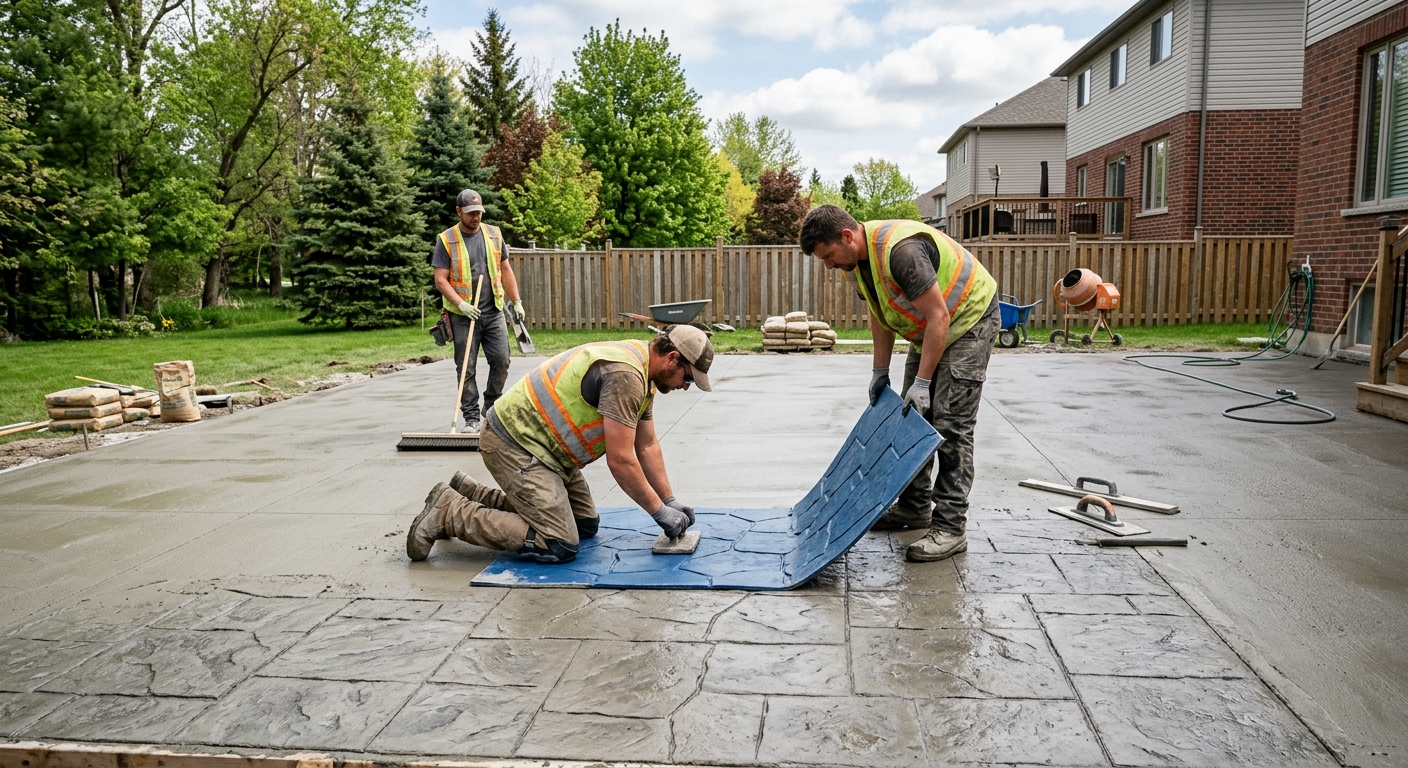
Concrete work options and costs in Renfrew
Renfrew, Alberta is a practical market for concrete because most homeowners want durable flatwork that can handle deep frost and repeated freeze–thaw. With a population of 6,580 (Statistics Canada, 2021 Census), the trade is sized around steady residential demand—especially for single-detached homes and the driveways, patios, garage floors, and front steps that come with them. In Calgary’s broader economic region, labour capacity and truck availability can shift quickly when multiple crews are chasing the same short exterior pour window, so timing and scope matter when you’re comparing quotes.
In this cold continental climate, engineering practice centres on frost depth and base prep. The design frost depth is about 1.2 m (roughly 4 ft), so footings for houses, garages, decks, and retaining structures need to bear on undisturbed soil below that depth to reduce frost heave and seasonal movement. Exterior slabs also rely on air-entrained concrete and well-spaced control joints to reduce cracking and spalling. When pours happen late in the season, contractors may need insulated blankets or temporary heat to protect curing—good practice that costs more upfront but helps prevent surface scaling over time.
Within Renfrew, areas with frequent infill and upgrades—such as established streets near downtown amenities—tend to see the most demand for driveway replacements and patio renewals. The next step is comparing typical project scopes and finishes side by side so you can understand where the money goes.
| Application |
Typical Size |
Key Spec |
Finish Option |
Price Range |
| Concrete driveway (standard broom finish) |
24’ x 24’ (576 sq. ft.) |
Air-entrained mix, compacted granular base, saw-cut joints |
Broom finish |
$12,000–$18,000 |
| Exposed aggregate driveway |
24’ x 24’ (576 sq. ft.) |
Air-entrained mix, proper surface retarder/cleaning, seal-ready base |
Exposed aggregate |
$15,000–$21,000 |
| Stamped concrete driveway or patio |
16’ x 20’ (320 sq. ft.) driveway/patio |
Air-entrained mix, integral colour (or top colours), joints to match pattern |
Stamped finish |
$15,000–$26,000 |
| Plain concrete patio or walkway |
10’ x 16’ (160 sq. ft.) patio or 4’ x 24’ walkway |
Air-entrained mix, compacted base, edge forms, control joints |
Float and broom/scored |
$5,000–$9,000 |
| Garage floor (interior slab) |
22’ x 22’ (484 sq. ft.) |
Reinforced slab (mesh or fibres), vapour considerations, proper subgrade compaction |
Plain trowel-finish or broom (depending on use) |
$10,000–$16,000 |
| Foundation footings (structural, below frost) |
Typical house/garage perimeter |
Engineered specs, excavation below design frost depth (~1.2 m), compacted bearing |
Structural only (not decorative) |
$28,000–$45,000 |
Prices are estimates only and vary by project scope, site access and material selection.
What affects the price of concrete work in Renfrew
In Renfrew, you can see the same basic concrete job land 30–50% apart from one quote to another, even when everyone says “standard.” The biggest reason is that concrete pricing isn’t just the slab—it’s the engineered preparation to survive Alberta conditions, plus the labour timing window in the Calgary region. When crews are busy, scheduling and truck logistics can add cost. Also, small scope differences—like whether disposal is included, whether reinforcement is specified correctly, or whether the contractor is planning for winter curing—show up as major line items later.
Frost line depth and freeze–thaw cycles dictate every spec here. Footings must extend below the design frost depth of about 1.2 m (roughly 4 ft) to avoid frost heave and seasonal movement. Exterior slabs in this climate require air-entrained concrete mixes to survive repeated freeze–thaw. Colder regions also face a shorter pour season, and cold-weather curing precautions (insulated blankets, sometimes temporary heat) can be necessary to achieve proper strength gain. Finally, de-icing salt accelerates surface spalling, which is why sealing is often recommended after cure—especially for driveways and patios that take winter traffic.
Two local examples: (1) If your subgrade is soft or you have clay that needs deeper granular replacement, excavation and base quantity increase and costs move toward the higher end of driveway pricing (around the $12,000–$18,000 band). (2) If you’re upgrading from plain to stamped or exposed aggregate, the finish labour and materials typically push projects toward the $15,000–$26,000 stamped/decorative band.
Even housing age can matter. Older lots often have uneven grades, buried services, or thicker topsoil layers that require more removal and regrading before any slab or foundation work can start—an avoidable expense if not inspected early.
| Price Factor |
Why It Matters |
Cost Impact |
| Frost line depth — determines footing depth and form height |
Footings must bear on undisturbed soil below design frost to prevent heave |
High variance; deeper excavation and more concrete can raise structural costs |
| Site preparation — excavation, grading, compacted granular base |
Correct base thickness and compaction prevent settlement and cracking |
Can add thousands if soils are unsuitable or grades are off |
| Reinforcement — rebar or wire mesh requirement |
Reduces cracking and supports slabs and footings under load |
Material and labour increase; poor reinforcement can force rework |
| Mix design — air-entrainment and compressive strength spec |
Air-entrainment protects against freeze–thaw damage; strength supports performance |
Better mixes cost more but reduce premature spalling/scaling |
| Finish type — broom vs. stamped vs. exposed aggregate |
Decorative finishes require extra steps, tools, and curing control |
Stamped/exposed options typically raise the project toward higher bands |
| Pour size and concrete truck access to site |
Smaller access constraints increase labour for placement and pumping/handwork |
Restricted access can increase labour hours and equipment needs |
| Cold-weather curing precautions — heating and blankets |
Winter-grade curing helps strength gain and reduces surface defects |
Added line items; often required in late fall or early spring |
| Control joint pattern and sealing cost |
Joints manage cracking locations; sealing repels salt and water ingress |
Skipping either can lead to faster maintenance and long-term damage |
Permits & regulations in Alberta
In Alberta, structural concrete work typically needs a building permit and often engineered drawings for review. That generally includes concrete footings, foundation walls, grade beams, and any structural elements supporting a house or major addition. For homeowners in Renfrew, these are the items that can’t be treated as “just concrete,” because inspections and engineered compliance affect safety and durability.
Concrete flatwork—such as driveways, patios, walkways, and garage floors—usually does not require a permit by itself. However, it can require approvals if it changes lot grading in a way that affects drainage, increases impervious surface beyond local expectations, or impacts municipal right-of-way conditions. Before breaking ground, confirm whether your scope triggers any approvals or if any notice is required.
To verify a contractor before they pour anything, go step-by-step:
- Ask for the certificate of insurance: liability coverage limits should be current and match the scope.
- Confirm WSIB/WCB coverage (as applicable) and request proof.
- Check licensing through Alberta’s public contractor/licensing resources (and ensure the registration matches the business name on your quote).
- Request references for similar-scale Renfrew or Calgary-area foundation and driveway work.
- Confirm that the permit/engineering responsibility is clearly stated in the proposal (especially for foundations).
Good contractors will welcome this verification because it’s part of managing risk in Alberta’s freeze–thaw environment.
Getting concrete right in Renfrew's freeze-thaw climate
Concrete failure in Renfrew usually isn’t mysterious—it’s predictable when freeze–thaw and de-icing salts get into a system that wasn’t engineered correctly. The most common issues I see are surface scaling and spalling from inadequate air-entrainment, cracking from poor base preparation, and uneven settlement when the granular sub-base isn’t compacted to spec. The fix is to specify the job as a complete assembly: base, mix design, joints, curing, and sealing.
Start with (1) base preparation. Use compacted granular sub-base to the right depth for your soil and frost conditions, and don’t skip proofing/compaction—this is what prevents settlement and keeps the slab flat. Next (2) mix design: specify air-entrained concrete with a target air content of about 5–7% for exterior flatwork, and a minimum 32 MPa compressive strength so the concrete can gain strength reliably under Alberta conditions. (3) Control joints should be planned to limit random cracking; spacing and timing matter. (4) Curing should include a minimum 7-day period under proper conditions, with cold-weather precautions in late fall or early spring (insulated blankets and/or heat if needed). (5) Seal with a penetrating sealer applied 28 days after the pour to help repel de-icing salts.
Ask contractors how they prevent spalling: specifically, confirm they’re using air-entrainment and that they’ll protect the surface during curing. As for price, here’s a real-world example: upgrading a plain driveway within the $12,000–$18,000 band to an exposed aggregate finish often adds cost toward the mid-to-upper range because of added steps and finishing control. If someone tries to cut mix and base spec to “save money,” that’s where long-term repairs can exceed the difference quickly.
| Spec |
Why It Matters in Renfrew |
What to Ask For |
Impact if Skipped |
| Compacted granular base (depth?) |
Correct depth and compaction reduce settlement and cracking under freeze–thaw movement |
Granular base thickness and compaction method; proof of preparation |
Uneven slab, early cracking, and water pooling |
| Air-entrained concrete mix (target air %?) |
Air voids help concrete resist freeze–thaw cycles and limit spalling |
5–7% air content for exterior flatwork (and air test plan) |
Surface scaling and spalling after winters |
| Compressive strength (MPa rating) |
Strength gain supports load capacity and durability in cold weather |
Minimum 32 MPa compressive strength (and mix documentation) |
Reduced performance and increased risk of cracking |
| Control joints (spacing per ACI guidelines) |
Joints control where shrinkage cracks occur and reduce random cracking |
Planned joint spacing, saw timing, and layout details |
Random cracking patterns and faster deterioration |
| Minimum 7-day curing period |
Proper curing is essential for strength development before freeze–thaw stresses |
How they protect curing in cold weather (blankets/heat if required) |
Surface defects, weak concrete, and durability problems |
| Penetrating sealer (when applied after cure) |
Helps repel salt and water intrusion common in Alberta winters |
Application timeline (typically 28 days after pour) and product type |
Higher salt/water absorption and quicker spalling |
How to choose a concrete work contractor in Renfrew
Choosing the right concrete contractor in Renfrew comes down to verifying risk controls and getting details in writing. In Alberta, structural and winter-weather scopes can carry serious consequences, so don’t rely on “trust” or a quick verbal assurance.
First, verify Alberta licensing by checking the contractor registration under the exact legal business name that will appear on your paperwork. Next, request an up-to-date certificate of liability insurance for the scope you’re hiring for (driveways, foundations, or both). Then confirm WSIB/WCB coverage—ask for proof or a clearance letter where applicable. A contractor who can’t quickly provide documents is usually cutting corners somewhere else.
Second, ask for 2–3 itemised written quotes. You want a breakdown that shows labour vs. materials, reinforcement details, removal/disposal, base preparation, and finishing/sealing scope—not just a lump sum. Confirm what’s excluded: permit fees, regrading, odd excavation conditions, crack repair at tie-ins, and whether winter curing measures are included if the pour is late season.
Third, focus on warranty and payment terms. Expect a workmanship warranty that’s clearly stated, and understand any limits. A good rule: never pay more than 10–15% upfront, and use a holdback until completion and cleanup. Finally, demand a start date and an estimated completion window in writing so you can plan around Alberta’s seasonal pour restrictions.
- Get proof of Alberta registration and ensure it matches the quote.
- Request liability insurance certificate before scheduling.
- Confirm WSIB/WCB coverage documentation in advance.
- Ask whether a permit/engineering is required and who handles it.
- Demand itemised quotes (base, excavation, reinforcement, mix spec).
- Confirm air-entrainment and compressive strength in writing.
- Ask about cold-weather curing plan if temps drop.
- Verify joint layout and saw-cut timing practices.
- Confirm disposal/removal of excavated material and forms.
- Clarify sealing: product type and when it will be applied (after cure).
- Review warranty length and what it covers (labour vs materials).
- Use a payment schedule with a holdback until final walkthrough.
Concrete red flags I see in Renfrew include: quoting a driveway or patio with no mention of air-entrained mix, promising “we’ll pour no matter the temperature” without winter curing precautions, avoiding details on base depth/compaction, leaving out reinforcement and joint spacing, or refusing to provide insurance/coverage documentation when asked.
Frequently asked questions — concrete work in Renfrew
What is a concrete overlay and is it suited to Renfrew?
A concrete overlay is a bonded resurfacing layer installed over an existing concrete slab, typically after repairs and surface preparation. In Renfrew and the Calgary area, overlays can be suited to the right situations—when the original slab is structurally sound, the base isn’t failing, and you address drainage so water doesn’t keep getting under the surface. The freeze–thaw cycles and de-icing salts common here mean surface preparation and bonding are critical; if the existing slab is already heaving or heavily cracked, an overlay may fail faster than a full replacement. Cost-wise, many homeowners compare overlays to driveway replacement in the $12,000–$18,000 band, but overlays are often only economical when the underlying slab is stable. A contractor should assess cracking pattern, spalling, and slope before recommending overlay.
How do I seal concrete to protect it in Renfrew?
In Renfrew’s winters, sealing is about reducing salt and water intrusion, which helps prevent scaling and spalling. For most exterior flatwork, use a penetrating sealer applied after proper cure—commonly at 28 days post-pour—so the concrete has developed enough strength and moisture levels are suitable. Before sealing, the surface should be clean and dry; pressure washing alone isn’t always enough if there’s old residue from de-icer. Plan the application around weather so the sealer can set without freeze risk. If your contractor says they can seal immediately after finishing, ask why they’re skipping the cure window. Sealing doesn’t replace proper air-entrainment and joints, but it can meaningfully extend service life for driveways and patios that see Calgary-region freeze–thaw cycles.
What is the difference between concrete and cement?
Concrete is the finished structural material—cement plus water plus aggregates (sand and gravel/crushed stone) and, often for exterior work in Alberta, admixtures like air-entrainment. Cement is only one ingredient within concrete; it’s the binding component that reacts with water to create strength. When contractors talk about mix design, they’re specifying the whole concrete recipe (including air content and compressive strength), not just the cement. That matters in Renfrew because exterior concrete needs engineered durability against freeze–thaw and salt exposure; a mix with the wrong air-entrainment can scale or spall even if it looks fine at first. For example, a driveway priced toward the $12,000–$18,000 band should include a proper exterior mix design, not just “regular cement.”
How much does concrete work cost in Renfrew?
Concrete costs in Renfrew depend on what you’re building, how much excavation and base prep is needed, and whether winter curing measures are included. For common flatwork, a driveway typically lands in the $12,000–$18,000 range, while a plain patio or walkway is often around the $5,000–$9,000 band for typical sizes. Decorative options like stamped concrete generally cost more and often fall within $15,000–$26,000, because there’s extra labour, forming, and finish control. If you’re dealing with structural foundation footings below frost, costs are typically higher, commonly in the $28,000–$45,000 range for footing work because excavation goes down to undisturbed soil below the design frost depth. Always request an itemised quote so you can see what’s included (base, reinforcement, sealing, and cold-weather protection).
How deep must footings be for Renfrew's frost line?
For Renfrew projects in Alberta, footings generally need to extend below the design frost depth to reduce frost heave and seasonal movement. The regional guidance used in engineering practice in this cold climate is about 1.2 m (roughly 4 ft) design frost depth. In practice, your exact footing depth and dimensions should be based on your engineered drawings (and site conditions like soil type and bearing capacity). Don’t let a contractor guess based on neighbour estimates—Alberta homes vary, and correct depth is part of structural compliance. Also note that excavating to that depth means increased excavation volume and granular bearing prep, which is why footing projects often sit in the $28,000–$45,000 band. If you’re budgeting a foundation, ask to see the engineered spec for footing elevations and bearing depth.
Why does concrete crack in Renfrew and how is it prevented?
Concrete cracks mainly because of shrinkage, temperature changes, and movement caused by soil and moisture—not because “concrete is bad.” In Renfrew’s freeze–thaw climate, preventing harmful cracking and spalling requires a full system approach: proper base preparation and compaction, the right air-entrained mix for freeze–thaw durability, and a deliberate control joint layout. Control joints are designed to give shrinkage cracks a predictable location, rather than letting random cracks form where water can penetrate. Timing matters too—saw-cutting and curing need to be managed so the concrete can gain strength properly before winter stresses. Sealing helps reduce salt/water ingress after cure, but it can’t replace correct mix design. A properly specified exterior slab—whether it’s in the $12,000–$18,000 driveway range or a smaller patio—should include joints and air entrainment to limit cracking-related deterioration.