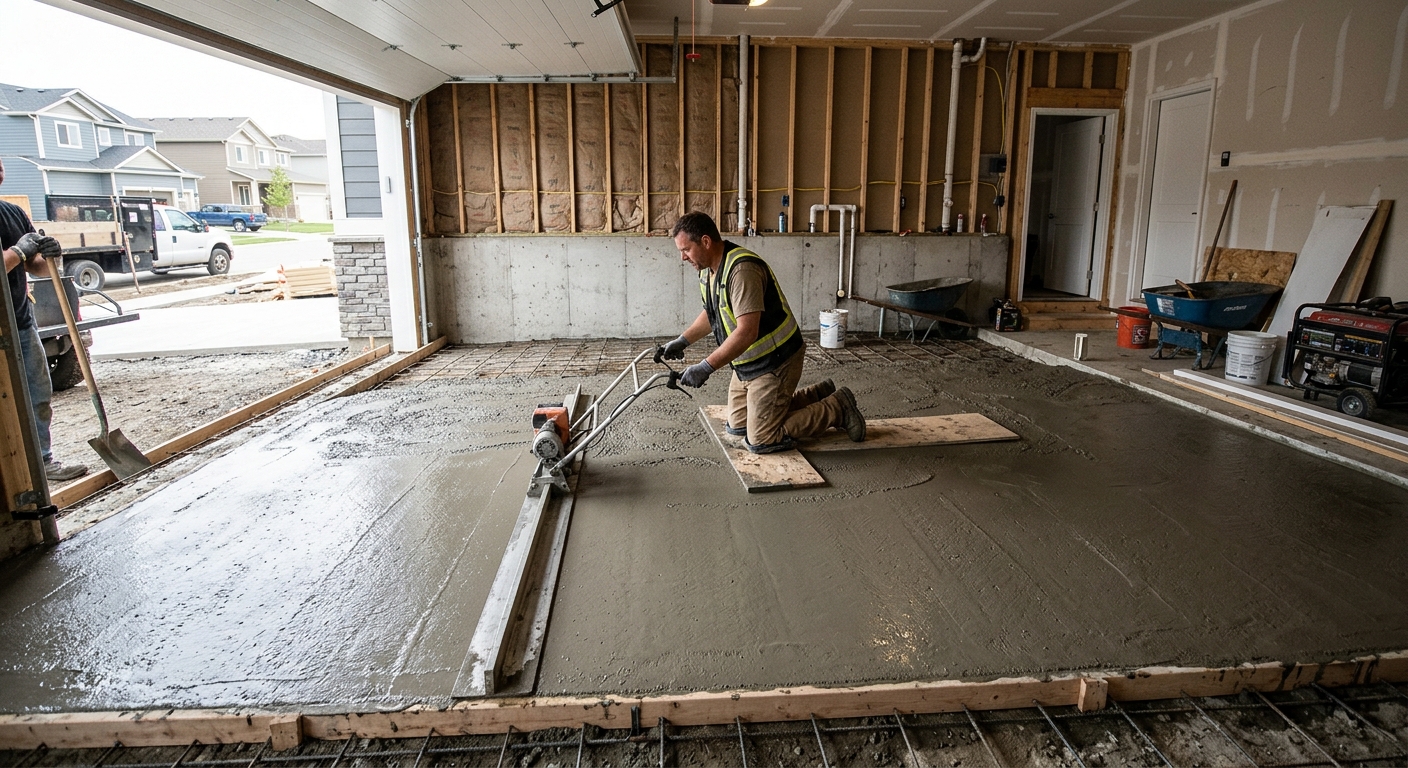
Concrete work options and costs in Vauxhall
Vauxhall concrete projects—from driveways to patios—are shaped by both local housing patterns and southern Alberta’s freeze–thaw swings. With single-detached houses making up 80.5% of dwellings, most concrete flatwork demand comes from homeowners maintaining and upgrading their exterior surfaces. In 2021, there were 335 homeowner households, representing 76.1% of households, which lines up with why driveways, walkways, and backyard slabs are the most frequent work orders.
In the Lethbridge–Medicine Hat economic region, costs don’t just depend on finish choice; they’re heavily influenced by a deep frost line and aggressive freeze–thaw cycles. For structural work, footings need to go below frost (often in the 5–6 ft range), which drives excavation, forming, and concrete volume. Exterior slabs also require air-entrained mixes and tight control joint layout to reduce surface cracking and freeze-related damage. The shorter pour season means many projects are clustered into warmer windows, and shoulder-season pours may require blankets or heaters so concrete can reach strength before backfill or traffic.
In Vauxhall, trade demand is especially noticeable in established residential pockets near the downtown and along Main Street corridors, where homeowners commonly replace older, cracked driveways and add steps or patios. If you’re comparing options, the right move is to look at finish and specification together—standard broom-finished concrete is typically the most budget-friendly, while stamped or exposed aggregate usually adds both material and labour.
Below is a practical comparison to help you benchmark contractor quotes.
| Application |
Typical Size |
Key Spec |
Finish Option |
Price Range |
| Concrete driveway (standard broom finish) |
18 ft x 10 ft (180 sq. ft.) |
4 in. slab, air-entrained, control joints |
Broom finish |
$2,520 – $3,960 |
| Exposed aggregate driveway |
18 ft x 10 ft (180 sq. ft.) |
4 in. slab, air-entrained, wash/expose process |
Exposed aggregate |
$3,240 – $4,860 |
| Stamped concrete driveway or patio |
12 ft x 12 ft (144 sq. ft.) |
4 in. slab, integral colour, air-entrained |
Stamped pattern |
$3,100 – $4,600 |
| Plain concrete patio or walkway |
10 ft x 12 ft (120 sq. ft.) |
4 in. slab, air-entrained, proper slope/drainage |
Light broom or smooth trowel (limited) |
$1,440 – $2,400 |
| Garage floor (interior slab) |
20 ft x 22 ft (440 sq. ft.) |
4 in. slab, fibre or mesh as specified |
Broom finish |
$6,160 – $8,800 |
| Foundation footings (structural, below frost) |
Per linear ft equivalent |
Designed section below frost, rebar per plan |
Structural pour (no decorative finish) |
$3,600 – $7,350 |
Prices are estimates only and vary by project scope, site access and material selection.
What affects the price of concrete work in Vauxhall
In the Lethbridge–Medicine Hat region, it’s normal to see the “same” concrete job come in 30–50% apart once contractors factor in frost depth, base prep, and mix/design requirements for Alberta’s freeze–thaw cycle. Driveway quotes can look close on paper, but the differences hide in excavation depth, compaction quality, reinforcement, and whether the slab is truly air-entrained and built to handle de-icing salts. When one crew plans for a deep frost profile and another assumes a shallow build-up, the gap shows up in both the materials and the time on site.
Frost line depth is a primary driver: structural footings must extend below the design frost depth to prevent frost heave, which is why excavation and forming costs climb in southern Alberta. Exterior slabs also rely on air-entrained concrete mixes to relieve internal pressure as water freezes and thaws. Cold-weather conditions reduce the practical pour season, so shoulder-season work may require blankets, heaters, or accelerators—budget impacts can shift an exterior slab toward the higher end of the $14,000–$22,000 driveway-type range (depending on exact project size and base requirements). And because de-icing salt can accelerate surface spalling, sealing (and doing it at the right time) becomes an important “small cost” that protects the bigger spend.
Locally, an older home stock is a factor too: with 67.0% of homes built before 1981, you’ll often see legacy drainage issues, settlement in walkways, or compacted fill that needs rework. As a concrete example, upgrading from plain broom-finished concrete to stamped can jump into the decorative band (often $20,000–$32,000 depending on area and complexity), but that price can be justified when you want pattern/colour to replace a full tear-out in the most visible front approach.
| Price Factor |
Why It Matters |
Cost Impact |
| Frost line depth — determines footing depth and form height |
Deeper frost requires more excavation and concrete volume |
Major swing upward, especially for foundations |
| Site preparation — excavation, grading, compacted granular base |
Good base controls settlement and cracking |
Medium to major; poor prep is cheaper short-term |
| Reinforcement — rebar or wire mesh requirement |
Controls shrinkage and structural cracking |
Medium; tied-in rebar increases labour time |
| Mix design — air-entrainment and compressive strength spec |
Air entrainment helps survive freeze–thaw and reduces spalling |
Medium; sometimes the difference is worth it |
| Finish type — broom vs. stamped vs. exposed aggregate |
Labour time and materials for decorative processes |
Medium to major; décor raises cost fastest |
| Pour size and concrete truck access to site |
Large pours and tight access affect crew time and equipment |
Medium; access can add forming/placement cost |
| Cold-weather curing precautions — heating and blankets |
Concrete needs time to reach strength before freeze periods |
Low to major depending on month and temperature |
| Control joint pattern and sealing cost |
Joints manage cracking; sealing improves salt resistance |
Low to medium; skipping can shorten lifespan |
Permits & regulations in Alberta
In Alberta, you typically need a building permit for structural concrete work like foundation footings, foundation walls, and grade beams—projects that affect a house’s structure or load path. For these, engineered drawings are often required and reviewed as part of the municipal building process. Concrete flatwork (driveways, patios, and walkways) usually does not require a permit, unless it changes lot grading, impacts impervious surface coverage limits, alters drainage patterns, or ties into a municipal right-of-way concern. Because rules can vary by circumstance (not just by city), confirm with the local authority before anyone breaks ground.
Before you hire a contractor in Vauxhall, verify three things: liability insurance, workers’ coverage, and whether the contractor can legally perform the work. Many homeowners ask for proof of liability coverage and WSIB/WCB-type coverage documentation; in Alberta this is commonly WCB (Workplace Health and Safety/coverage depending on the employer’s registration). You should also request references from similar-scale jobs—ideally projects with freeze-thaw exposed slabs and below-frost footings.
Step-by-step for verification: (1) Ask the contractor for their certificate of insurance and confirm it lists your project address or at least the class of work; (2) Request their WCB clearance letter or proof of coverage; (3) Check Alberta licensing/registrations through the appropriate provincial or industry registry online (the contractor should be able to provide the exact licence/class number); (4) Confirm they pull any required permits or that you understand which permits are homeowner-responsibility.
Getting concrete right in Vauxhall's freeze-thaw climate
Concrete failure in Vauxhall is usually a freeze–thaw story: water finds its way into the slab or sub-base, then expands as temperatures drop, leading to heaving, cracking, and—worst-case—surface spalling. To spec the job correctly, focus on five items that directly match southern Alberta conditions. First, base preparation: use a properly compacted granular sub-base at the required thickness for your soil and frost conditions, with correct grading and drainage so water doesn’t sit under the slab. Second, mix design: exterior slabs should use air-entrained concrete (commonly 5–7% air content for typical exterior flatwork) and meet a minimum compressive strength of 32 MPa so it can perform through weather cycles. Third, control joints: joint spacing must be planned to limit random cracking while allowing the slab to “move” safely. Fourth, curing: even if it looks hard the next day, concrete needs time to develop strength—minimum 7-day curing under suitable conditions, with blankets or heaters if temperatures drop. Fifth, sealing: apply a penetrating sealer after the slab has cured (often at 28 days) to help repel de-icing salts.
When you’re interviewing contractors, ask technical questions up front—especially about air-entrainment and the planned joint pattern. If a contractor can’t clearly explain the mix spec and how they’ll control cracking, that’s how you end up paying for premature repairs. For dollar context, spending more for proper air-entrainment and a well-prepped base can be cheaper than decorative upgrades: a plain broom-finished driveway often sits around the region’s $14–$22 per sq. ft. band, while stamped options can rise into the $20–$32 per sq. ft. band. If the base/mix are wrong, the decorative finish won’t protect you from spalling.
| Spec |
Why It Matters in Vauxhall |
What to Ask For |
Impact if Skipped |
| Compacted granular base (depth?) |
Proper thickness and compaction reduce settlement and frost-related movement |
Granular type, target compacted depth, and compaction method/testing |
Cracking, uneven surfaces, pumping at joints |
| Air-entrained concrete mix (target air %?) |
Air bubbles provide pressure relief during freeze–thaw |
Confirm air content target (commonly 5–7% for exterior flatwork) |
Higher risk of spalling and surface scaling |
| Compressive strength (MPa rating) |
Strength development affects durability under traffic and freeze cycles |
Minimum 32 MPa spec and how strength is verified |
Soft surface, rutting, faster degradation |
| Control joints (spacing per ACI guidelines) |
Joints manage where cracks occur during shrinkage and movement |
Proposed joint spacing and sealing plan |
Random cracking across the slab |
| Minimum 7-day curing period |
Cold temps slow strength gain, increasing vulnerability |
Temperature plan, curing duration, and protective measures if cold |
Reduced strength before freeze events and loading |
| Penetrating sealer (when applied after cure) |
Improves salt and moisture resistance on exterior surfaces |
Sealer type and timing (commonly around 28 days post-pour) |
Faster spalling and water penetration |
How to choose a concrete work contractor in Vauxhall
Choosing the right concrete contractor in Vauxhall is mostly about verification and clarity. Start by confirming Alberta coverage and legal ability to work: ask for a copy of the certificate of liability insurance (ensure it’s current and the policy isn’t expired), then request proof of workers’ coverage (WCB-style coverage documentation or a clearance letter). Don’t accept verbal assurances—review the paperwork. If the contractor claims a permit is needed, ask them how they handle it and who pulls it.
Next, get 2–3 itemised written quotes, not just one lump sum. Ideally, each quote breaks down labour versus materials, shows what’s included in excavation and granular base prep, and states whether reinforcement (rebar/mesh) is included or excluded. Confirm disposal is included (spoils haul-away), and whether the quote includes sawcut control joints and sealing. If you’re doing a decorative finish like stamped or exposed aggregate, ask for the specific process and colour system—these aren’t all interchangeable.
Warranty matters too: request the workmanship warranty length in writing, and ask whether any product/manufacturer warranty is included (and whether it’s transferable to you). For payment schedule, a solid rule is to avoid paying more than 10–15% upfront; then hold back a reasonable amount until the finishing work, joint sealing (if included), and cleanup are complete. Finally, get the start date and an estimated completion timeline in writing, especially because freeze–thaw cycles can force schedule shifts in Alberta when temps swing.
- Verify liability insurance certificate is current and matches the class of work.
- Confirm workers’ coverage (WCB) with a clearance letter or proof of account.
- Request references for similar exterior slabs (driveways/patios) in Alberta weather.
- Ask for mix details: air-entrainment and target strength (e.g., 32 MPa).
- Require an itemised quote: excavation, granular base, concrete, finishing, and joints.
- Confirm reinforcement scope: rebar or mesh—what’s included and spacing.
- Check whether sawcut control joints are included and the proposed joint pattern.
- Clarify slope/drainage design (especially near doors and garages).
- Ask if sealing is included and when it will be applied after cure (often ~28 days).
- Confirm disposal/haul-away of excavated material is included.
- Review warranty terms: workmanship only vs product coverage, duration, and transferability.
- Use a payment schedule with a holdback until final inspection/cleanup.
Red flags in Vauxhall include contractors who: (1) won’t clearly state air-entrainment and joint spacing; (2) pressure you to pay the bulk upfront; (3) promise “one-day cure” without cold-weather precautions; (4) provide only a lump sum with vague scope (no base depth or reinforcement details); or (5) skip sealing when de-icing salt exposure is expected on exterior slabs.
Frequently asked questions — concrete work in Vauxhall
How do I compare concrete quotes?
To compare concrete quotes in Vauxhall, start by matching scope line-by-line: excavation depth, granular base depth, reinforcement (if included), slab thickness, control joint layout, and whether the mix is air-entrained for exterior durability in Alberta’s freeze–thaw climate. A cheaper quote often saves money by thinning the base, reducing reinforcement, or using a “standard” mix without adequate air content—then you pay later for cracking and spalling. Ask for an itemised breakdown of labour and materials, not only a total. Also compare finish work: stamped or exposed aggregate typically costs more than plain broom-finished concrete, and the labour/time difference shows up quickly. As a benchmark, many standard driveway projects land around the region’s $14–$22 per sq. ft. band, while decorative work can move toward the $20–$32 per sq. ft. range. Finally, confirm curing and sealing expectations—especially sealing timing (commonly after full cure) for exterior slabs.
Can concrete be poured in cold weather in Vauxhall?
Yes, concrete can be poured in cold weather in Vauxhall, but only if the contractor plans for temperature control and strength gain. Alberta winters slow cement hydration, and if concrete freezes too early it may never reach intended durability. A competent contractor will use cold-weather curing precautions such as insulating blankets, heating the work area (where feasible), windbreaks, and sometimes accelerators depending on the mix design and temperature range. The key is that curing time and protection are part of the spec—not an afterthought. You should ask how they’ll maintain concrete temperature during the first critical hours and how they’ll ensure 7-day curing conditions (or longer, as required) before loading/backfilling. If a quote doesn’t mention cold-weather procedures, treat it as incomplete—especially for exterior slabs exposed to freeze–thaw and de-icing salt, where inadequate curing contributes to early surface scaling and cracking.
How do I maintain concrete in Vauxhall's freeze-thaw climate?
Maintaining concrete in Vauxhall is about moisture and salt management. First, use a penetrating sealer once the slab has fully cured (often around 28 days after pour). Sealing helps reduce water and brine penetration from de-icing, which helps protect against freeze-related spalling. Second, keep an eye on drainage: if water sits near your driveway edge or flows toward the slab, the sub-base can degrade and joints can fail. Third, clean regularly and avoid overusing harsh de-icing chemicals—use the least corrosive option available and don’t let thick ice-removal residue build up. Fourth, inspect control joints: if joints are sealed (where included), monitor whether sealant stays intact and keep weeds out so debris doesn’t hold water. Finally, address small surface cracks early—early patching is typically far cheaper than full-area repairs. Proper maintenance pairs best with the right original build spec: air-entrained mix, proper base prep, and correct jointing.
What causes concrete to spall in Vauxhall winters?
Spalling in Vauxhall winters is most commonly caused by freeze–thaw action combined with moisture getting into the concrete surface and inadequate air-entrainment or curing. When water enters micro-pores and freezes, it expands; without enough properly entrained air bubbles to relieve internal pressure, the surface can flake or chip. De-icing salt accelerates the process by increasing moisture movement and chemical exposure. Another cause is poor base drainage—if water pools under or at the slab edge, freeze–thaw cycles are harsher than they should be. Control joint issues can also contribute, because random cracking creates pathways for water entry. If your driveway was poured without a specification for exterior air content, or if cold-weather curing precautions weren’t used, spalling risk rises sharply in Alberta. When you’re planning new work, insist on an air-entrained mix and correct joint pattern, and budget for sealing (often around 28 days post-pour) to help resist salt and moisture.
What is rebar and when is it required in Alberta?
Rebar (reinforcing steel) is steel bars placed inside concrete to help control cracking and improve structural capacity. In Alberta, rebar requirements depend on the type of concrete work and the engineering/design loads. For foundation footings and foundation walls, reinforcement is typically required and determined by engineered drawings—because those elements carry structural loads and must resist soil and frost-related movement. For plain exterior flatwork like patios and driveways, reinforcement may be required based on slab thickness, soil conditions, intended loads (like vehicles), and contractor/design standards—sometimes wire mesh or fibre reinforcement is used instead of full rebar grids. Since your climate includes deep frost exposure and freeze–thaw cycles, reinforcement often helps manage shrinkage and movement where the slab is most stressed. When comparing quotes in Vauxhall, ask whether the contractor uses rebar or mesh, where it sits within the slab (coverage), and whether they’re following the intended spec. If the contractor won’t specify reinforcement placement and rationale, ask for an explanation tied to your slab design.
How long does a concrete project take in Vauxhall?
Project duration in Vauxhall depends on size, site access, and whether the pour is interior or exterior. A small patio or walkway typically takes about a day for excavation/base prep and a pour, then additional time for finishing and early curing. Driveways are often completed faster than decorative work because stamped/exposed aggregate requires extra staging, finishing steps, and careful timing. Foundation footings and below-frost structural work take longer due to excavation, forming, inspections (when required), and reinforcement placement before concrete is poured. Weather also affects scheduling: Alberta’s freeze–thaw cycles can interrupt work if temperatures drop unexpectedly, and cold-weather curing measures (blankets/heaters) can extend the schedule. Also remember curing time: even when surfaces are ready to walk on sooner, concrete should cure properly before backfilling or heavier loading. If you’re comparing timelines, ask when they expect to pour, when they can remove forms (if applicable), and when the slab will be safe for traffic—don’t rely on “it’s hard tomorrow” estimates. For context, typical exterior slab options priced around the $14–$22 per sq. ft. band often move faster than stamped jobs within the $20–$32 per sq. ft. band due to fewer finish steps.