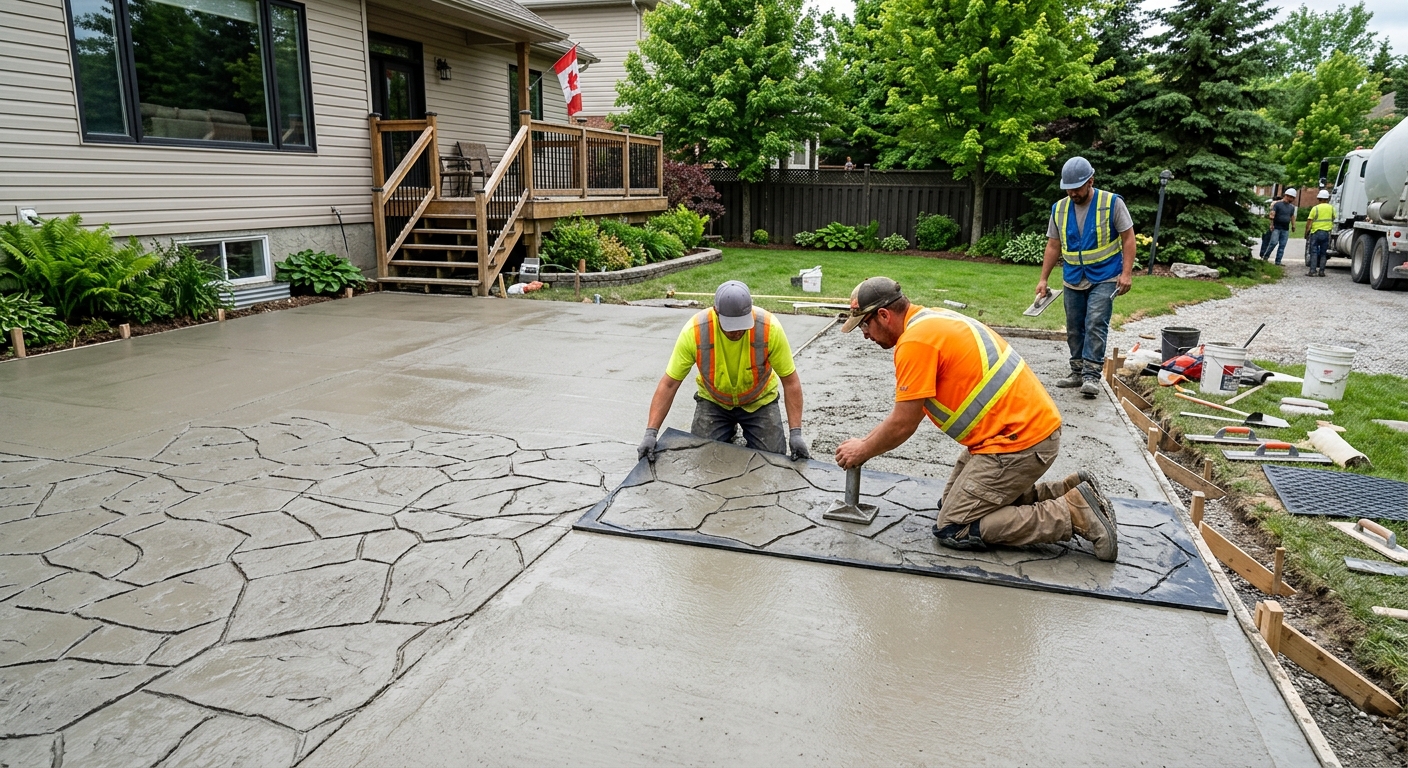
Concrete work options and costs in Hawkwood
Hawkwood, Alberta is a strong market for concrete flatwork, from driveways to patios, because homeowners here want durable surfaces that handle long winters and frequent freeze–thaw cycles. In the 2021 Census, Calgary’s broader housing landscape shows a large presence of single-detached homes—these are the most common settings for driveway replacements and backyard walkways—(Statistics Canada, 2021 Census). With Hawkwood’s own population at 9,115, the local demand is steady and contractors tend to be busiest around the late-spring to early-fall window (Statistics Canada, 2021 Census). In this cold continental climate, concrete pricing reflects more than just the slab: footings typically must be designed around a deep frost depth of about 1.2 m (roughly 4 ft), and exterior work needs air-entrained mixes plus careful curing plans.
Because the frost line is deeper and excavation is more intensive, foundation-related concrete costs run higher than in milder regions. For exterior slabs (driveways, patios, and walkways), freeze–thaw conditions also push pricing toward proper granular base prep, winter-grade placement practices when temperatures drop, and control joints that reduce random cracking. In practical terms, contractors who can mobilize quickly and manage curing correctly often price with more realistic labour schedules—especially near high-demand areas like the newer infill pockets around the Hawkwood/Kingsland transition where many projects involve regrading and enhanced drainage.
Below are common applications and realistic price ranges you’ll see for Hawkwood projects, aligned with Calgary’s market and winter-engineered specs.
| Application |
Typical Size |
Key Spec |
Finish Option |
Price Range |
| Concrete driveway (standard broom finish) |
24 ft x 10 ft (240 sq ft) |
Air-entrained concrete, proper compacted base |
Broom finish with control joints |
$12,000 – $18,000 |
| Exposed aggregate driveway |
24 ft x 10 ft (240 sq ft) |
Retarder/exposure plan, air-entrained mix |
Exposed aggregate (light/medium texture) |
$14,000 – $20,000 |
| Stamped concrete driveway or patio |
20 ft x 12 ft (240 sq ft) |
Colour hardener, air-entrained mix |
Stamp pattern + integral colour |
$15,000 – $26,000 |
| Plain concrete patio or walkway |
12 ft x 16 ft (192 sq ft) |
Air-entrained concrete, compacted base |
Float + broom edge (or light trowel) |
$5,000 – $9,000 |
| Garage floor (interior slab) |
20 ft x 22 ft (440 sq ft) |
Vapour barrier, proper reinforcement as needed |
Broom finish (interior) |
$8,500 – $14,000 |
| Foundation footings (structural, below frost) |
Detached garage/house footing set |
Engineered footing depth below ~1.2 m frost line |
Reinforced structural concrete |
$28,000 – $45,000 |
Prices are estimates only and vary by project scope, site access and material selection.
What affects the price of concrete work in Hawkwood
In Hawkwood and the Calgary region, you can see quotes for the “same” concrete job swing by 30–50% because the price is driven by how contractors engineer for frost, drainage, and curing—not just how much concrete they pour. In Alberta, design frost depth (about 1.2 m, roughly 4 ft for this region’s practice) means excavation and footing volumes can get expensive quickly. For exterior slabs, Calgary’s freeze–thaw cycles also require air-entrained concrete and a granular base that won’t pump or shift when water expands and contracts. That’s why one contractor might include better base depth and jointing, while another focuses on the pour-day material count.
Cold-weather constraints matter too: the exterior pour season is shorter, and late fall/early spring placements often need winter-grade mixes, insulated blankets, and sometimes temporary heat. Those curing precautions protect strength gain and reduce the risk of surface scaling and long-term spalling. On top of that, de-icing salt use in Calgary can accelerate surface deterioration when the mix and sealing plan aren’t matched.
Here are a few local examples of how costs rise or fall in Hawkwood. If your driveway ties into an older, settled approach, you may need extra excavation and regrading—pushing a standard driveway closer to the higher end of the $12,000–$18,000 band. If you add stamped finishes, the labour and material steps increase, typically moving you toward $15,000–$26,000. Conversely, a simple plain patio with good access and minimal demolition can stay nearer the $5,000–$9,000 range because base prep is straightforward and finishing is less labour-intensive. Housing age also plays a role: many older lots have drainage patterns that direct meltwater to edges, which increases the importance (and cost) of proper base thickness and edge detailing—sometimes by thousands of dollars when drainage corrections are required.
| Price Factor |
Why It Matters |
Cost Impact |
| Frost line depth — determines footing depth and form height |
Footings must bear below frost heave risk (about 1.2 m practice in this region) |
Higher excavation/formwork can add thousands to foundation/footing scope |
| Site preparation — excavation, grading, compacted granular base |
Proper base reduces settlement and pumping during freeze–thaw |
Loose soils or regrading can swing price significantly (often the biggest variable) |
| Reinforcement — rebar or wire mesh requirement |
Controls cracking and supports loads on slabs and footings |
Adding reinforcement and chairs/dowels increases labour and materials |
| Mix design — air-entrainment and compressive strength spec |
Air-entrainment improves freeze–thaw durability for exterior work |
Cold-climate mix specs can raise per-yard costs, especially in winter |
| Finish type — broom vs. stamped vs. exposed aggregate |
More steps and specialized finishing systems affect labour time |
Stamped/exposed can add material and labour, moving closer to higher price bands |
| Pour size and concrete truck access to site |
Long carries, tight turns, or crane placement can limit productivity |
Access issues can add crew time and extra charges |
| Cold-weather curing precautions — heating and blankets |
Strength gain needs stable temps to avoid scaling and durability issues |
Winter-grade protection can add several hundred to over a few thousand |
| Control joint pattern and sealing cost |
Joints and sealing manage crack control and water/de-icer ingress |
Proper jointing/layout + sealer typically costs more upfront but reduces callbacks |
Permits & regulations in Alberta
In Alberta, structural concrete work typically requires a building permit and, in many cases, engineered drawings reviewed through the municipal process. This includes work like foundation footings, foundation walls, grade beams, and other structural elements designed to carry loads and resist frost-related movement. For Hawkwood homeowners, that usually means your permit package is handled through the home’s overall building permit workflow.
Concrete flatwork—driveways, patios, sidewalks, and walkway slabs—usually does not require a permit unless the project affects lot grading, changes drainage patterns, impacts impervious surface coverage limits, or touches municipal right-of-way conditions (for example, work close to boulevards/sidewalks). Even when a permit isn’t required for the slab itself, you still need to confirm requirements locally before breaking ground.
Before you sign a contract in Hawkwood, verify three things step-by-step. First, check the contractor’s Alberta business registration and any trade-related credentials they claim (ask for the exact licence/registration number and proof). Second, ask for a current certificate of liability insurance—make sure it’s valid for the job address and includes concrete/flatwork. Third, confirm WSIB/WCB coverage (provide a clearance letter or current account status evidence). Then request references on similar-scale pours (for example, a 240 sq ft driveway or a comparable footing set) so you’re matching experience to the same kind of frost and drainage detailing.
Getting concrete right in Hawkwood's freeze-thaw climate
Concrete fails in Hawkwood mainly when the slab assembly can’t handle water and expansion during freeze–thaw cycles. The most common result is spalling: surface flaking and edge deterioration caused by freeze damage, often linked to inadequate air-entrainment, poor base drainage, or rushed curing. To spec the job correctly in this Calgary-area market, focus on the full system, not just the concrete price.
(1) Base preparation: start with excavation to the required depth, then place and compact a properly graded granular sub-base so the slab doesn’t settle or pump. (2) Mix design: specify air-entrainment for exterior flatwork. In cold-weather Alberta, a target of about 5–7% air content is typical for durable freeze–thaw performance, along with a minimum 32 MPa compressive strength. (3) Control joints: install joints with a spacing plan that limits random cracking and routes cracking to predictable lines. (4) Curing: aim for at least 7 days of proper curing conditions; in cold weather this may mean insulated blankets and/or temporary heat to protect strength gain. (5) Sealing: apply a penetrating sealer after the slab is fully cured (commonly 28 days) to help repel de-icing salts at the surface.
If you’re comparing options, this is where cost can be justified. For example, upgrading from a basic broom-finish driveway plan to a properly engineered air-entrained mix with deeper base and correct jointing can move a standard driveway toward the higher end of the $12,000–$18,000 band—but that’s often cheaper than replacing a failing slab early. By contrast, adding stamped colour without correcting base/grout/curing details doesn’t protect the concrete. Ask questions specifically about air content, base thickness, curing method, and joint layout to avoid the most expensive mistake: spalling from inadequate air-entrainment.
| Spec |
Why It Matters in Hawkwood |
What to Ask For |
Impact if Skipped |
| Compacted granular base (depth?) |
Prevents pumping/settlement under repeated freeze–thaw |
Depth and gradation plan, compaction method, and sub-base prep |
Cracking, uneven settlement, and faster edge failure |
| Air-entrained concrete mix (target air %?) |
Improves freeze–thaw durability for exterior slabs in Calgary winters |
Target air content (commonly 5–7% for exterior flatwork) |
High risk of spalling/scaling within a few winters |
| Compressive strength (MPa rating) |
Ensures strength gain for durability in cold conditions |
Minimum 32 MPa (and confirmation of mix/strength spec) |
Surface wear, reduced durability, possible structural performance issues |
| Control joints (spacing per ACI guidelines) |
Limits random cracking caused by shrinkage and thermal movement |
Joint layout, spacing, and edging details |
Uncontrolled cracking and water infiltration along cracks |
| Minimum 7-day curing period |
Strength development and surface integrity are time- and temperature-dependent |
How they protect curing in cold weather (blankets/heat if needed) |
Scaling, early weakness, and higher long-term repair risk |
| Penetrating sealer (when applied after cure) |
Repels de-icing salt and reduces surface deterioration |
Sealer type and timing (commonly after 28 days cure) |
More rapid surface breakdown around edges and joints |
How to choose a concrete work contractor in Hawkwood
Choosing the right contractor in Hawkwood is mostly about verifying proof and matching the quote to the frost-and-drainage reality of the site. In Alberta, confirm licensing/registration (ask for the exact number tied to the company you’re hiring), and don’t rely on “we’re insured” without documentation. Get a current certificate of liability insurance and verify it covers the work at your address. Then request proof of WSIB/WCB clearance or current coverage status—ask them to provide the clearance letter or documentation your file can reference. If they can’t provide it promptly, that’s a red flag.
Next, get 2–3 itemised written quotes rather than one lump sum. You want a breakdown that shows labour, demo/removal, excavation and granular base, reinforcement, formwork, concrete supply, finishing, and any protection/curing measures. Confirm what’s included and what’s excluded: permit pull (if applicable), disposal and hauling, traffic control, and snow/ice protection prior to the pour. A good contractor will also include a workmanship warranty length in writing, and will clarify whether product/manufacturer warranty is separate and transferable to you.
For payment, avoid large up-front deposits. A common homeowner-safe approach is no more than 10–15% upfront for mobilization, with a holdback until completion and any walk-through corrections. Finally, get the schedule in writing: start date, pour date (if weather dependent), and an estimated completion window. In Calgary-area freeze–thaw conditions, timelines need to include curing protection, not just “we’ll pour and you’ll be done.”
- Provide Alberta licence/registration details in writing before you sign
- Confirm liability insurance certificate is valid for your project address
- Request WSIB/WCB coverage proof (clearance letter or current status)
- Ask for 2–3 itemised quotes with line-by-line scope and quantities
- Verify concrete mix specs (air-entrainment) and minimum strength (e.g., 32 MPa)
- Confirm base prep includes excavation depth, granular material, and compaction method
- Check reinforcement plan: rebar/wire mesh, chairs/dowels, and where it’s required
- Review finishing details: broom vs stamped vs exposed aggregate and sealing plan
- Confirm control joint layout and spacing rather than “we’ll do joints”
- Ask how cold-weather curing will be handled (blankets/heat) if temps drop
- Understand inclusions/exclusions: disposal, regrading, drainage corrections, and permits
- Keep warranty terms in writing and ask what triggers coverage/voiding
Red flags to watch in Hawkwood: vague mix wording (“standard concrete” with no air-entrainment spec), missing documentation for WSIB/WCB or insurance, quotes that ignore base depth and compaction, refusal to put curing protection in the scope for cold or late-season pours, and schedules that don’t account for minimum curing time before expecting normal use.
Frequently asked questions — concrete work in Hawkwood
Can concrete be poured in cold weather in Hawkwood?
Yes, but it has to be planned. In Hawkwood and across the Calgary region, the freeze–thaw cycle and deep frost conditions mean winter-grade concrete and temperature protection are often required. A contractor should explain the curing approach before any pour: insulated blankets, wind protection, and sometimes temporary heat to keep the concrete within a safe temperature range during early strength gain. They also need to adjust the mix and timing so you still achieve proper strength development. If someone offers a “normal spring pour” approach in late fall or early spring without protection, that’s when surface scaling risk jumps. For context, cold-weather protection can be a meaningful part of the budget inside the typical $12,000–$18,000 driveway range, but it’s usually cheaper than replacing a failing slab.
How do I maintain concrete in Hawkwood's freeze-thaw climate?
Maintenance in Hawkwood is mostly about managing water and de-icers. Keep surface drainage clear so meltwater doesn’t pond near edges and joints—those are the first places that freeze damage shows up. Use de-icing salts carefully: rock salt can accelerate surface deterioration, especially if the concrete wasn’t designed and cured correctly. Apply a penetrating sealer after the slab cures (commonly 28 days post-pour) to help repel de-icing chemicals at the surface. Re-check joints after winter; if joint material fails, water can work into cracks and worsen spalling. For driveways and walkways, avoid heavy scraping with metal shovels, which can damage the surface and leave it vulnerable. If you’re planning a patio or walkway, a well-finished job that includes sealing is often easier to maintain within the $5,000–$9,000 range than a bare, unsealed slab.
What causes concrete to spall in Hawkwood winters?
Spalling is usually caused by freeze–thaw damage at the surface. The big culprit is inadequate air-entrainment (not enough air voids to relieve water expansion when temperatures drop). Other contributors include poor base drainage and pumping, insufficient curing time, or sealing not being done after the concrete fully cures. When water gets into the slab or along joints/cracks and then freezes, it expands and breaks down the concrete near the surface. In Hawkwood, where freeze–thaw cycles are frequent and winter conditions are harsh, these problems appear faster than in milder regions. That’s why quotes should include an exterior mix plan with target air content (often about 5–7% for exterior flatwork), proper granular base prep, and a curing plan. If you cheap out on mix design or curing, you may stay near the low end of the $12,000–$18,000 driveway band—but you can pay later through repairs or replacement.
What is rebar and when is it required in Alberta?
Rebar (reinforcing steel) is used to add tensile strength to concrete assemblies that would otherwise crack under movement and loading. In Alberta, rebar is typically required when engineering and design specify reinforcement for footings, foundation walls, grade beams, and sometimes for slabs-on-grade depending on thickness, loading, and soil conditions. For smaller flatwork like many residential patios and walkways, some designs may use wire mesh or specific slab thickness instead of full rebar—again, based on engineer/contractor design and local conditions. Frost depth and soil movement risk influence the reinforcement plan, especially if the slab is exposed to de-icing salts and repeated freeze–thaw. A good contractor should describe where reinforcement is placed, tie it to the slab thickness, and confirm dowels/chairs as needed. For foundation/footing scope, reinforcement is part of the structural package and commonly aligns with foundation pricing like the $28,000–$45,000 band.
How long does a concrete project take in Hawkwood?
Timing depends on the scope, access, weather, and curing requirements. For typical residential flatwork, the excavation and base preparation can take 1–3 days depending on demolition and regrading. The actual pour day is usually quick, but finishing and jointing are coordinated immediately after placement. The bigger scheduling factor is curing: you should plan for at least 7 days before treating the slab as fully stable for normal use, and longer protection where temperatures are cold. If cold-weather curing is required (blankets/heat), mobilization and protection setup can add days. For stamped or exposed aggregate work, finishing steps can also lengthen the schedule compared with a plain broom finish. For homeowners, a driveway project commonly fits into about 1–2 weeks including prep and curing protection. Always ask the contractor to provide a written start date, pour date expectation, and finish date with weather contingency—Hawkwood’s winter swing matters.
What is a concrete overlay and is it suited to Hawkwood?
A concrete overlay is essentially a new layer poured or placed over an existing concrete surface, usually after repair/prep. Overlays can work when the original slab is still sound—meaning minimal heaving/voids, manageable cracking, and decent bond potential after prep. In Hawkwood’s freeze–thaw climate, overlays can be less suitable if the existing slab has widespread spalling, significant settlement, or deep frost-related damage, because the new layer can fail along with the old base. A thorough condition assessment is crucial: contractors should evaluate surface delamination, crack widths, and drainage issues before recommending overlay versus full removal. Overlays can be a cost-saver in the right cases, but they shouldn’t be presented as a universal fix. For homeowners whose concrete is already deteriorated, budgeting for replacement typically lands within the standard driveway band (often $12,000–$18,000 depending on size and details) rather than assuming a cheaper overlay will last through Calgary winters.