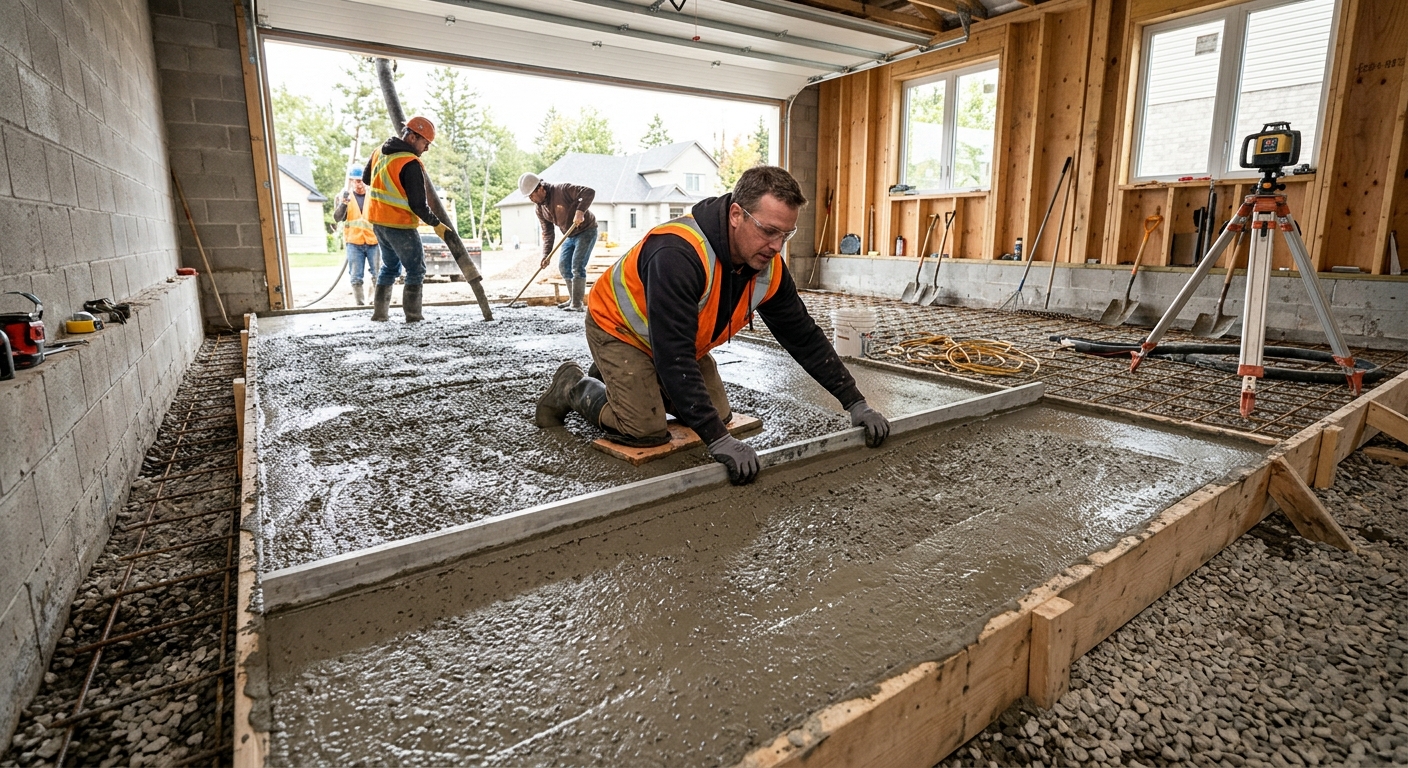
Concrete work options and costs in Meyonohk
Meyonohk sits in the Calgary economic region, and local homeowners typically rely on concrete for the same reasons—durability, low maintenance, and year-round usability. With a 2021 population of 2,923 people (Statistics Canada, 2021 Census), the market is smaller than Calgary proper, so you’ll often schedule work around the contractor availability of crews that also service nearby communities. The housing stock is strongly tuned to family life and properties that need practical flatwork; in this area, driveways, patios, and walkways are among the most frequent concrete upgrades. Concrete flatwork is especially in demand in established residential pockets of Meyonohk where lot sizes support side yards and rear patios, and where homeowners replace aging asphalt or uneven stone.
In Calgary’s cold continental climate, pricing is driven less by “average material cost” and more by frost and freeze–thaw engineering. Footings and structural pours are built around a design frost depth of about 1.2 m (roughly 4 ft), so excavation and formwork are more intensive than in milder provinces. Exterior slabs also need air-entrained mixes, granular base prep, and well-planned control joints to reduce cracking and spalling through repeated winter cycles. In addition, the practical exterior pour season is shorter, which can increase labour demand during the peak months and affect scheduling.
Below is a practical comparison of common Meyonohk concrete options and typical ranges you’ll see from responsible contractors, then we’ll break down what causes quote differences.
| Application |
Typical Size |
Key Spec |
Finish Option |
Price Range |
| Concrete driveway (standard broom finish) |
400–600 sq. ft. |
Air-entrained mix; granular base; control joints |
Broom finish, light wash |
$12,000–$18,000 |
| Exposed aggregate driveway |
400–600 sq. ft. |
Air-entrained mix; proper base and curing |
Exposed aggregate with clean-out finish |
$14,000–$20,500 |
| Stamped concrete driveway or patio |
300–500 sq. ft. |
Air-entrained mix; stamped colouring system |
Stamped patterns; release powder/texture |
$15,000–$26,000 |
| Plain concrete patio or walkway |
200–400 sq. ft. |
Air-entrained mix; compacted granular sub-base |
Light broom or trowel (non-slip for exterior) |
$5,000–$9,000 |
| Garage floor (interior slab) |
480–650 sq. ft. |
Vapour barrier; proper thickness and reinforcement plan |
Standard trowel with sealer (optional) |
$11,000–$17,500 |
| Foundation footings (structural, below frost) |
Perimeter length varies |
Excavation to design frost depth (~1.2 m); engineered rebar |
Structural concrete walls/footings system |
$28,000–$45,000 |
Prices are estimates only and vary by project scope, site access and material selection.
What affects the price of concrete work in Meyonohk
In Meyonohk and across the Calgary area, the same “concrete driveway” description can end up 30–50% apart between quotes. That’s usually because contractors are pricing different engineering assumptions: how deep they excavate, whether they’re including frost-protected granular base, how much reinforcement they’re placing, and what concrete mix spec they’re delivering for freeze–thaw durability. When you see a low number, it’s often tied to thinner base prep, fewer joints, or a finish scope that’s not equivalent. Conversely, higher quotes often include winter-ready placement planning (insulation blankets, heating strategy) and longer curing assurance that protects the slab from early surface scaling.
Frost line depth is the big cost driver. In Alberta’s climate, footings must extend below the design frost depth (up to about 2.4 m in Alberta depending on engineering and soil conditions) to prevent frost heave. On top of that, exterior slabs require air-entrained concrete mixes to survive freeze–thaw cycles; without proper air content, you’ll often see spalling and scaling over time. Cold placement also matters: as the practical pour season shortens, achieving correct curing becomes more expensive. Finally, de-icing salt accelerates surface deterioration—so sealing is a smart line item for driveways and walkways.
Here are a few real-world examples from Meyonohk projects: replacing a cracked asphalt pad usually costs more than homeowners expect when excavation reveals unsuitable subsoil and requires additional granular base; adding exposed aggregate or stamp systems can raise costs beyond a standard broom finish because of material and labour complexity; and a driveway with limited access for the concrete truck often adds hauling and shorter lift planning. If you’re comparing an exterior patio at $5,000–$9,000 versus a decorative stamped option at $15,000–$26,000, the difference is usually justified by the finish system, reinforcement attention, and the time required to form and texture properly before the mix begins to set.
| Price Factor |
Why It Matters |
Cost Impact |
| Frost line depth |
Determines footing depth and form height |
Major increase when excavation must reach deeper undisturbed soil |
| Site preparation |
Excavation, grading, compacted granular base |
Higher for poor drainage, soft spots, or limited compaction access |
| Reinforcement |
Rebar or wire mesh requirement |
Can add cost, but reduces cracking risk on driveways and slabs |
| Mix design |
Air-entrainment and compressive strength spec |
Essential for freeze–thaw durability; skipping spec lowers price but increases failure risk |
| Finish type |
Broom vs. stamped vs. exposed aggregate |
Decorative finishes add materials, labour time, and curing discipline |
| Pour size and concrete truck access to site |
Placement efficiency, pump needs, and labour planning |
Small access issues can add significant labour and equipment charges |
| Cold-weather curing precautions |
Heating and blankets |
Can raise costs during shoulder seasons but protects long-term performance |
| Control joint pattern and sealing cost |
Limits random cracking and protects against salt scaling |
Jointing is usually modest cost; sealing adds a clear line item but extends service life |
Permits & regulations in Alberta
In Alberta, structural concrete work generally falls under the building permit and engineering review process. That typically includes footings, foundation walls, grade beams, and other structural foundation elements that support a house. Municipal involvement can apply where excavation and foundation depth tie into engineered drawings, soil conditions, and compliance with local requirements. For concrete flatwork like patios, walkways, and driveways, permits are often not required on their own, unless the work affects lot grading, impervious surface coverage limits, drainage patterns, or the municipal right-of-way.
For Meyonohk homeowners, the safest approach is to treat “structural vs. non-structural” as the first check. Concrete flatwork that changes drainage, ties into a swale, or alters how water sheds off your property may require additional municipal coordination. Likewise, if you’re pouring near an existing foundation or doing any work that changes support conditions, ask your contractor whether a permit is needed before breaking ground.
Step-by-step contractor verification in Alberta:
- Request the contractor’s certificate of insurance (liability) and confirm the coverage is active and aligned to the job scope.
- Ask for proof of WCB coverage (or WSIB/WCB equivalent coverage documentation per their province of registration) and keep it in your project file.
- Ask for their business details and supporting documentation (trade registration where applicable) and verify they have the capacity to take on structural or flatwork scopes.
- Request references on similar-scale projects in the Calgary area, including freeze–thaw exterior slabs.
- Confirm in writing what permits (if any) are included: permit pull responsibility, plan requirements, and lead times.
If you want one practical rule: if any portion of the plan touches structural foundation elements, assume permits and engineered review are part of the process until proven otherwise.
Getting concrete right in Meyonohk's freeze-thaw climate
Concrete fails in Meyonohk’s winters when it can’t handle water movement and freezing temperatures. The most common issues I see start with base prep that isn’t compacted to the right depth for local soil and frost conditions, followed by a mix that doesn’t have adequate air-entrainment. When the slab cycles through freeze–thaw, water gets trapped at the surface and within paste. Over time you can get scaling and spalling—especially on driveways where de-icing salt is used.
To spec the job correctly in Calgary’s cold continental environment, start with the base: a compacted granular sub-base to the required depth so the slab doesn’t settle or frost heave. Second, specify air-entrained concrete with target air content appropriate for exterior flatwork (commonly in the 5–7% air range) and a minimum compressive strength rating of 32 MPa for the structural performance you expect. Third, plan control joints so cracks form where you want them—typically at designed spacing—rather than randomly. Fourth, curing: aim for at least 7 days under proper conditions, and if you’re pouring near cold temperatures, require winter protection such as insulated blankets and, when necessary, temporary heat to ensure hydration continues. Finally, sealing: add penetrating sealer after the cure (commonly around 28 days) to improve resistance to salt and moisture intrusion.
To avoid the costly “it looked fine at first” problem, ask specifically how they’ll prevent spalling through correct air-entrainment and curing. As a dollar example: a standard broom-finish driveway might land in the $12,000–$18,000 range, while an exposed aggregate option can run higher because of additional finishing steps and careful curing discipline. That extra investment is often justified when the contractor uses the same quality base and mix spec, not when they only upgrade the surface appearance.
| Spec |
Why It Matters in Meyonohk |
What to Ask For |
Impact if Skipped |
| Compacted granular base (depth?) |
Reduces pumping and frost-related movement |
Documented excavation depth and compacted granular lift method |
Settlement, cracking, and faster deterioration |
| Air-entrained concrete mix (target air %?) |
Helps concrete resist freeze–thaw damage |
Specified air content (commonly 5–7% for exterior flatwork) |
Surface scaling and spalling in winter cycles |
| Compressive strength (MPa rating) |
Supports long-term structural performance |
Minimum 32 MPa (or engineered spec for your foundation/structure) |
Higher risk of cracking, surface wear, and early failure |
| Control joints (spacing per ACI guidelines) |
Controls where cracks occur |
Planned joint layout and spacing for your slab size |
Random cracking and water infiltration |
| Minimum 7-day curing period |
Ensures proper hydration before exposure |
How they protect the slab in cold weather (blankets/heating if needed) |
Weakened surface, scaling, and reduced durability |
| Penetrating sealer (when applied after cure) |
Repels moisture and limits salt-driven breakdown |
Apply penetrating sealer after cure (commonly around 28 days) |
More salt damage and higher maintenance sooner |
How to choose a concrete work contractor in Meyonohk
Start with Alberta contractor verification. Ask for their liability insurance certificate and confirm it covers concrete work on projects in your area. Next, request proof of WCB coverage documentation so you know the crew is properly covered on site. For licensing, concrete contractors may be registered under different trade categories depending on the scope—so ask what specific permits and registrations they hold for the work you’re hiring them to do (especially for any structural foundation scope). Finally, don’t skip references: request 2–3 comparable projects they’ve completed in the Calgary region and ask what mix and base specs were used.
When you request quotes, push for 2–3 itemised written estimates instead of lump sums. You want a breakdown that clearly separates excavation and disposal, granular base and compaction, reinforcement, concrete supply (including air-entrainment and strength spec), formwork, finishing labour (broom vs. stamped vs. exposed aggregate), jointing, and sealing if included. Also confirm exclusions: is the driveway removal and haul-away included? Is permit pull included if required? What about temporary heat or insulated curing blankets if the pour is in shoulder season?
Use a payment schedule that protects you: never pay more than 10–15% upfront; hold back the final amount until the work is complete and meets finish and curing expectations. Get a start date and completion estimate in writing so you’re not dealing with endless delays during the short pour season.
- Provide a written scope with slab thickness, base depth, and reinforcement approach.
- State the concrete mix spec (air-entrainment and minimum strength) for exterior work.
- Explain control joint locations and sealing plan.
- List site access assumptions (truck path, crane/pump needs, distance from street).
- Confirm disposal and grading restoration are included.
- Show winter curing plan (blankets/heating) if work starts near cold weather.
- Include warranty terms for workmanship and what product/manufacturer warranty covers.
- Clarify whether warranties are transferable to future owners.
- Use an itemised quote with labour and materials separated.
- Provide proof of liability insurance coverage limits appropriate for the job.
- Provide WCB coverage documentation and confirm it’s current.
- Agree on a payment schedule with milestones tied to inspections.
Concrete contractor red flags in Meyonohk: vague specs (“standard mix” with no air content), no mention of frost-depth or base compaction, refusal to provide insurance/WCB documentation, quoting a “lowest price” without disposal or access assumptions, and starting work near cold weather without a written curing protection plan.
Frequently asked questions — concrete work in Meyonohk
How do I prepare the base for a concrete slab?
Base preparation in Meyonohk is where good concrete starts, especially with Alberta’s frost depth and freeze–thaw cycles. A contractor should excavate to the required depth for undisturbed soil, then place compacted granular base in lifts. The goal is stable support that won’t pump or settle when moisture changes and temperatures drop. Ask what granular material they’re using, how deep the compacted base will be, and what compaction testing (or at least documented compaction procedures) they follow. For exterior flatwork, ensure proper drainage away from the slab; trapped water is a major driver of winter surface scaling. If your site has soft spots or poor subgrade, base depth and material amount can increase, which is a common reason quotes differ by 30–50%.
How do I compare concrete quotes?
In Alberta, comparing quotes is not about picking the lowest total—it’s about matching specs. When you compare, look for itemised line items: excavation and disposal, granular base depth and compaction, reinforcement method, and the concrete mix spec (for exterior work, air-entrainment is critical). Make sure joint layout and sealing are included or clearly excluded. Check whether winter curing protection is part of the plan if the pour is in late fall or early spring; curing support can add cost but prevents early damage. You should also compare finish scope: a broom-finished driveway in the $12,000–$18,000 band may not be comparable to an exposed aggregate or stamped finish without equivalent base, mix, and curing requirements. If a quote is much lower, ask what they’re reducing—usually it’s base prep depth, mix quality, or curing measures.
Can concrete be poured in cold weather in Meyonohk?
Yes, concrete can be poured in cold weather in Meyonohk, but it requires a winter plan and proper protection. Cold temperatures slow hydration, so contractors need to maintain curing conditions long enough for strength development. That may include insulated blankets, temporary heating of the enclosed area (more common for garage slabs), and scheduling so the concrete doesn’t freeze during early set. For exterior slabs, winter-grade placement procedures are especially important because Calgary-area freeze–thaw cycles can magnify early surface damage. Your best protection is a contractor who will specify how they’ll meet curing needs for at least 7 days and document the protection measures they’ll use. If a contractor says “we just pour and it’ll be fine” without a written curing plan, that’s a major risk.
How do I maintain concrete in Meyonohk's freeze-thaw climate?
Maintenance in Meyonohk mostly comes down to controlling water and salt exposure. Start with sealing: a penetrating sealer applied after curing (often around 28 days) helps repel moisture and reduces how quickly de-icing salts break down the surface. Keep drainage directing water away from the slab to reduce freeze–thaw pressure. Use de-icing methods that minimize aggressive salt use when possible, and avoid scraping that can damage the concrete surface texture. Inspect your driveway or patio each spring for early scaling, small cracks, or joint failure. If control joints are compromised, water can infiltrate and expand damage during Alberta winters. With a proper base, air-entrained mix, and curing discipline upfront, you reduce how often maintenance is needed; with poor specs, repairs become a yearly routine.
What causes concrete to spall in Meyonohk winters?
Spalling in Meyonohk winters is usually tied to moisture plus freeze–thaw expansion, and the biggest avoidable cause is inadequate air-entrainment. If the mix doesn’t have enough entrained air for the exterior environment, freeze–thaw cycles can break apart the paste near the surface, leading to scaling and spalling. Base issues can also contribute: insufficient granular base prep or weak drainage allows water to sit under or on the slab. Another common contributor is rushed curing—pouring in colder conditions without blankets or heat can result in a weaker surface that fails sooner. Finally, de-icing salts accelerate deterioration if the concrete isn’t protected. The practical takeaway is to insist on a proper air-entrained mix and a curing plan that’s realistic for Calgary’s cold continental season, not just the day of the pour.
What is rebar and when is it required in Alberta?
Rebar (reinforcing steel bars) strengthens concrete by helping control cracking and improving load performance, especially where slabs or foundation elements experience tension. In Alberta, when rebar is required depends on the engineered design for the specific application—particularly for structural work like foundation footings, foundation walls, and grade beams. For exterior flatwork such as driveways and patios, some designs use wire mesh, steel fibres, or rebar based on slab thickness, sub-base conditions, and loading (vehicle traffic versus foot traffic). The key is that you should not guess: a good contractor ties reinforcement to thickness and engineering needs, rather than using a one-size-fits-all approach. If you’re building or doing major foundation work, expect permitting and engineering review. Even for non-structural slabs, ask whether the contractor is meeting a spec that aligns with freeze–thaw durability and crack control.