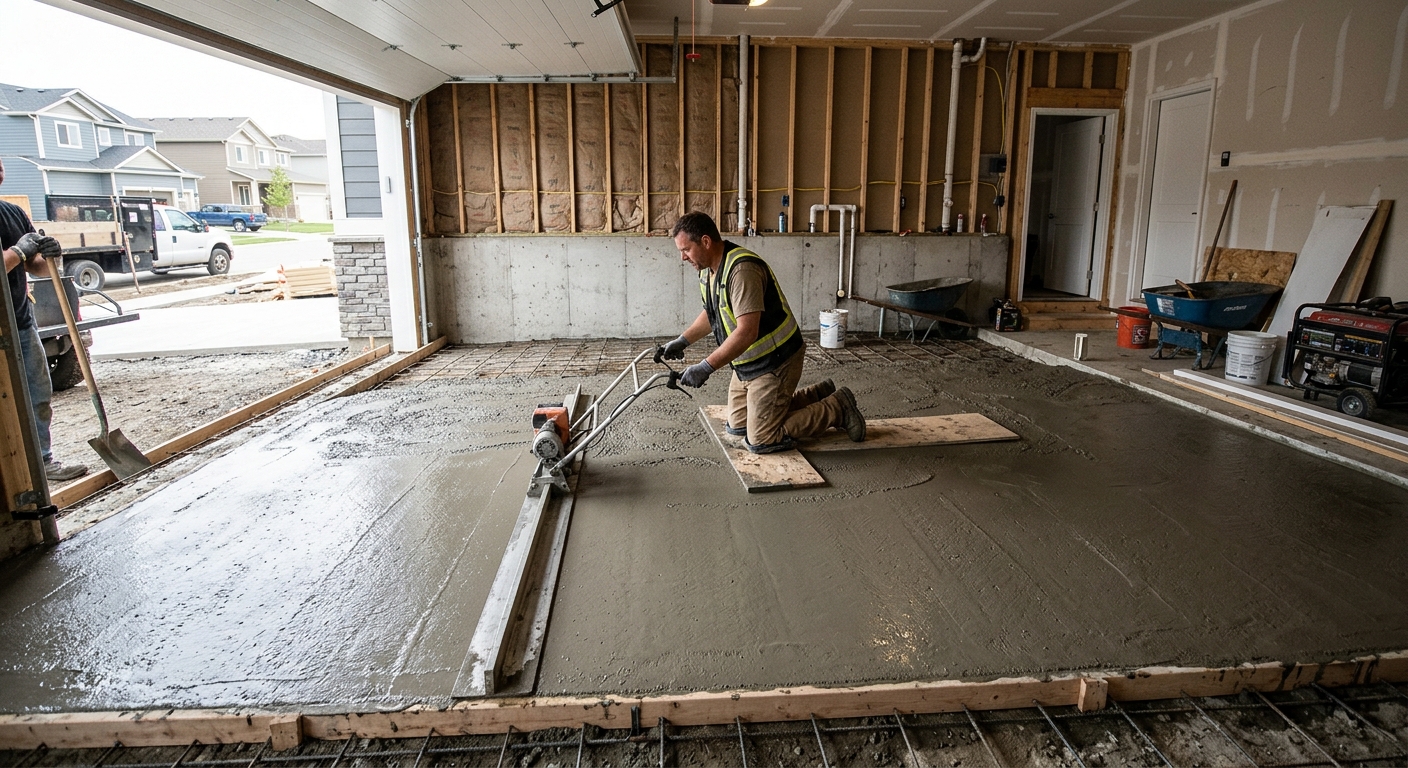
Concrete work options and costs in Homesteader
In Homesteader, Alberta, concrete is one of the most practical choices for driveways, patios, walkways, and structural foundations—especially in a community of 3,277 residents (Statistics Canada, 2021 Census). It’s also the kind of market where homeowners expect long service life, because Calgary-area freeze–thaw cycles are hard on unprotected surfaces. In this region, the same project can come back with noticeably different pricing depending on excavation depth, reinforcement, and finishing type.
Concrete flatwork is in steady demand around the newer growth pockets near the Calgary market—where trades see frequent residential builds and replacements of older slabs. Homesteader’s housing stock tends to follow the broader Calgary pattern of single-detached homes and upgrades, which drives consistent work for driveway and patio contractors.
Cost is strongly shaped by the climate. Local engineering practice assumes a deeper design frost depth (about 1.2 m, roughly 4 ft). That means exterior footings and many foundation elements must bear on undisturbed soil below frost to reduce frost heave and seasonal movement. For slabs, Calgary’s freeze–thaw swings also push spec requirements: granular base prep, air-entrained concrete mixes, control joints, and sometimes heated curing or insulated blankets during shoulder seasons. Add in the short exterior pour season and the logistics of concrete truck access, and you’ll see why pricing bands in this region run higher than in milder areas.
Below is a realistic snapshot of typical options and budgets to help you compare like-for-like, then we’ll break down the major cost drivers in the next section.
| Application |
Typical Size |
Key Spec |
Finish Option |
Price Range |
| Concrete driveway (standard broom finish) |
400 sq. ft. (about 20’ x 20’) |
Air-entrained mix, compacted granular base, control joints |
Broom finish |
$12,000–$18,000 |
| Exposed aggregate driveway |
400 sq. ft. (about 20’ x 20’) |
Air-entrained mix, retarder/rock exposure steps, sealed finish |
Exposed aggregate |
$14,000–$22,000 |
| Stamped concrete driveway or patio |
250 sq. ft. (about 10’ x 25’) |
Air-entrained mix, color hardener, release agent system |
Stamped |
$15,000–$26,000 |
| Plain concrete patio or walkway |
160 sq. ft. (about 8’ x 20’) |
Air-entrained mix, compacted sub-base, joints as needed |
Plain |
$5,000–$9,000 |
| Garage floor (interior slab) |
600 sq. ft. (about 20’ x 30’) |
Vapour barrier, reinforced slab, proper base compaction |
Broom or smooth-trowel (lightly textured) |
$7,000–$14,000 |
| Foundation footings (structural, below frost) |
Typical house footing footprint (engineering-dependent) |
Excavation below design frost, reinforcement, concrete mass for footings |
Engineered structural |
$28,000–$45,000 |
Prices are estimates only and vary by project scope, site access and material selection.
What affects the price of concrete work in Homesteader
In Homesteader and across the Calgary economic region, quotes for the “same” concrete job can swing by 30% to 50% because contractors price engineering, logistics, and site risks—not just square metres. The largest drivers are frost depth requirements, freeze–thaw exposure, and how much preparation your site needs. When a bid assumes standard base prep but the site actually needs deeper excavation, thicker granular lift, more reinforcement, or extra curing measures, the labour and materials change quickly.
Here’s the key climate reality: frost line depth and freeze–thaw cycles dictate specs. In Alberta, footings for houses, garages, decks, and retaining elements must extend below the design frost depth (about 1.2 m in the local engineering approach) to reduce frost heave and seasonal movement. Exterior slabs also need air-entrained concrete to survive Calgary’s repeated freeze–thaw cycles. That mix design alone affects both materials cost and placement methods.
Cold weather also changes the process. The practical pour season for exterior work is shorter here, and winter placement may require winter-grade mixes, insulated blankets, or temporary heat to protect curing. That’s why a driveway around the local band of $12,000–$18,000 can become closer to the upper end when curing precautions are required, especially late in the fall or early spring. De-icing salt and traffic add another layer—without a good sealing strategy, surface scaling and spalling risk increases over time.
Two practical examples from Homesteader: (1) a driveway replacement on a sloped lot usually costs more due to regrading and thicker base; (2) a stamped patio often costs more than plain work (often within the $5,000–$9,000 plain patio band versus the $15,000–$26,000 stamped-decorative band) because it requires additional steps, controlled timing, and more colour/finish materials.
Even within the same neighbourhood, older driveways may need saw-cut removal and haul-away, and that impacts the total budget more than most homeowners expect.
| Price Factor |
Why It Matters |
Cost Impact |
| Frost line depth |
Determines footing depth and form height below the design frost |
Higher excavation and more concrete; can push foundation-related work toward the top of local bands |
| Site preparation |
Excavation, grading, and compacted granular base affect settlement and cracking |
Extra loads, labour hours, and disposal can add significant cost on uneven or saturated sites |
| Reinforcement |
Rebar or wire mesh is selected based on slab type and loads |
Materials and placement labour; heavier reinforcement increases both cost and lead time |
| Mix design |
Air-entrainment and compressive strength specs improve freeze–thaw durability |
Winter-grade or higher-spec mixes can raise material cost and affect placement requirements |
| Finish type |
Broom vs. stamped vs. exposed aggregate changes labour steps and timing |
Stamped and exposed work generally costs more than plain slabs due to added finish systems |
| Pour size and concrete truck access to site |
Smaller pours still require setup; tight access can slow production |
More mobilization time, potential pump/extra handling, and higher coordination costs |
| Cold-weather curing precautions |
Heating, insulated blankets, and curing protection maintain strength gain |
Added labour, materials, and longer protection windows |
| Control joint pattern and sealing cost |
Joints manage cracking; sealing helps reduce surface damage from de-icing salts |
More layout/finishing time and sealant; usually small compared to the cost of failure |
Permits & regulations in Alberta
In Alberta, structural concrete work generally requires more oversight than decorative flatwork. For Homesteader homeowners, the typical rule of thumb is: structural foundations and engineered elements usually need a building permit and often engineered drawings reviewed by the municipality, while simple concrete flatwork commonly does not—unless it changes drainage, lot grading, or impervious surface coverage rules.
Work that typically DOES require a permit includes foundation footings, foundation walls, grade beams, and other structural concrete elements tied to the building’s load path. If you’re building a new house, adding a basement, underpinning, or changing the structural foundation design, expect permits and engineering to be part of the process.
Work that typically does NOT require a permit includes standard driveways, patios, and walkways, assuming they don’t impact lot grading, drainage plans, right-of-way constraints, or the municipal approach to impervious surfaces. Even when permits aren’t required, contractors still need to respect municipal requirements like setback and drainage.
Step-by-step, here’s how to verify a contractor in Homesteader: (1) ask for their Alberta licence information—then confirm it using the appropriate online registry for the trade classification; (2) request a Certificate of Insurance showing general liability (and ensure it covers concrete-related operations); (3) confirm WSIB/WCB coverage details—request the clearance/coverage proof your contractor can provide; and (4) call references from similar-scale projects in the Calgary area to ensure they can execute at the cold-weather standards local specs demand.
Getting concrete right in Homesteader's freeze-thaw climate
Concrete failures in Homesteader usually come back to three things: the base, the mix, and the “in-between” details like joints and curing. In a Calgary-area freeze–thaw environment, water movement is the enemy. If the base isn’t compacted correctly, if the slab isn’t built on the right granular depth, or if the mix lacks proper air-entrainment, you can get scaling, spalling, and premature cracking—especially on exterior surfaces that see de-icing salts.
To spec the job correctly, start with base preparation: a properly compacted granular sub-base to the right depth for your soil and frost conditions. Next, the mix design: exterior flatwork should use air-entrained concrete (commonly targeting about 5% to 7% air content) and a minimum compressive strength around 32 MPa for durability. Then control joints: they’re not optional when you want cracks in predictable locations rather than random “stress breaks.”
Curing matters more than many homeowners realize. In cold snaps, concrete must cure protected—commonly with a minimum 7-day curing period under appropriate conditions (and sometimes additional winter-grade measures like insulated blankets or temporary heat). Finally, sealing: apply a penetrating sealer about 28 days after the pour so the slab can fully cure and repel de-icing salts.
Here’s where money is justified: upgrading from a basic broom-finish driveway to a decorative finish may cost more, but skipping air-entrainment or joints is never worth it. For example, a plain driveway budget can sit around $12,000–$18,000. A stamped driveway or patio often lands higher—closer to $15,000–$26,000—because of added labour and materials. Spend on the right specs, then decide whether the decorative finish is truly worth the premium for your lifestyle.
| Spec |
Why It Matters in Homesteader |
What to Ask For |
Impact if Skipped |
| Compacted granular base (depth?) |
Prevents settlement and reduces water pumping under freeze–thaw |
Confirm granular depth, compaction method, and whether existing soil is unsuitable |
Early cracking, unevenness, and higher maintenance |
| Air-entrained concrete mix (target air %?) |
Protects against freeze–thaw damage and salt scaling |
Ask for target air content (typically 5%–7% for exterior flatwork) and mix design details |
Spalling risk increases, especially on driveways and walkways |
| Compressive strength (MPa rating) |
Ensures durability and strength gain for winter exposure |
Confirm minimum 32 MPa and whether winter-grade measures are used if needed |
Reduced long-term performance and surface breakdown |
| Control joints (spacing per ACI guidelines) |
Directs shrinkage cracking and limits random cracks |
Ask about joint spacing/layout for your slab size and exposure |
Uncontrolled cracking and costly patching |
| Minimum 7-day curing period |
Cold-weather curing affects strength development and surface resistance |
Ask how curing will be protected and what protection is used if temperatures drop |
Scaling, dusting, and weaker slab performance |
| Penetrating sealer (when applied after cure) |
Repels de-icing salt and reduces moisture ingress |
Ask for penetrating sealer application timing (about 28 days post-pour) and coverage rate |
Faster deterioration and higher frequency of repairs |
How to choose a concrete work contractor in Homesteader
Choosing the right concrete contractor in Homesteader comes down to proof of accountability and technical competence—not just a low price. In Alberta, verify that the contractor is properly licensed for the scope, carries liability insurance, and has WSIB/WCB coverage. The practical way to check is simple: (1) ask for their insurance certificate and confirm it’s current and includes concrete-related operations; (2) request proof of WSIB/WCB coverage (or clearance documentation, where applicable); (3) verify their trade registration/licence through the appropriate Alberta online registry; and (4) confirm they list references from similar work in the Calgary area, since cold-weather placement and frost considerations affect execution.
Get 2–3 itemised written quotes. You want a labour and materials breakdown, not a lump sum with vague allowances. Compare line items such as excavation and disposal, granular base depth, reinforcement placement, concrete mix specification (including air-entrainment and strength), finishing schedule, curing protection, and whether sealing is included. Also check exclusions: Who supplies saw-cutting? Are control joints included and sealed as specified? Is the permit pull included when needed for structural concrete? If not, clarify who handles it.
Warranty deserves attention. Ask for the length of workmanship warranty and whether product/manufacturer warranties apply to any sealers or admixtures. Confirm if any warranty is transferable. On payment schedule, never pay more than 10% to 15% upfront; hold back a portion until the job is complete and properly cured. Finally, insist on a start date and completion estimate in writing—winter curing delays are common, and you want expectations documented.
- Request insurance certificate and confirm coverage is active on pour day.
- Confirm WSIB/WCB coverage proof before work starts.
- Ask to see recent photos of Homesteader-area cold-weather exterior pours.
- Get a written, itemised quote (labour vs materials vs disposal).
- Verify granular base depth and compaction method are specified.
- Confirm air-entrainment target and minimum strength (e.g., 32 MPa).
- Ask about reinforcement details (mesh vs rebar, tie spacing, coverage).
- Ensure control joint spacing and location plan is included.
- Ask how they handle curing if the temperature drops (blankets/heat).
- Confirm sealing: whether a penetrating sealer is included and timing.
- Review disposal/haul-away for removed concrete and excess soils.
- Use a payment schedule with a holdback until final acceptance.
Concrete red flags we see in Homesteader include: bids that don’t specify air-entrainment or curing protection, “lowest price” quotes with no itemised excavation/base prep, skipping or under-specifying control joints, starting pours during freezing conditions without winter-grade precautions, and contracts that demand full payment upfront with no holdback or workmanship warranty terms.
Frequently asked questions — concrete work in Homesteader
Concrete vs pavers for a patio in Homesteader?
In Homesteader, both concrete and pavers can work, but they fail differently in Alberta’s freeze–thaw conditions. Concrete patios (when built with a compacted granular base, air-entrained mix, joints, and proper curing) tend to be smoother to maintain and easier to seal against de-icing salt—though you still need a good joint pattern to control cracking. Pavers can be flexible if the base is engineered well, but weeds and shifting sand become common when base compaction or edge restraints are off. Cost-wise, a plain concrete patio often falls in the $5,000–$9,000 range depending on size and access, while pavers frequently price higher once edging, base build-up, and drainage adjustments are included. If you expect frequent salt exposure, concrete with penetrating sealing usually gives more consistent long-term performance.
How long does a concrete driveway last?
In Alberta’s Calgary-area climate, a concrete driveway can often last 20 to 30 years or longer when it’s built for freeze–thaw durability: air-entrained concrete, proper granular base, correctly spaced control joints, and curing protection. Many driveways don’t fail structurally first—they show surface scaling or spalling when de-icing salts get moisture into a slab that wasn’t sealed and protected properly. If your driveway is poured late in the season without winter-grade curing measures, you can get early surface breakdown. A typical standard-broom driveway budget in Homesteader sits around $12,000–$18,000, and paying for the correct base prep and mix design in that band usually buys you better longevity. Ask contractors what they recommend for sealing timing and what maintenance schedule they follow in cold-weather conditions.
What is air-entrained concrete and why does it matter here?
Air-entrained concrete is mixed with microscopic air bubbles designed to give water space to expand when it freezes. In Homesteader and the wider Calgary economic region, the freeze–thaw cycles repeatedly stress exterior slabs and cause scaling or spalling if air content is wrong. That’s why local specs for driveways, patios, and walkways depend on air-entrainment and not just the visual finish. When contractors properly air-entrain and place concrete, the slab is far more resistant to salt-driven surface deterioration—especially because de-icing chemicals are common in winter. In practical terms, air-entrainment can be one reason your quote differs by 30% to 50% from a “basic concrete” price. Make sure your contractor specifies the air-entrainment target (commonly about 5%–7% for exterior flatwork) and confirms the curing approach if temperatures drop.
How do I prepare the base for a concrete slab?
Base prep is where most driveway and patio failures are prevented in Homesteader. Your contractor should excavate to remove unsuitable soil, then place and compact a granular sub-base in layers to the correct depth for the frost conditions and site drainage. The goal is to reduce settlement and stop water from “pumping” upward through the slab during freeze–thaw cycles. For exterior flatwork, ask what granular material is used (and whether they use compaction testing). Good prep also affects thickness decisions, so the final slab doesn’t crack immediately from uneven support. If there’s soft subgrade or poor drainage, the base build-up becomes more intensive and is reflected in the bid—often pushing the project toward the higher side of the $12,000–$18,000 driveway band. Don’t skip base steps even if it means a smaller finish upgrade.
How do I compare concrete quotes?
To compare concrete quotes fairly in Homesteader, insist on itemised line items and like-for-like specs. Watch for quotes that only mention square footage and finish, but omit base depth, compaction approach, reinforcement, and mix requirements. Concrete bids can legitimately differ by 30% to 50% because one contractor may include proper granular base prep, air-entrained mix, curing protection for cold weather, and sealing, while another leaves those out. Request details such as: concrete strength (e.g., minimum 32 MPa), air-entrainment target, control joint spacing, and curing method (blankets/heat if needed). Also check what’s excluded: disposal, regrading, permit handling (when structural permits apply), and sealing. If one quote is in the $5,000–$9,000 patio range and another is much higher, verify whether the higher number includes a better base build-up, joints, and sealing.
Can concrete be poured in cold weather in Homesteader?
Yes, concrete can be poured in cold weather in Alberta, but it must be engineered and protected during curing. The key is that concrete needs proper conditions to develop strength; otherwise, you risk surface scaling, weakened durability, and long-term spalling issues. In Homesteader’s freeze–thaw climate, reputable contractors use cold-weather procedures such as winter-grade mixes, insulated curing blankets, wind protection, and sometimes temporary heat so the slab stays within the required temperature range during early strength gain. Always ask what temperatures trigger their extra precautions and whether they provide a documented curing plan. If you’re trying to pour outside the practical exterior pour season, don’t accept a “we’ll just pour it” approach—ask about winter-grade concrete and curing protection. Costs can rise modestly due to labour and equipment, and that’s one reason exterior projects can move toward the upper end of local price bands.