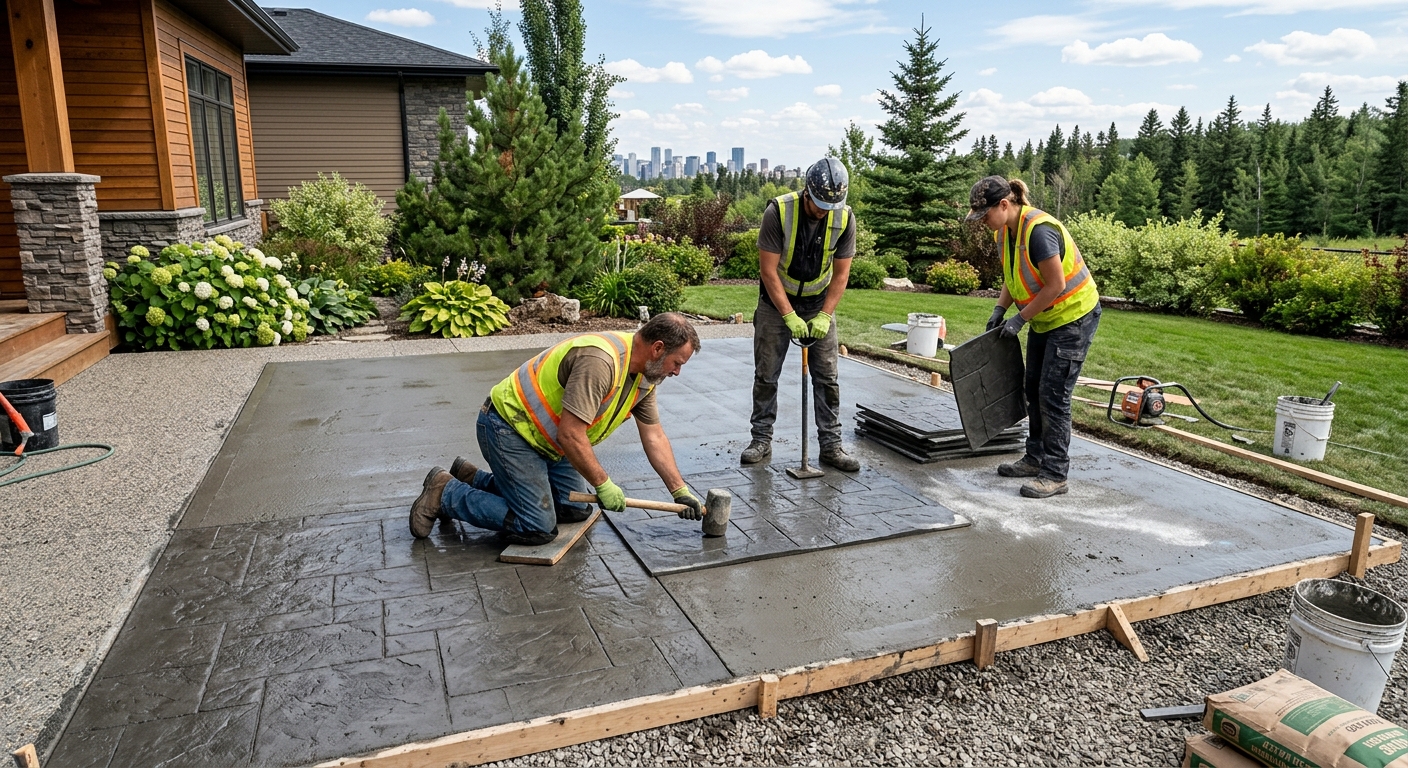
Concrete work options and costs in Secord
Secord, Alberta is a growing community, and it’s where homeowners typically start noticing how quickly a rough grade and a harsh winter can affect concrete. With Secord’s population at 3,171 (Statistics Canada, 2021 Census), the demand is steady for driveways, patios, walkways, and the concrete elements that support new construction. In many Calgary-area neighbourhoods—including the broader Secord market—concrete flatwork is most often tied to single-detached homes, since driveways, yard paths, and rear patios are usually first to get built or replaced. That matters because flatwork is exposed to frequent freeze–thaw cycles, de-icing salts, and heavy ploughing.
In Calgary and the surrounding region, pricing is engineered around frost and freeze–thaw more than in milder provinces. A design frost depth of about 1.2 m (roughly 4 ft) means footing and structural work needs to extend into undisturbed soil below seasonal movement. Exterior slabs also need air-entrained concrete and a clean base prep so freeze–thaw doesn’t lift edges, crack, or cause surface scaling. The other cost driver is timing: the practical exterior-pour season is shorter, and cold-weather curing measures—insulated blankets, heat, and stricter curing discipline—can add labour and material costs if you build late in the season.
Trades tend to concentrate around active building zones in the area, and in Secord proper, driveway and walkway replacement is especially in demand as homeowners complete landscaping and finalize grading. With that in mind, compare the typical cost ranges below for the concrete options most requested in Secord, so you can match scope to budget before you call for quotes.
| Application |
Typical Size |
Key Spec |
Finish Option |
Price Range |
| Concrete driveway (standard broom finish) |
400–550 sq. ft. |
Air-entrained mix; compacted granular base; control joints |
Broom finish |
$12,000–$18,000 |
| Exposed aggregate driveway |
400–550 sq. ft. |
Air-entrained mix; proper curing and wash timing |
Exposed aggregate |
$14,000–$21,000 |
| Stamped concrete driveway or patio |
300–550 sq. ft. |
Air-entrained mix; integral colour; sealed finish |
Stamped pattern (ashlar/stone look) |
$15,000–$26,000 |
| Plain concrete patio or walkway |
150–350 sq. ft. |
Air-entrained mix; minimum 7-day cure; joints as needed |
Plain broom/float finish |
$5,000–$9,000 |
| Garage floor (interior slab) |
500–700 sq. ft. |
Vapour barrier; reinforcement as specified; broom finish |
Interior broom finish |
$6,500–$12,000 |
| Foundation footings (structural, below frost) |
Typical single-detached footprint |
Reinforced footings; engineered bearing depth; below design frost |
Structural concrete |
$28,000–$45,000 |
Prices are estimates only and vary by project scope, site access and material selection.
What affects the price of concrete work in Secord
In Secord and across the Calgary region, it’s common to see quotes for the “same” concrete job vary by 30–50%. The reason usually isn’t the concrete itself—it’s what’s included in site work, the engineering/spec details behind frost protection, and how the contractor plans for curing and freeze–thaw durability. In practical terms, two contractors can both say “a driveway,” but one may price in deeper excavation and a properly compacted granular base, while the other may under-provision reinforcement, joints, or mix design.
Frost depth is a big driver. Footings and any structural concrete tied into the foundation system must extend below the design frost depth (about 1.2 m in this region). That usually increases excavation volume, formwork height, and concrete volume—especially where subsoil conditions are variable. For exterior slabs and flatwork, Calgary’s frequent freeze–thaw cycles require air-entrained concrete mixes, typically targeting about 5–7% air content so the paste can manage expansion and prevent surface damage. Cold-weather placement also changes the cost: later-season pours may require winter-grade measures such as insulated blankets and temporary heat to protect curing. Finally, de-icing salt accelerates surface spalling if the surface isn’t properly sealed after cure.
Cost can also move up or down based on local scope decisions in Secord. For example, upgrading from a standard broom driveway to stamped concrete can shift a project into the $15,000–$26,000 range, because you’re paying for colour system, stamping tools, and extra finishing steps. Or, when foundation work is engineered with extra bearing depth and reinforcement, it can land near the $28,000–$45,000 band. If your driveway is being built over soft fill or needs significant regrading, that site preparation can increase costs more than people expect—because excavation and compacted base prep aren’t optional in freeze–thaw climates.
| Price Factor |
Why It Matters |
Cost Impact |
| Frost line depth — determines footing depth and form height |
Footings must bear below seasonal movement to prevent frost heave |
Higher excavation and concrete volume can add thousands, especially on deeper bearing sites |
| Site preparation — excavation, grading, compacted granular base |
Proper sub-base prevents settlement and edge heaving |
Soft soils, poor drainage, or limited access can materially increase labour and material quantities |
| Reinforcement — rebar or wire mesh requirement |
Controls cracking and helps distribute loads |
Mesh/rebar and placement labour can add cost, but skipping it often leads to early cracking |
| Mix design — air-entrainment and compressive strength spec |
Durability under freeze–thaw depends on air content and strength |
Better durability mixes cost more and may require stricter placement/curing practices |
| Finish type — broom vs. stamped vs. exposed aggregate |
Different finishing steps and materials affect yield and labour time |
Stamped/exposed systems typically add labour and specialty materials |
| Pour size and concrete truck access to site |
More concrete and constrained access increases handling time |
Small changes in size or access can shift crew time and pump/placement logistics |
| Cold-weather curing precautions — heating and blankets |
Concrete must cure properly to reach strength and reduce scaling risk |
Winter protection can add direct material costs and extra crew time |
| Control joint pattern and sealing cost |
Joints limit random cracking; sealing repels salt and water |
Proper jointing and sealing add line-item cost but reduce long-term repair risk |
Permits & regulations in Alberta
In Alberta, many homeowners assume “concrete work” always needs a permit. In reality, permits usually depend on whether the work is structural and whether it changes drainage or lot grading. Structural concrete—like foundation footings, foundation walls, and grade beams—typically requires a building permit and, in many cases, engineered drawings that get reviewed by the municipality. Concrete flatwork (patios, walkways, driveways) often does not require a permit unless it affects lot grading, impervious surface coverage limits, or you’re working near a municipal right-of-way. Before you break ground in Secord, confirm requirements with the local authority so you’re not caught mid-project.
For contractor verification in Alberta, take a simple step-by-step approach. First, ask for the contractor’s liability insurance certificate and confirm the policy is active for the project period. Second, ask how they handle workplace coverage—WSIB/WCB coverage—and request a clearance letter or proof of account status where applicable. Third, verify licensing/registration: review the contractor’s business standing through the appropriate online provincial tools/registries (and cross-check it against their website, contract documents, and references). Finally, request references for similar-scale concrete work in the Calgary region and ask to see photos from projects that have been in service through at least one winter.
Practical takeaway: permits typically apply to footings, foundation walls, and other structural concrete; patio/walkway/driveway work usually does not—unless grading/drainage, right-of-way impacts, or local lot coverage rules come into play.
Getting concrete right in Secord's freeze-thaw climate
Concrete failures in Secord usually come from one of five places: poor base preparation, incorrect mix design for freeze–thaw, weak or incomplete curing, inadequate control joints, or skipping sealing where de-icing salts are used. With a design frost depth of about 1.2 m, any foundation-related concrete has to be placed to the correct bearing depth so frost can’t lift the structure or cause differential movement. For flatwork—driveways, patios, and walkways—the freeze–thaw cycles are relentless, especially when water gets into cracks and then expands during freezing. That’s why the specs matter as much as the colour or pattern.
To spec the job correctly in the Calgary/Secord market, focus on: (1) base preparation with a compacted granular sub-base to the right depth for local soil and frost requirements; (2) mix design with air-entrainment—commonly targeting 5–7% air for exterior flatwork—and minimum 32 MPa compressive strength; (3) control joints spaced to reduce random cracking; (4) curing with a minimum 7-day cure under proper conditions; and (5) penetrating sealer applied after the cure window (often at 28 days) to repel salts and water.
When homeowners compare options, it’s easy to think “it’s all just concrete,” but the durability specs can justify the difference. For example, a stamped patio in the $15,000–$26,000 band isn’t only decorative—the colour system and extra finishing steps require careful curing and sealing. If a basic broom-finish walkway at the $5,000–$9,000 level is priced similarly but without air-entrainment, proper joints, and curing precautions, it’s not a fair comparison—and it can deteriorate faster in Secord winters.
| Spec |
Why It Matters in Secord |
What to Ask For |
Impact if Skipped |
| Compacted granular base (depth?) |
Stabilizes the slab and reduces frost-related movement |
Base type and compacted depth; compaction method/proof |
Settlement, edge heaving, cracking, and premature surface deterioration |
| Air-entrained concrete mix (target air %?) |
Lets concrete resist freeze–thaw without spalling |
Air target typically 5–7% for exterior flatwork; mix design sheet |
Higher risk of scaling/spalling after one or two winters |
| Compressive strength (MPa rating) |
Strength gain affects long-term durability and load resistance |
Confirm minimum 32 MPa and whether it’s tested/verified |
Surface wear, cracking, and reduced performance in freeze–thaw conditions |
| Control joints (spacing per ACI guidelines) |
Controls where cracking happens |
Joint spacing plan and saw-cut timing; sealed vs unsealed joints |
Random cracking and wider channels for water intrusion |
| Minimum 7-day curing period |
Proper curing reduces surface scaling and strength loss |
How they protect curing in cold weather; curing temperature plan |
Reduced strength, surface damage, and higher repair likelihood |
| Penetrating sealer (when applied after cure) |
Repels de-icing salts and water that worsen freeze–thaw |
Sealer type and application timing (commonly after 28 days cure) |
Faster spalling and staining, leading to earlier resurfacing or patching |
How to choose a concrete work contractor in Secord
Choosing the right contractor in Secord is about verification and scope clarity, not just the lowest number on the page. Start by confirming Alberta coverage details before you sign. Ask for a current liability insurance certificate and verify the policy is active for the job timeline. Then request proof of WSIB/WCB coverage or a clearance letter showing their account status—don’t accept verbal assurances. If you’re working on structural concrete (footings/foundations), make sure they can coordinate with the permit/engineering process.
Next, get 2–3 itemised written quotes. You want a breakdown that separates labour, excavation/site prep, reinforcement, concrete supply, finishing, disposal, and any protection/heating for cold-weather curing. Avoid quotes that lump everything together without showing what’s included. Read the scope carefully for exclusions like permit pulls, disposal of removed materials, saw-cutting, sealing, or any snow/ice management needed to protect curing.
Warranty matters in this climate. Ask for a workmanship warranty length and whether it applies to cracking and spalling that results from workmanship, not just surface colour. Also ask about product/manufacturer warranties on sealers, integral colour systems, or admixtures—then confirm if any warranty is transferable to a future homeowner. For payments, use a schedule that doesn’t front-load the job; never pay more than 10–15% upfront, and hold back a portion until the final inspection items are complete. Finally, insist on a start date and completion estimate in writing so schedule changes don’t become “extra cost later.”
- Confirm active liability insurance dates and project-specific coverage.
- Request WSIB/WCB clearance or proof of coverage status.
- Verify their experience with freeze–thaw durability specs (air-entrainment, curing plan).
- Require the quote to list excavation depth and granular base scope.
- Ask what reinforcement is included (mesh vs rebar) and why.
- Confirm joint layout (spacing plan and saw-cut timing).
- Ensure cold-weather curing protection is included if pouring near seasonal limits.
- Ask whether disposal of concrete and spoil is included.
- Confirm whether sealing is included, and the application timing (post-cure).
- Get an itemised labour/material breakdown—not a single lump sum.
- Check warranty terms in writing, including exclusions.
- Set a payment schedule with a final holdback after punch-list completion.
Concrete red flags in Secord include: quotes that don’t mention air-entrainment or curing protection, no explanation of control joints, “it’ll be fine” statements about winter pours without blankets/heating, vague scope exclusions for disposal and base prep, and payment requests that front-load more than 15% without a clear schedule or signed contract.
Frequently asked questions — concrete work in Secord
How do I prepare the base for a concrete slab?
In Secord, base prep is where projects win or fail in freeze–thaw. Your contractor should excavate to the required depth, remove topsoil and any unsuitable fill, then build a compacted granular sub-base to the spec depth needed for your soil and frost considerations (design frost depth is about 1.2 m in this region). Ask how they compact—typically in lifts—with proof of compaction. Drainage matters too: slopes should direct surface water away from the slab to reduce water getting into joints. For exterior work, the goal is a stable, uniform base before concrete placement. When base prep is rushed, you can see settlement and cracking within a season or two, especially on driveways and patios that get ploughed and salted.
How do I compare concrete quotes?
Comparing quotes in Alberta is less about the total price and more about line items that control durability. Ask each contractor for an itemised breakdown: excavation/site prep, granular base depth and compaction scope, reinforcement (mesh vs rebar), concrete supply, finishing, disposal, and whether sealing is included. Then compare the technical spec: exterior flatwork should be air-entrained and cured correctly; structural work should extend below the design frost depth. A driveway price in the $12,000–$18,000 range can look “better” than one in the higher band, but only if the lower quote includes the same base prep, joints, and curing precautions. If one quote includes de-icing salt sealing and the other doesn’t, that’s a real durability difference.
Can concrete be poured in cold weather in Secord?
Yes, concrete can be poured in cold weather in Secord, but it must be engineered for curing and protection. The risk isn’t just “cold”—it’s whether the concrete reaches adequate early strength before freezing conditions prevent proper hydration. Reputable contractors use cold-weather curing precautions such as insulated blankets, temporary heating, and a documented protection plan for the pour and curing period. You should also ask about winter-grade mix requirements and how they’ll monitor temperature. If a contractor insists on pouring without heating/blankets when night temps are dropping, you’re taking on a spalling and scaling risk over time. The price can be higher than a summer pour because winter protection adds labour, materials, and time—often enough to explain part of the 30–50% variance you may see between quotes.
How do I maintain concrete in Secord's freeze-thaw climate?
Maintenance in Secord is mainly about controlling water and salts. After your concrete cures, have a penetrating sealer applied—commonly about 28 days post-pour—so de-icing salts and moisture don’t soak into the surface. Use de-icers responsibly: avoid heavy, repeated salt saturation when alternatives are available. Keep drainage flowing away from the slab by maintaining any grading and clearing debris in edges and joints. During winter, plough carefully to avoid chipping edges and re-scraping the surface. If you see hairline cracks, don’t ignore them: joints control cracking, but water intrusion can widen fractures over freeze–thaw cycles. With correct sealing and joint attention, many driveways and patios can stay serviceable far longer through Alberta winters.
What causes concrete to spall in Secord winters?
Spalling in Secord winters is most often a freeze–thaw durability problem combined with water and de-icing salts. Common causes include inadequate air-entrainment (too little air content), poor curing, and base prep that allows water to accumulate or the slab to move. If joints are poorly planned or sealed treatment is skipped, water enters micro-cracks and freezes, creating internal pressure that pops off the surface. Over time, repeated cycles accelerate deterioration. Another contributor is late-season pours without winter-grade curing measures: if the concrete hasn’t gained sufficient strength before freezing conditions, the surface can scale even if the slab “looks okay” initially. That’s why contractors should specify air-entrained mix targets and a curing plan, not just colour and finish.
What is rebar and when is it required in Alberta?
Rebar is steel reinforcement bars embedded in concrete to improve tensile capacity and crack control. In Alberta (including Secord), whether rebar is required depends on the structure and the engineering/permit design. For foundation footings and other structural elements, reinforcement is typically part of the designed system and is used to meet strength and movement-control requirements. For concrete flatwork like slabs, reinforcement may be required based on slab thickness, spans, soil conditions, and loading; sometimes wire mesh is used, sometimes rebar, and sometimes reinforcement isn’t necessary for small, properly prepared interior slabs. The best approach is to follow the engineered drawings for structural work and ask for the reinforcement spec in your quote—don’t accept “we’ll see later.” Your contractor should be able to explain why reinforcement is included and what it’s protecting against in freeze–thaw conditions.