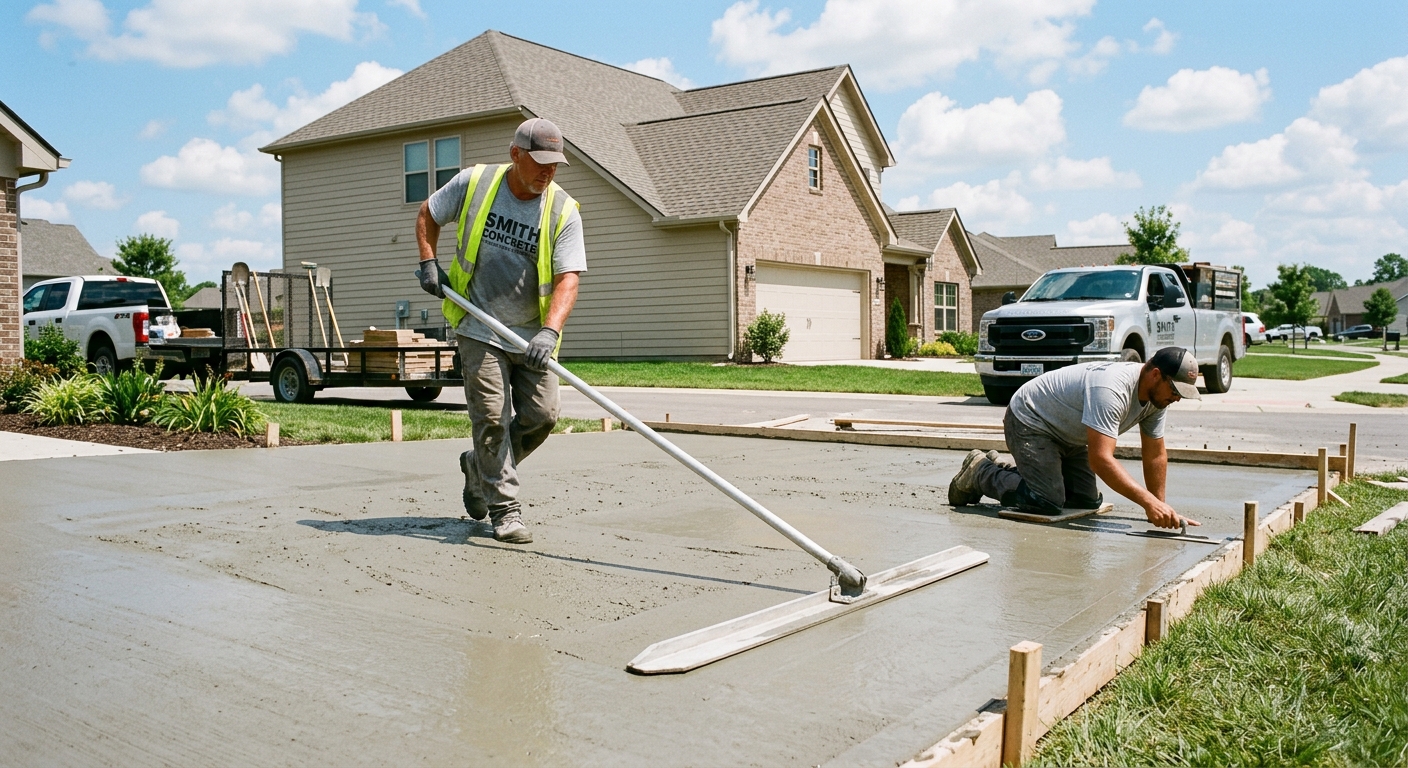
Concrete work options and costs in Coaldale
Concrete work in Coaldale is a year-round need, but it’s a seasonal business. With 77.7% of dwellings in the region being single-detached homes (Statistics Canada, 2021 Census), most driveways, patios, walkways, and interior garage slabs we see are tied to owner-occupied houses—exactly the type of projects that benefit from proper base prep, tight grading, and good finishing. Coaldale’s housing stock also skews older: 40.7% of homes were built before 1981 (Statistics Canada, 2021 Census), which often means existing slabs or approaches need saw-cut removal, regrading, and sometimes raising tie-ins to match settled grade.
In the Lethbridge–Medicine Hat region, pricing is strongly influenced by a deep frost line and aggressive freeze–thaw cycles. Footings and structural elements must be carried below frost to reduce heave, which drives excavation and forming costs up versus milder climates. Exterior slabs also need air-entrained concrete to withstand repeated water freeze inside the slab. On top of that, the practical pour season is shorter, so late-fall and early-spring work may require blankets, heaters, or accelerators—small materials and labour add-ons that can move the total cost noticeably.
Contractor availability can also tighten around peak summer timelines, especially in areas with consistent redevelopment and renovations such as the Coaldale central corridor along 19 St and the older established residential pockets near downtown. If you’re comparing options, use the ranges below as a baseline before you choose the finish level and site-spec details.
| Application |
Typical Size |
Key Spec |
Finish Option |
Price Range |
| Concrete driveway (standard broom finish) |
400–600 sq ft |
Air-entrained, 4–5 in slab; compacted granular base |
Broom finish + control joints |
$7,000–$11,500 |
| Exposed aggregate driveway |
400–600 sq ft |
Air-entrained; aggregate exposure controlled for durability |
Exposed aggregate + sealer-ready surface |
$9,500–$15,500 |
| Stamped concrete driveway or patio |
300–500 sq ft |
Air-entrained; reinforced as needed |
Stamp mats + color hardener |
$10,000–$16,500 |
| Plain concrete patio or walkway |
150–350 sq ft |
Air-entrained; proper slope to drain |
Float + light broom texture |
$3,000–$6,800 |
| Garage floor (interior slab) |
300–600 sq ft |
Standard slab spec; moisture control as required |
Light trowel or broom texture |
$5,000–$12,000 |
| Foundation footings (structural, below frost) |
Varies by house |
Below frost depth; engineered reinforcement |
Typically formed concrete only (not decorative) |
$10,000–$28,000 |
Prices are estimates only and vary by project scope, site access and material selection.
What affects the price of concrete work in Coaldale
In Coaldale and across the Lethbridge–Medicine Hat economic region, the same-looking concrete job can come in 30–50% apart between quotes. The biggest reason is that “concrete” isn’t one product—it’s a system: excavation depth, granular base quality, frost requirements, mix design, reinforcement, finishing method, curing plan, and even truck access all change the labour and materials you actually pay for.
Frost line depth and freeze–thaw cycles dictate nearly every exterior spec here. Footings and structural elements must extend below the design frost depth (often up to 2.4 m in Alberta, depending on soil and engineering requirements) to prevent frost heave. Exterior slabs also need air-entrained concrete mixes to survive repeated freeze–thaw action; if the air content isn’t right, spalling risk jumps. Cold-shoulder conditions shorten the practical pour season, so crews may need insulating blankets, heat blankets, or accelerators to protect curing—costs that don’t show up if a contractor only quotes “material per yard.” De-icing salt is also a real-world driver: sealed surfaces generally resist damage better, so sealing may be recommended even when not explicitly asked for.
Concrete finish choices create wide gaps too. For example, a plain patio or walkway is commonly aligned with the $12–$20 per sq ft band, while stamped work often falls closer to the $20–$32 per sq ft range because stamping, colour, release agents, and extra finishing time add up. In Coaldale, older lot grades and drainage patterns (particularly on pre-1981 homes) can mean more excavation and regrading before the slab can be built to last—sometimes adding thousands just to get the base and drainage correct.
| Price Factor |
Why It Matters |
Cost Impact |
| Frost line depth — determines footing depth and form height |
Controls excavation volume and structural concrete quantity |
Higher depth can add significant excavation and forming labour |
| Site preparation — excavation, grading, compacted granular base |
Ensures the slab won’t settle or heave |
Poor soils or limited access can raise base and equipment time |
| Reinforcement — rebar or wire mesh requirement |
Improves slab performance where loads and movement are expected |
Material + placement labour; may be added after soil/load review |
| Mix design — air-entrainment and compressive strength spec |
Critical for freeze–thaw durability and long-term strength |
Higher-spec mixes can add per-yard material cost |
| Finish type — broom vs. stamped vs. exposed aggregate |
Finishing method changes labour time and product steps |
Stamped/exposed options add colour, mats, and extra finishing labour |
| Pour size and concrete truck access to site |
Determines efficiency and whether pumps/extended chutes are needed |
Small job access issues can raise minimum charges and labour hours |
| Cold-weather curing precautions — heating and blankets |
Protects strength gain when temperatures drop |
Heaters/blankets and added monitoring can add a noticeable surcharge |
| Control joint pattern and sealing cost |
Reduces random cracking and helps with salt/abrasion durability |
Sealer and joint saw-cuts add labour and time |
Permits & regulations in Alberta
In Alberta, structural concrete work typically needs a building permit, and municipalities often expect engineered drawings for foundation elements. That means work like footings, foundation walls, grade beams, and other structural components normally require permits because they directly affect building capacity and load paths. For concrete flatwork—driveways, patios, and walkways—permits are usually not required unless the project changes lot grading significantly, impacts stormwater/lot drainage, exceeds impervious surface limits, or affects municipal right-of-way requirements. Because each lot can have unique drainage and servicing details, it’s smart to confirm with the City of Coaldale or the relevant local authority before breaking ground.
Step-by-step, here’s how a Coaldale homeowner should verify a contractor’s credentials in Alberta:
- Ask for their liability insurance certificate (COI) showing coverage limits and the job address/location.
- Ask for proof of required worker coverage (WSIB/WCB) for employees or subcontractors involved.
- Request their contractor references for similar-sized concrete placements (especially exterior freeze–thaw exposure jobs).
- Check the Alberta business/contractor standing through official online registries if applicable to the contractor’s trade category.
- Make sure their quote references whether a permit pull is included (if required) and who is responsible for it.
If they can’t provide paperwork on request, or they won’t clarify permit responsibility, treat that as a red flag and keep shopping.
Getting concrete right in Coaldale's freeze-thaw climate
Concrete can fail in Coaldale’s freeze–thaw climate in predictable ways: slab heave from inadequate base or wrong frost depth, random cracking from missing or poorly spaced control joints, and surface damage (spalling) when air-entrainment isn’t correct. The right way to spec the job is to treat it as a layered system rather than a “poured pad.”
First is base preparation: use a properly graded and compacted granular sub-base to the right depth for local soil conditions and frost considerations. Next is mix design. For exterior flatwork, specify air-entrainment (commonly in the 5–7% air range for durable exposure) and a minimum 32 MPa compressive strength unless engineering calls for more. Third are control joints—place them to limit random cracking and manage shrinkage. Fourth is curing: plan for at least 7 days of curing under suitable conditions; in cold snaps, you may need blankets or other curing protection so the slab reaches strength before backfilling or heavy use. Fifth is sealing: a penetrating sealer applied 28 days after the pour helps repel de-icing salts and reduces abrasion damage.
Ask contractors directly about spalling prevention. If a contractor can’t explain air-entrainment targets and curing protection, don’t assume “it’ll be fine.” For a dollar example: choosing a sealed, air-entrained concrete driveway (often in the $14–$22 per sq ft region for standard work) is usually money better spent than going decorative without durability specs. Stamped options may land closer to the $20–$32 per sq ft band, but if the base and air-entrainment aren’t right, the added aesthetic won’t protect the surface.
| Spec |
Why It Matters in Coaldale |
What to Ask For |
Impact if Skipped |
| Compacted granular base (depth?) |
Reduces settlement and heave under freeze–thaw |
Base thickness tied to site conditions and frost considerations |
Cracking, uneven slabs, and premature failure |
| Air-entrained concrete mix (target air %?) |
Protects against freeze–thaw internal pressure |
Confirm air content target for exterior exposure |
Spalling and surface scaling during winters |
| Compressive strength (MPa rating) |
Ensures strength gain for loading and durability |
Minimum 32 MPa (or higher per engineering/spec) |
Surface wear, rebound loss, and reduced service life |
| Control joints (spacing per ACI guidelines) |
Manages shrinkage and movement cracks |
Planned joint layout and saw-cut timing |
Random cracks that are harder to correct |
| Minimum 7-day curing period |
Cold weather slows strength development |
Protection plan if temperatures drop |
Weak concrete and increased risk of damage |
| Penetrating sealer (when applied after cure) |
Helps repel salt and moisture intrusion |
Apply after cure—typically 28 days post-pour |
Faster surface deterioration and more staining |
How to choose a concrete work contractor in Coaldale
Choosing the right concrete contractor in Coaldale is mostly about proof and process, not just the lowest line number. Start by verifying Alberta compliance and coverage. Ask for a current certificate of liability insurance (COI) that names the job location, and confirm workers are covered through WSIB/WCB. Don’t be shy about requesting certificates before signing—reputable crews provide them quickly. Next, request 2–3 itemised written quotes. You want labour and materials broken out (concrete supply, excavation, granular base, reinforcement, finishing, sealing, joints, disposal), not a single lump sum that hides where the trade-offs are.
When you read the scope, look for what’s excluded: Is permit pulling included if the work requires it? Is demolition and haul-away included, or “by others”? Is base depth included or “as per site”? Also check warranty terms. A workmanship warranty should be stated clearly (length and what defects are covered), and you should know whether product/manufacturer warranties apply directly to you and whether they are transferable.
Payment scheduling matters in Ontario and Alberta alike—never pay more than about 10–15% upfront. Hold back payment until the job is complete, final clean-up is done, and key items like joint cuts and curing/protection steps are finished. Finally, require a start date and completion estimate in writing—especially in southern Alberta where schedule compression during summer can impact cure timing and finishing.
- Verify liability insurance COI is current and matches the project location.
- Confirm WSIB/WCB coverage for employees/subcontractors.
- Ask for 2–3 local references from similar freeze–thaw exposure jobs.
- Require an itemised quote (labour + materials + equipment time).
- Confirm granular base depth and compaction method are stated.
- Ensure mix design notes include air-entrainment for exterior work.
- Ask how joints will be laid out and when saw cuts occur.
- Clarify curing protection plan for any cold nights.
- Confirm sealing is included or optional with clear timing (often 28 days).
- Check whether demolition, disposal, and regrading tie-ins are included.
- Review warranty length and what constitutes “defect” vs normal shrinkage.
- Set payment milestones and keep a holdback until walkthrough and sign-off.
Concrete red flags to watch in Coaldale: contractors who won’t discuss air-entrainment targets, quotes that don’t specify base depth or compaction, no written scope for joints and curing, promises of “no cracking” (unrealistic), and schedules that assume perfect weather with no curing protection plan.
Frequently asked questions — concrete work in Coaldale
How long does concrete take to cure?
In Coaldale, curing time is more than a calendar date because cold nights slow strength gain during shoulder seasons. As a practical guideline, concrete typically needs at least 7 days of proper curing before you start treating it as ready for routine use, but it’s not at full strength until longer—especially for exterior slabs that will see freeze–thaw and de-icing salts. If you’re scheduling around winter risk, ask your contractor about curing protection (blankets or heaters) and how they’ll monitor temperature. For many exterior projects, we plan the job so the slab can safely handle traffic after initial cure while reserving full durability and sealing timing. Sealing is commonly completed after cure—often around 28 days—so the surface is dry enough to accept the sealer.
Do I need a permit for concrete work in Alberta?
In Alberta, it depends what concrete work you’re doing. Structural concrete such as footings, foundation walls, and grade beams typically requires a building permit and often engineered drawings reviewed by the municipality. For concrete flatwork—driveways, patios, and walkways—permits are usually not required unless your project changes lot grading/drainage, affects impervious surface coverage rules, or touches municipal right-of-way requirements. For a homeowner in Coaldale, the simplest way to protect yourself is to ask the contractor to clarify whether a permit is required for your scope and whether they will pull it (if needed). You can also confirm directly with the local authority before work begins. If a contractor tells you “permits never apply,” ask for the basis for that statement in your situation.
Concrete vs pavers for a patio in Coaldale?
Concrete and pavers can both work well in Coaldale, but concrete is often the better fit when you want a uniform surface with straightforward maintenance. Properly air-entrained concrete with correct base prep and control joints can handle freeze–thaw cycles predictably. Pavers can look great and are repair-friendly if one section shifts, but they still require well-compacted base and correct drainage; without that, you’ll see uneven settling. Cost-wise, concrete patios commonly land in the $12–$20 per sq ft band for plain work, while pavers tend to vary widely with block type and installation complexity. If you’re comparing bids, insist both options address base depth, drainage slope, and joint/crack management. Where pavers shine is complicated patterns; where concrete shines is consistent pricing and durability when spec’d correctly.
How long does a concrete driveway last?
A well-built concrete driveway in southern Alberta can last many years—often 20+—but that timeline depends on the details. The freeze–thaw climate around Coaldale makes air-entrainment, base preparation, and joint spacing non-negotiable. If the slab is built on a poorly compacted granular base or doesn’t have properly planned control joints, you’ll typically see cracking sooner and water can migrate into the edges. If air-entrainment is wrong, spalling and scaling can appear after winters with repeated freeze–thaw and salt use. Sealing after the slab cures (commonly about 28 days) can help repel de-icing salts and slow surface wear. When comparing quotes in the $14–$22 per sq ft range, ask what’s included for base prep, air-entrainment, and sealing; those items often explain why one price holds up better than another.
What is air-entrained concrete and why does it matter here?
Air-entrained concrete has microscopic air bubbles intentionally incorporated into the mix so that when water in the concrete freezes, there’s room for expansion. In Alberta’s freeze–thaw cycles, this is one of the most important factors preventing surface damage like scaling and spalling. For exterior work in Coaldale, you should expect air-entrainment to be specified for durability, not treated as optional. If a contractor can’t confirm the mix is designed for freeze–thaw exposure and the target air content is appropriate for the project, that’s a major gap. Air-entrainment costs a bit more, but it’s typically cheaper than repairs after winter. Ask your contractor how they’ll protect the pour during cold nights too, since curing affects strength gain before the slab sees real traffic and freeze cycles.
How do I prepare the base for a concrete slab?
Base preparation is where long-term performance is won or lost, especially in Coaldale’s frost-driven climate. A proper base typically includes excavation to the right depth, grading to match slope for drainage, and installation of compacted granular material. The contractor should describe the granular base depth and compaction process based on your soil conditions and frost considerations; this is not a “one size fits all” step. After compaction, the contractor sets forms and reinforcement as required, then places the air-entrained mix. The key is to ensure the slab doesn’t sit on soft spots or thin granular layers—those issues can show up as settlement, cracked corners, or heaving. When you request a quote, ask whether base prep is included in the price and what materials and compaction they use. This is often the difference between a driveway that stays solid and one that needs early patching.