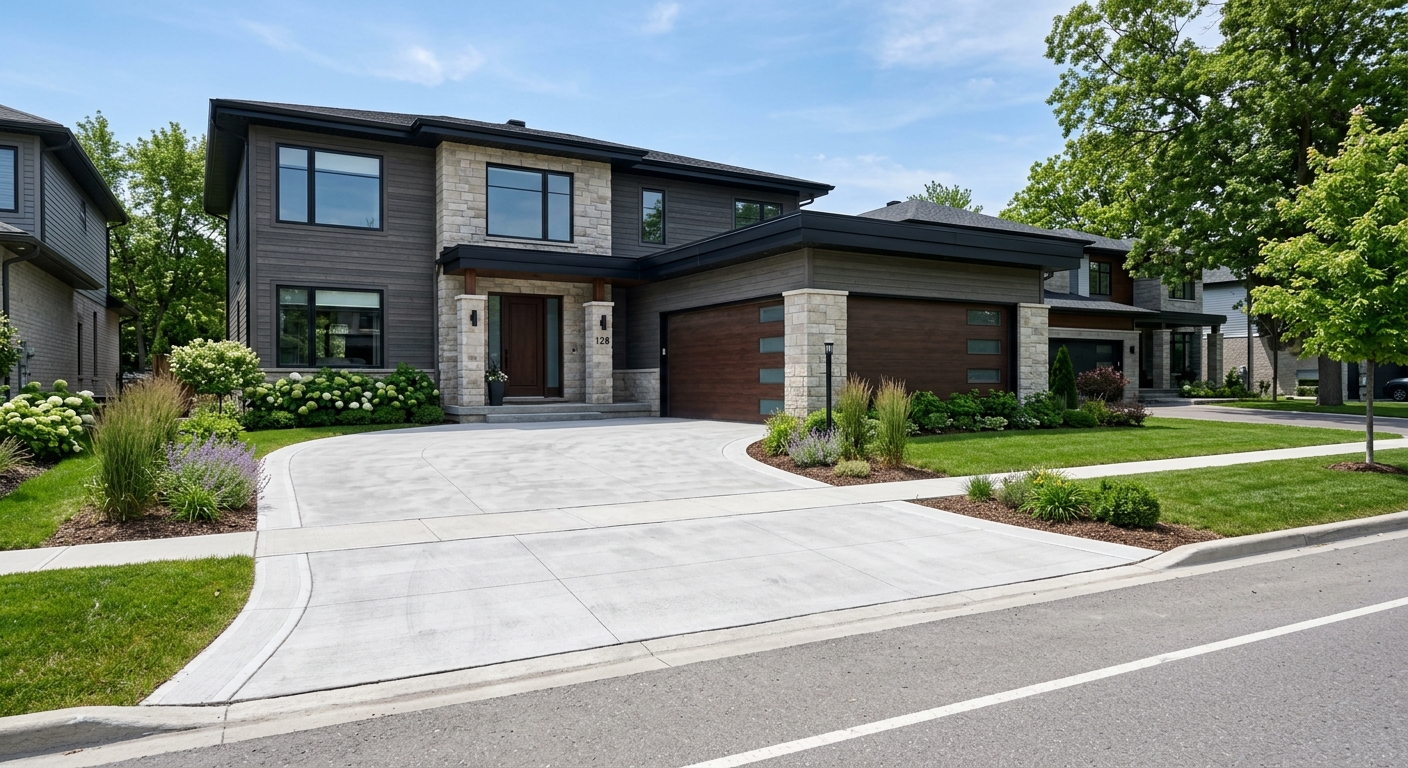
Concrete work options and costs in Evergreen
Evergreen, Alberta is a growing community in the Calgary economic region, and it’s exactly the kind of place where homeowners notice the differences between concrete options—from clean broom-finish driveways to decorative stamped work on patios and walkways. With 20,780 residents as of the 2021 Census (Statistics Canada, 2021 Census), the area reflects a typical Calgary pattern: a lot of owner-occupied housing demand, which drives steady turnover for exterior flatwork. Many projects revolve around the most common concrete “flatwork” needs—driveways, patios, and walkways—where air-entrainment, proper base preparation, and good jointing matter every freeze–thaw season.
In Calgary and nearby neighbourhoods in Evergreen, including the faster-developing pockets around new residential streets, concrete pricing can swing more than people expect because engineered foundation work has to deal with a design frost depth of about 1.2 m (roughly 4 ft). That means deeper excavation and larger footing volumes than in milder regions. On top of that, repeated cold snaps shorten the practical exterior pour season and increase labour time for cold-weather curing precautions (insulation blankets, sometimes temporary heat) to protect the slab while it gains strength. Contractors also plan around efficient truck access and staging, which becomes a cost factor when driveways or forms can’t be set up quickly.
Below is a realistic comparison of typical sizes and finishes homeowners request in Evergreen—then you can line up what you want with the price band that matches your scope.
| Application |
Typical Size |
Key Spec |
Finish Option |
Price Range |
| Concrete driveway (standard broom finish) |
24 ft x 10 ft (240 sq. ft.) |
Air-entrained exterior mix; compacted granular base; joints |
Broom finish; light edge formwork |
$12,000–$18,000 |
| Exposed aggregate driveway |
24 ft x 10 ft (240 sq. ft.) |
Air-entrained mix; controlled wash timing; reinforced edges |
Exposed aggregate with saw-cut control joints |
$15,000–$22,000 |
| Stamped concrete driveway or patio |
16 ft x 20 ft (320 sq. ft.) |
Air-entrained exterior mix; integral colour + seal; joint plan |
Stamped pattern (e.g., stone/brick); sealed finish |
$15,000–$26,000 |
| Plain concrete patio or walkway |
12 ft x 16 ft (192 sq. ft.) |
Air-entrained exterior mix; compacted base; expansion details |
Float + broom or smooth trowel edge |
$5,000–$9,000 |
| Garage floor (interior slab) |
20 ft x 22 ft (440 sq. ft.) |
Vapour control/insulation as needed; reinforcement; proper curing |
Standard trowel finish; optional saw cuts |
$9,000–$15,000 |
| Foundation footings (structural, below frost) |
Typical detached home footprint (varies) |
Reinforced concrete footings extending below design frost depth |
Structural finish—forms and embedments |
$28,000–$45,000 |
Prices are estimates only and vary by project scope, site access and material selection.
What affects the price of concrete work in Evergreen
In Evergreen (and across the Calgary region), quotes for what sounds like “the same concrete job” can differ by 30–50% because the scope usually isn’t actually identical once you factor in excavation, frost protection requirements, reinforcement, and finishing time. A driveway that’s easy to stage and form versus one with tight access, tree roots, or steep grades can take significantly more labour. That’s before you even get to weather-driven curing precautions—cold-weather placement can add labour and materials to keep concrete at the right temperature while it gains strength.
The single biggest technical driver here is frost. Local engineering practice uses a design frost depth of about 1.2 m (roughly 4 ft), so footings for houses, garages, and retaining structures must bear on undisturbed soil below that depth to limit frost heave. Exterior slabs also need air-entrained concrete to survive the frequent freeze–thaw cycles, and joints must be planned and spaced to reduce cracking and spalling. Calgary’s practical exterior pour season is shorter, and crews often need winter-grade measures—insulated blankets and, in some cases, temporary heat—to achieve proper curing. On top of that, de-icing salt accelerates surface wear, so sealing is often recommended, adding both product and labour.
In Evergreen, we commonly see cost increases when homeowners want stamped or exposed aggregate finishes (because the finishing process is slower and requires exact timing), which aligns with the stamped & decorative pricing band of $15,000–$26,000. Meanwhile, a basic broom-finish patio or walkway often fits the $5,000–$9,000 band if site conditions are straightforward. For context, newer homes in the area may still be settling slightly, but concrete performance depends much more on what’s under the slab: base compaction, frost depth compliance, and curing.
| Price Factor |
Why It Matters |
Cost Impact |
| Frost line depth — determines footing depth and form height |
Footings must extend below design frost depth to resist frost heave |
Can raise foundation/footing costs materially due to deeper excavation and concrete volume |
| Site preparation — excavation, grading, compacted granular base |
Proper base prevents settlement and helps manage freeze–thaw movement |
Higher when access is tight, soil is variable, or base thickness increases |
| Reinforcement — rebar or wire mesh requirement |
Controls cracking and improves slab capacity, especially for driveways |
Adds material and labour; depends on slab type and loading |
| Mix design — air-entrainment and compressive strength spec |
Air entrainment helps resist freeze–thaw damage and spalling |
Can increase material cost; reduces long-term repair risk |
| Finish type — broom vs. stamped vs. exposed aggregate |
Finishing affects time, materials, and timing control |
Stamped/exposed typically increases cost versus broom-finish flatwork |
| Pour size and concrete truck access to site |
Truck access affects how fast forms can be placed and how concrete is delivered |
Tight access or long wheelbarrowing can add labour and staging costs |
| Cold-weather curing precautions — heating and blankets |
Ensures strength gain and prevents surface scaling |
More common in fall/early spring and can add noticeable labour/material charges |
| Control joint pattern and sealing cost |
Joints guide cracking; sealing protects against de-icing salts |
Small-to-moderate add-ons, often worth it for exterior slabs |
Permits & regulations in Alberta
In Alberta, structural concrete work typically needs a building permit. That includes reinforced footings, foundation walls, grade beams, and other elements that are part of the structural system. In many cases, engineered drawings are required or reviewed as part of the permitting process. For concrete flatwork—driveways, patios, and walkways—permits are often not required unless the project affects lot grading, impervious surface coverage limits, or ties into municipal right-of-way requirements. Because rules can vary by how your site drains and how the slab is positioned, it’s smart to confirm with the local authority before breaking ground.
Homeowners in Evergreen can also reduce risk by verifying contractor credentials. Step one is to confirm the contractor’s Alberta licence/registration details through the provincial licensing/registry information they provide (or their compliance documents). Step two is insurance: ask for a current Certificate of Insurance showing general liability coverage, and confirm the named insured matches the contracting company on your agreement. Step three is worker protection coverage—verify WSIB/WCB status (the contractor should provide a clearance letter or equivalent proof). Finally, request references on similar-scale concrete work in the Calgary area so you can confirm quality on joints, base prep, and finishing.
If a contractor can’t produce proof of coverage quickly or avoids written scope details, treat that as a red flag—especially in winter-season pours where curing performance depends on process discipline.
Getting concrete right in Evergreen's freeze-thaw climate
Concrete fails in Evergreen mainly because freeze–thaw expands and contracts moisture inside the slab system. If the base isn’t compacted properly, water finds pathways. If the mix isn’t air-entrained at the right level, surface scaling and flaking can show up sooner—sometimes after just a couple of winters. If control joints aren’t planned, cracking can happen randomly, and those cracks become the “routes” for water and salt intrusion.
To spec the job correctly in this Calgary-region climate, start with base preparation: excavate to the right depth for local soil and frost requirements, then place and compact a clean, well-graded granular sub-base. Next is the mix design: for exterior flatwork, ask for air-entrained concrete with an air content target typically in the 5–7% range and a minimum 32 MPa compressive strength specification where applicable. Then address control joints: you want a spacing plan that limits random cracking and works with the finishing and saw-cut schedule. Curing is critical—plan for minimum 7 days of curing under appropriate conditions; in cold weather, the contractor may need insulated blankets and/or heating to maintain proper strength gain. Finally, sealing: apply a penetrating sealer after the slab has cured (often after 28 days) to repel de-icing salts and reduce surface deterioration.
As an example, choosing a stamped driveway may add cost within the $15,000–$26,000 decorative band compared with a broom-finish driveway in the $12,000–$18,000 band. That premium is justified when the contractor is meticulous about joint placement, colour consistency, and curing/season planning. If the base or air-entrainment is compromised, no finish will “fix” long-term spalling.
| Spec |
Why It Matters in Evergreen |
What to Ask For |
Impact if Skipped |
| Compacted granular base (depth?) |
Reduces settlement and manages water movement through freeze–thaw cycles |
Base depth and compacted thickness for your soil, plus proof of compaction |
Uneven slab movement, early cracking, and water pooling |
| Air-entrained concrete mix (target air %?) |
Helps concrete resist freeze–thaw damage and surface scaling in cold Alberta winters |
Specify air content target (commonly 5–7% for exterior flatwork) and mix design |
Spalling and flaking, especially after salt exposure |
| Compressive strength (MPa rating) |
Ensures the slab reaches required strength for durability and loading |
Minimum 32 MPa compressive strength (as specified for the project) |
Lower durability and higher risk of surface and structural issues |
| Control joints (spacing per ACI guidelines) |
Controls where cracking happens so freeze–thaw doesn’t exploit random splits |
Joint spacing plan, saw-cut timing, and sealant/clean-out approach |
Random cracking, water infiltration, and faster deterioration |
| Minimum 7-day curing period |
Strength gain is essential before the slab is exposed to Alberta temperature swings |
How curing will be protected in cold weather (blankets/heat if needed) |
Surface scaling, reduced long-term performance, and weakened durability |
| Penetrating sealer (when applied after cure) |
Repels de-icing salts and moisture that accelerate spalling |
Penetrating sealer timing (often after 28 days) and product details |
Faster surface wear and higher maintenance costs |
How to choose a concrete work contractor in Evergreen
Start by verifying Alberta credentials the practical way. Ask for their current insurance paperwork: a Certificate of Insurance that lists the correct contracting company and shows general liability coverage limits. For worker protection, request proof of WSIB/WCB coverage (commonly provided as a clearance letter or equivalent proof). Many homeowners also confirm licence/registration information using the provincial registry details the contractor references in their marketing or paperwork—don’t rely on “we’re covered” statements without documents.
Next, get 2–3 itemised written quotes. Instead of one lump sum, ask for a breakdown that shows labour, concrete supply, reinforcement, excavation/base prep, formwork, finishing, and site cleanup/disposal. Clarify exclusions: is permit pulling included if it’s required? Is spoil disposal included? What about coring for drainage connections, saw-cutting, sealing, or patching adjacent surfaces? A solid quote will also list the schedule assumptions for truck access and curing protection in cold weather.
For warranty, ask two things: the workmanship warranty length (how long they stand behind cracking/spalling related to installation), and product/manufacturer warranty terms for any sealers or specialty materials. Confirm whether warranties are transferable if you sell the home.
Payment schedule matters. Don’t pay more than about 10–15% upfront. Use holdback until the work is complete and punch-list items are addressed. Finally, insist on a start date and a completion estimate in writing—especially in Calgary-area pours where the cold weather can change the curing plan.
- Ask what mix design and air content target they use for exterior flatwork in Alberta.
- Require base prep details: excavation depth, compacted granular base thickness, and compaction approach.
- Confirm reinforcement plan (wire mesh vs. rebar) matches slab size and expected loads.
- Get the joint plan in writing (spacing and saw-cut timing).
- Ask whether the contractor seals exterior slabs and when (after curing) if you want salt protection.
- Request a materials list for stamped/exposed aggregate work (integral colour, release agents, sealer).
- Verify truck access and staging methods in your driveway/yard layout.
- Ask about cold-weather curing: blankets, heating strategy, and temperature monitoring if needed.
- Make disposal and hauling explicit—don’t assume it’s included.
- Confirm who supplies and installs any expansion joints where the slab meets structures.
- Review warranty terms in plain language and who performs service calls.
- Use a written payment schedule with holdback until curing/sealing and final cleanup are done.
Concrete red flags in Evergreen include: skipping documentation of WSIB/WCB or insurance, quoting stamped work without specifying curing/air-entrainment details, refusing to provide a joint plan (or giving “we’ll figure it out later”), inconsistent wording on disposal/cleanup, and insisting on large upfront payments without a written schedule.
Frequently asked questions — concrete work in Evergreen
Stamped vs broom-finish concrete — cost difference?
In Evergreen, the price gap is usually driven by finishing labour time and tighter timing controls, not just the look. A broom-finish exterior driveway typically falls into the $12,000–$18,000 band for a common size (for example, about 240 sq. ft.), while stamped concrete often lands in the $15,000–$26,000 range depending on square footage, pattern complexity, and whether colour and sealing are included. Stamped work also benefits from disciplined jointing and curing, because colder freeze–thaw cycles in the Calgary region punish weak workmanship. If you’re comparing quotes, ask both contractors to list the same specs: air-entrainment, compressive strength, base thickness, and joint spacing—otherwise the “cheap” quote may be cutting corners that show up after a few winters (spalling and cracking).
When is the best time to pour concrete in Evergreen?
For Evergreen and the Calgary region, the best pours are typically late spring through early fall, when temperatures are stable and curing is easier to protect. The challenge isn’t only air temperature—it’s nighttime cooling and whether the slab can maintain adequate curing temperatures for the strength gain window. In practice, winter pours can still be done, but the contractor should plan cold-weather curing precautions such as insulated blankets and, in some cases, temporary heat. That extra work is part of why exterior slabs can cost more in colder shoulder seasons. If you want the best value and durability, book early for conditions when air and sub-base temperatures are favourable, and ask how the crew will protect curing if there’s a cold snap forecast.
How long does concrete take to cure?
Concrete curing is a process, not a single day. For most exterior flatwork in Alberta, plan on minimum 7 days of curing protection under proper conditions before you expose the slab to heavier use. That doesn’t mean it’s at final long-term performance yet. Many sealers also require more time—often around 28 days after the pour—so the concrete can fully cure and dry to the right condition. In Evergreen’s freeze–thaw climate, curing discipline matters because early cold exposure can lead to surface scaling and reduced durability. When you review quotes, ask what the contractor’s curing plan is for your specific pour date—especially if you’re in late fall or early spring and temperatures drop at night.
Do I need a permit for concrete work in Alberta?
In Alberta, structural concrete work like reinforced footings, foundation walls, and grade beams generally requires a building permit, often with engineered drawings reviewed as part of the permit process. For concrete flatwork such as patios, walkways, and driveways, permits are often not required unless the work affects lot grading, impervious surface coverage limits, or connects to municipal right-of-way/servicing considerations. Because the “permit needed” answer can hinge on site drainage and how the slab is located, confirm with the local authority before you start excavation. Separately, verify your contractor’s liability insurance and WSIB/WCB coverage documentation—having the right paperwork protects you if something goes wrong during cold-weather excavation, forming, or finishing.
Concrete vs pavers for a patio in Evergreen?
Concrete and pavers both work well in Evergreen, but they fail differently. Concrete patios benefit from a continuous slab that’s engineered with base compaction, air-entrainment, and control joints to handle Alberta freeze–thaw. Pavers are modular—if one section heaves, you may be able to lift and reset a smaller area. Cost-wise, plain concrete patios commonly fit the $5,000–$9,000 band for a typical residential-size scope, while paver projects usually vary more depending on base depth, edging, and pattern labour. The bigger decision often comes down to maintenance and aesthetics: concrete is typically lower maintenance once sealed, while pavers may require periodic joint sand top-ups. Ask your contractor for the base spec and the freeze–thaw drainage plan either way.
How long does a concrete driveway last?
With correct base preparation, air-entrained exterior mix, appropriate joints, and curing discipline, a concrete driveway in the Calgary region commonly lasts 20+ years and sometimes longer. Evergreen’s reality is that freeze–thaw and de-icing salt are the main accelerators of wear—surface scaling can appear if air-entrainment or curing protection is compromised. That’s why sealing (often applied after curing, commonly around 28 days) is a practical step for repelling salt and slowing surface deterioration. Also, driveway life depends on how the slab is detailed where it meets garage slabs and sidewalks, and whether water is managed to avoid pooling. If you’re budgeting, a broom-finish driveway in the $12,000–$18,000 range is usually the best balance of durability and cost when the specs are done right.