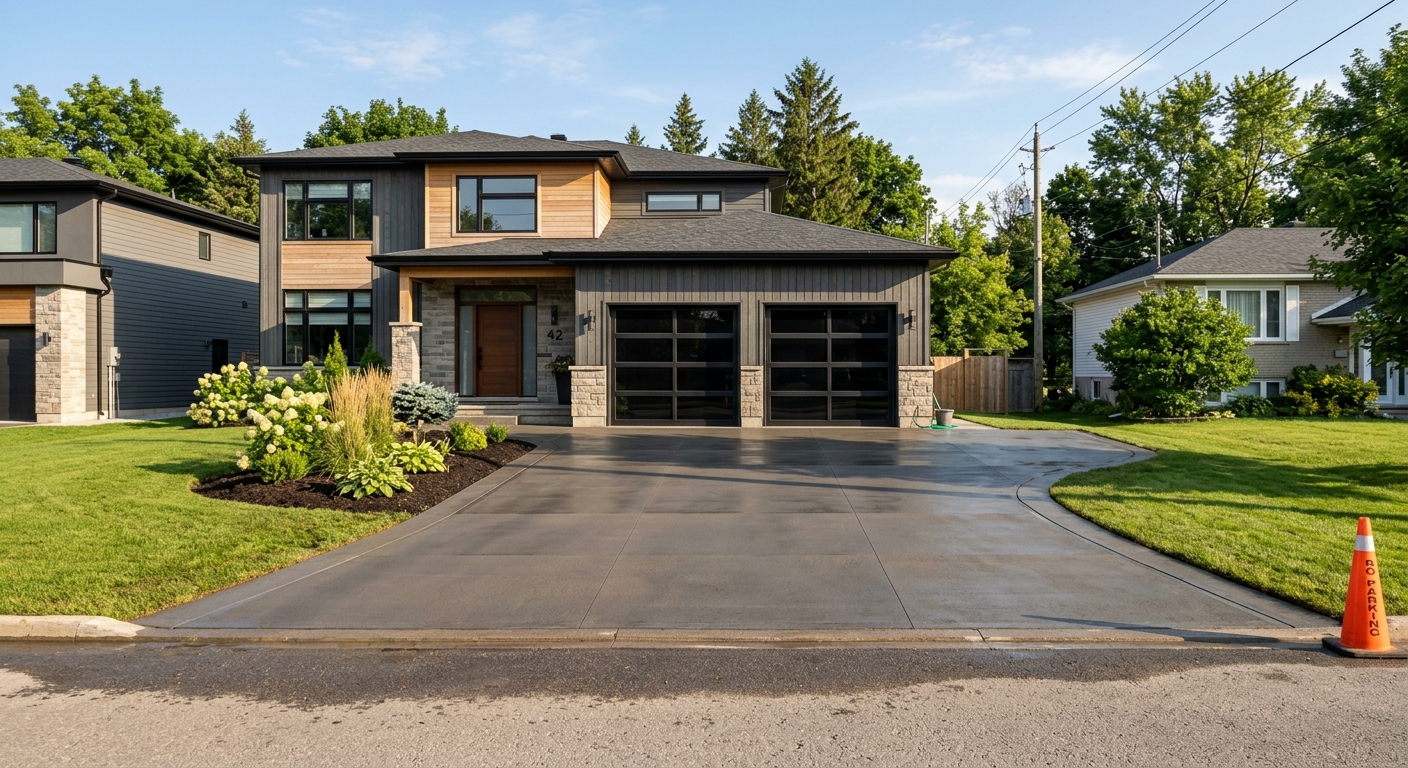
Concrete work options and costs in Allendale
Allendale, Alberta is a great neighbourhood to invest in concrete flatwork, but pricing reflects the realities of building in the Calgary area. With a total population of 2,728 (Statistics Canada, 2021 Census), local demand is steady and you’ll often see crews booked around the exterior pour season. Most homeowners here are dealing with the same core needs—driveways, patios, walkway repairs and, in many cases, new or upgraded foundation work—because single-detached housing is a common driver of projects that require durable, properly detailed slabs on grade. In Calgary’s cold continental climate, concrete isn’t “set and forget.” The frost line is deeper and freeze–thaw cycles are frequent, so designs focus on keeping water away from the slab edges and supporting footings below undisturbed soil.
That deeper frost depth (about 1.2 m, roughly 4 ft, as used in engineering practice) means more excavation and higher footing volumes, especially for garages, retaining walls and house foundations. Exterior flatwork also requires air-entrained concrete mixes, careful grading, and tight control joint planning to reduce cracking and scaling. On top of that, cold-weather placement may require insulated blankets and sometimes temporary heat to protect curing—one reason you can see contractor availability tighten in late fall and early spring.
In Allendale, areas close to established residential lanes where access is straightforward tend to be especially in demand—driveways and front walkways for homeowners near ongoing upgrades are common calls. Next, here’s a practical comparison of typical options and what you can expect to pay.
| Application |
Typical Size |
Key Spec |
Finish Option |
Price Range |
| Concrete driveway (standard broom finish) |
24 ft x 12 ft (288 sq. ft.) |
Air-entrained, compacted granular base |
Broom finish with joints |
$12,000–$18,000 |
| Exposed aggregate driveway |
24 ft x 12 ft (288 sq. ft.) |
Air-entrained mix; good surface curing |
Exposed aggregate (stone reveal) |
$15,000–$22,000 |
| Stamped concrete driveway or patio |
20 ft x 16 ft (320 sq. ft.) |
Air-entrained mix; proper release and joints |
Stamps with colour hardener or integral colour |
$15,000–$26,000 |
| Plain concrete patio or walkway |
12 ft x 12 ft (144 sq. ft.) |
Air-entrained; compacted base and drainage slope |
Broom or smooth-trowel (light texture) |
$5,000–$9,000 |
| Garage floor (interior slab) |
22 ft x 24 ft (528 sq. ft.) |
Vapour barrier as required; reinforcement |
Steel trowel + broom edges |
$12,000–$20,000 |
| Foundation footings (structural, below frost) |
Per plan; typical new build/major underpin |
Engineered rebar; bearing below frost depth |
Structural concrete only |
$28,000–$45,000 |
Prices are estimates only and vary by project scope, site access and material selection.
What affects the price of concrete work in Allendale
If you’re comparing quotes in Allendale, it’s not unusual to see the same “size” job swing by 30–50% across Calgary and the wider region. The difference usually comes down to what’s included in the excavation and base prep, how reinforcement is specified, and whether the contractor is building for freeze–thaw durability instead of trying to minimize concrete cost. In a deeper-frost climate, footings for houses, garages and retaining structures must bear on undisturbed soil below the design frost depth of about 1.2 m. That can add labour and truck time compared with places where frost penetration is shallower.
Concrete mix design also drives cost. Exterior slabs need air-entrained concrete to survive freeze–thaw cycling, and cold-weather placement can require winter-grade mixes, insulated blankets and sometimes temporary heat to achieve proper curing. Those curing precautions protect the surface from scaling and help maintain long-term strength. Finally, de-icing salt in winter accelerates surface spalling if the mix and finishing aren’t right—sealing is often a small add-on compared to the cost of repairs.
In Allendale, three common examples where your bill changes: (1) poor soil or soft subgrade means deeper removal and more granular base, which pushes driveway pricing upward toward the upper end of $12,000–$18,000; (2) complex grading or tight access can require more time and smaller placements, sometimes bringing stamped work toward $15,000–$26,000; and (3) winter pours or late-season scheduling can add heat/blanket requirements and extend labour hours, especially for larger patios and walkway systems.
Even how recently a home was built can matter—older lots often have older drainage patterns and more fill, so you may pay more for correct regrading and drainage control than a new-build site.
| Price Factor |
Why It Matters |
Cost Impact |
| Frost line depth — determines footing depth and form height |
Footings must extend below design frost depth to limit frost heave |
Higher excavation and concrete volume; can significantly increase foundation-related bids |
| Site preparation — excavation, grading, compacted granular base |
Proper base prevents settling and helps manage water |
Soft soils or poor drainage can raise costs via extra removal and granular material |
| Reinforcement — rebar or wire mesh requirement |
Controls cracking and supports loads (especially driveways/garage slabs) |
More steel and tying time increases labour and material costs |
| Mix design — air-entrainment and compressive strength spec |
Air-entrainment improves freeze–thaw durability |
Upgraded mix and quality control can increase per-cubic-yard cost |
| Finish type — broom vs. stamped vs. exposed aggregate |
Surface finish affects appearance, slipping resistance, and labour time |
Decorative finishes add formwork, tooling, and staging; typically higher |
| Pour size and concrete truck access to site |
Smaller access or multiple placements increases labour and coordination |
Tight driveways can add truck delays and labour for placement/moving materials |
| Cold-weather curing precautions — heating and blankets |
Protects curing when nights drop and freeze risk increases |
Winter protection increases labour time and materials for insulation/heating |
| Control joint pattern and sealing cost |
Joints manage cracking; sealing helps reduce salt-driven surface wear |
More precise layout and seal application add cost but reduce future repairs |
Permits & regulations in Alberta
In Alberta, structural concrete work generally requires a building permit and often engineered drawings that the municipality reviews. That means work such as concrete footings, foundation walls and grade beams should be permitted because they relate directly to structural integrity. For concrete flatwork like patios, walkways and driveways, permits usually are not required by default; however, exceptions can apply when the work impacts lot grading, drainage, impervious surface coverage rules, or the municipal right-of-way. The safest approach is to confirm with the local authority before breaking ground, especially if you’re changing elevations near a sidewalk or altering drainage paths.
Before you hire in Allendale, verify the contractor is properly insured and able to legally perform the work. Step-by-step: (1) ask for their current certificate of insurance and confirm liability coverage limits are appropriate for your scope; (2) confirm they carry WSIB/WCB coverage (or provide proof you can keep on file); (3) request a contractor business licence or registration details where applicable and ensure their company name matches the quote; and (4) use available online registries to confirm the correct status and contact information for the legal entity.
Finally, ask for references on similar-scale Calgary-area pours (especially projects with exterior freeze–thaw exposure). Good contractors are ready with past job photos, timelines, and a clear list of exclusions so you know what you’re paying for from day one.
Getting concrete right in Allendale's freeze-thaw climate
In Allendale’s winter cycles, the most common concrete failures come from freeze–thaw damage plus poor water management. If the base isn’t compacted correctly or if water can infiltrate the slab edges, expansion during freezing can lead to heaving, while ongoing wetting and thawing weakens the surface. You spec the job correctly by locking in five essentials: (1) base preparation with a properly compacted granular sub-base to the correct depth for local soil and the region’s frost considerations; (2) mix design—exterior flatwork should use air-entrained concrete (target air content typically around 5%–7%) and a minimum 32 MPa compressive strength; (3) control joints placed to limit random cracking (and properly detailed); (4) curing—aim for a minimum of 7 days under proper conditions, and in cold weather include insulated blankets or temporary heat as needed; and (5) sealing with a penetrating sealer applied 28 days after the pour to help repel de-icing salts.
For driveways and walkways in the Calgary market, air-entrainment and a sound base are where you buy durability. It’s not unusual to see a “lower price” quote that skimps on granular base thickness or uses a less robust mix—those savings often show up as scaling or spalling earlier than expected. For example, a stamped patio might land around $15,000–$26,000, while a broom-finished plain patio could be closer to $5,000–$9,000; choosing stamped is a design decision, but you should demand the same freeze–thaw specifications underneath so the decorative surface doesn’t become the first thing to fail.
Use your estimate as a technical checklist: if the contractor can’t clearly explain base depth, air-entrainment, curing plan and joint layout, you’re taking unnecessary risk in Allendale’s climate.
| Spec |
Why It Matters in Allendale |
What to Ask For |
Impact if Skipped |
| Compacted granular base (depth?) |
Supports the slab and reduces movement under freeze–thaw |
Confirm base thickness and the compaction standard (engineered for your soil) |
Settling, cracking, and edge breakdown over winter cycles |
| Air-entrained concrete mix (target air %?) |
Improves resistance to freeze–thaw scaling and spalling |
Ask for air content target (commonly 5%–7% for exterior flatwork) |
Higher risk of surface deterioration from salty meltwater |
| Compressive strength (MPa rating) |
Ensures structural adequacy and longer-term durability |
Minimum 32 MPa (confirm strength spec on the quote) |
Reduced strength development and faster wear |
| Control joints (spacing per ACI guidelines) |
Controls where cracks form so they’re not random |
Ask for joint spacing plan and whether saw-cut timing is followed |
Random cracking, wider cracks, and more water intrusion |
| Minimum 7-day curing period |
Concrete gains strength while it cures; cold weather slows cure |
Ask what conditions/temperature measures are used in cold snaps |
Surface weakness, scaling, and reduced long-term performance |
| Penetrating sealer (when applied after cure) |
Repels water and helps reduce salt-driven surface breakdown |
Confirm sealer type and that it’s applied at 28 days post-pour |
Faster spalling risk and more staining/penetration |
How to choose a concrete work contractor in Allendale
Choosing the right contractor matters even more in Allendale because your slab and joints must survive Calgary-area freeze–thaw and winter salt. Start by verifying Alberta compliance the practical way. Ask for: (1) a current liability insurance certificate—confirm your address is covered by the policy period; (2) proof of WSIB/WCB coverage for their workers; and (3) the legal business details that match the quote. If they hesitate or provide outdated documents, treat that as a red flag.
Then get 2–3 itemised written quotes rather than one lump-sum number. You want separate line items for excavation, granular base, reinforcement, concrete supply, finish, joints, sealing (if included), and cold-weather curing measures (blankets/heating). Clear scope reduces the chance of “change orders” later.
Read the scope carefully for exclusions: Is demolition/removal included? Is disposal of concrete included? Are permits and inspections included if required? Also ask about warranty terms—what is the workmanship warranty length, and does it cover workmanship only or also materials? For products (like sealers or admixtures), confirm whether there’s a manufacturer warranty and whether you’re able to transfer it if you sell the home.
Payment scheduling should protect you: never pay more than about 10–15% upfront, and hold back a portion until final cleanup and close-out paperwork are complete. Finally, require a written timeline with a start date and estimated completion date, since Edmonton-style weather fronts don’t respect a contract schedule.
- Provide proof of liability insurance and WSIB/WCB coverage before you sign.
- Use itemised quotes: base, concrete supply, reinforcement, finishing, joints, sealing.
- Ask for their approach to air-entrainment and minimum strength (e.g., 32 MPa).
- Confirm they engineer for frost considerations and won’t undercut base/footings.
- Request a joint layout plan and saw-cut timing expectations.
- Ask how they handle cold-weather curing (blankets/heating) if temperatures drop.
- Clarify disposal and cleanup (haul-away, brooming, protection of landscaping).
- Confirm whether crack control sealing is included and when sealer will be applied (after cure).
- Ask about access: concrete truck staging, pumping requirements, and traffic control.
- Get a written warranty and confirm it’s in plain language.
- Avoid quotes that don’t mention drainage slope and edge details for exterior slabs.
- Use a payment schedule tied to milestones, with a holdback for final acceptance.
Concrete red flags in Allendale include: quotes that don’t mention air-entrained mix for exterior work, vague scope with no base prep details, contractors who rely on “it’ll be fine” curing practices in cold weather, missing insurance/WSIB documentation, and payment requests that demand a large upfront deposit without a clear schedule.
Frequently asked questions — concrete work in Allendale
How long does a concrete project take in Allendale?
In Allendale, timelines depend on size, site access, and weather window for curing. A typical driveway or patio job often takes a few days of active work (excavation, base prep, formwork, pour, finishing, and saw-cutting), but the schedule doesn’t “finish” until the concrete has cured properly. Many exterior slabs should sit undisturbed for at least 7 days before you expect normal light use, and full durability comes with time under good curing conditions. If the pour is pushed into colder nights, the contractor may need insulated blankets or temporary heat to protect curing—this can add setup time and shift completion. For homeowners planning around winter, it’s usually safer to schedule exterior work earlier in the season so curing conditions stay within a contractor’s controlled range (Statistics Canada, 2021 Census).
What is a concrete overlay and is it suited to Allendale?
A concrete overlay is a new concrete layer placed over an existing slab—often to renew a driveway or patio surface without full removal. It can be suited to Allendale when the original slab is structurally sound: minimal settlement, no major heaving, and good drainage control. The key is prep: the existing surface must be properly cleaned, profiled, and bonded correctly, and any recurring water issues must be fixed or the overlay can fail early. In Calgary-area freeze–thaw conditions, overlay systems can be more sensitive to moisture and adhesion quality than full replacement because expansion and water pathways remain a concern if edges and base drainage aren’t corrected. If you’re comparing options, ask for a detailed bonding and joint plan and expect overlays to cost less than full decorative replacement—but full replacement may be the safer durability choice if there’s widespread cracking or spalling.
How do I seal concrete to protect it in Allendale?
Sealing helps protect exterior concrete from water penetration and de-icing salt effects, which is especially important during Calgary-area freeze–thaw cycling. For best results in Allendale, wait until the slab has cured properly—commonly 28 days post-pour—then apply a penetrating sealer rather than only a surface film. The concrete should be clean and dry before application, and the contractor should confirm that the sealer type matches your finish (broom, stamped, exposed aggregate) and expected salt exposure. If you live near high-salt access routes or you use aggressive de-icers, sealing is one of the lowest-cost durability steps compared to repairing spalling later. Many homeowners who invest in decorative work still choose sealing because it protects the colour and reduces water-driven wear. Ask whether the contractor includes sealing as part of the estimate or treats it as an add-on.
What is the difference between concrete and cement?
In everyday terms, people often say “cement” when they mean “concrete,” but technically they’re different. Cement is a binder powder (a component) that’s combined with aggregates (sand and stone), water, and often admixtures (like air-entraining agents) to produce concrete. In Allendale, what matters most for performance is the final concrete mix: exterior slabs should use air-entrainment to handle repeated freezing and thawing, and the mix should meet a specified compressive strength (often 32 MPa for many structural and exterior applications). So when you’re getting quotes, don’t just ask for “cement”—ask for the concrete mix design, the air content expectation, and how cold-weather curing will be handled. That’s where freeze–thaw durability is built, not in the word choice.
How much does concrete work cost in Allendale?
Concrete pricing in Allendale generally follows the Calgary-area price bands tied to climate-driven requirements like air-entrainment, base prep, and cold-weather curing. For example, a typical concrete driveway commonly falls around $12,000–$18,000 depending on size, excavation, and finish details. A plain patio or walkway may run closer to $5,000–$9,000, while stamped or decorative concrete is usually higher because it includes labour-intensive finishing—often landing around $15,000–$26,000. If your project involves foundation footings, pricing can be in the $28,000–$45,000 range depending on engineered requirements and excavation depth. Exact costs vary with access, removal/disposal needs, soil conditions, and whether the contractor includes sealing and winter curing precautions.
How deep must footings be for Allendale's frost line?
For Allendale, concrete footings are designed around the local frost depth used in engineering practice for the Calgary region. The design frost depth is about 1.2 m (roughly 4 ft). That means footings for houses, garages, decks, and retaining structures typically must bear on undisturbed soil below that frost depth so seasonal freezing can’t lift the foundation. In real jobs, the final depth can vary based on soil conditions, drainage, and the engineered foundation design for your specific footprint and building loads. When you receive a quote, ask whether they’re working to engineered drawings and whether excavation will reach undisturbed bearing. If a contractor suggests shallower bearing “to save money,” that’s a durability risk in a freeze–thaw climate where movement can show up as cracking, uneven settlement, or recurring water problems.