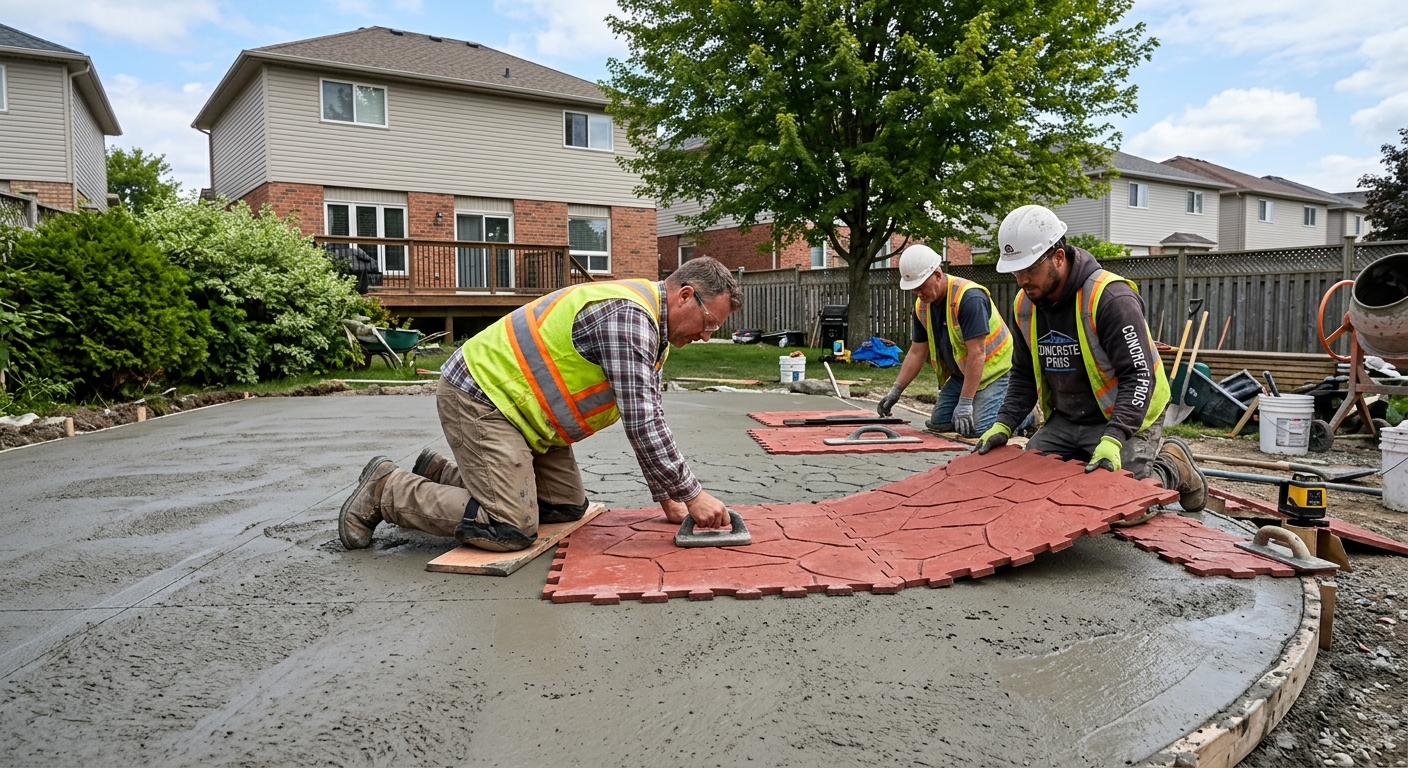
Concrete work options and costs in Belmead
Belmead, Alberta is a smaller community within the Calgary area, and concrete flatwork is one of the trades homeowners rely on for driveways, patios, walkways, and foundation work. With a population of 4,602 (Statistics Canada, 2021 Census), the market is tighter than Calgary itself—so contractor availability and scheduling can affect how quickly you can get on a pour calendar. In many homes here, the primary demand is for durable exterior slabs that can stand up to long winters and freeze–thaw cycles, which is especially important given how actively people maintain driveways and entry areas in the region.
In the Calgary economic region, the cold continental climate drives costs through engineering and construction practices: local code/engineering practice commonly uses a design frost depth of about 1.2 m (roughly 4 ft) for typical residential work. That means more excavation and deeper, larger footing volumes than you’d see in milder climates. Exterior slabs and walkways also need air-entrained concrete and well-planned control joints to reduce cracking and surface scaling. If you’re taking bids for work in a higher-traffic pocket like the newer subdivisions and serviced edges where home renovations are frequent, you’ll often see more demand for broom-finished, exposed-aggregate, and decorative front-entry upgrades.
Because of these climate-driven requirements, two bids for “the same” driveway can land far apart depending on base preparation, mix design, reinforcement, and finish. Use the ranges below as a practical starting point for comparing options, then we’ll break down what changes the price most.
| Application |
Typical Size |
Key Spec |
Finish Option |
Price Range |
| Concrete driveway (standard broom finish) |
10 m x 3 m (30 m²) |
Air-entrained mix, compacted granular base |
Broom finish |
$12,000–$18,000 |
| Exposed aggregate driveway |
10 m x 3 m (30 m²) |
Air-entrained mix, proper cure window |
Exposed aggregate |
$15,000–$21,000 |
| Stamped concrete driveway or patio |
10 m x 3 m (30 m²) |
Air-entrained mix, color hardener (optional) |
Stamped pattern |
$15,000–$26,000 |
| Plain concrete patio or walkway |
3 m x 3 m (9 m²) |
Air-entrained mix, compacted sub-base |
Plain trowel/broom blend |
$5,000–$9,000 |
| Garage floor (interior slab) |
6 m x 6 m (36 m²) |
Vapour barrier (if specified), reinforcement as required |
Broom finish or smooth trowel (hybrid) |
$9,000–$16,000 |
| Foundation footings (structural, below frost) |
Typical house perimeter |
Excavate to design frost depth, reinforced footings |
Structural concrete |
$28,000–$45,000 |
Prices are estimates only and vary by project scope, site access and material selection.
What affects the price of concrete work in Belmead
In Belmead and across the Calgary area, it’s common to see quotes for the “same” concrete work vary by 30–50% once you compare the details. That’s because concrete isn’t just a material cost—it’s engineered around frost depth, durability, and careful construction sequencing. The frost line depth drives excavation and form height; in Alberta, footings must bear on undisturbed soil below the design frost depth (often up to about 1.2–2.4 m depending on application and engineering). Add in frequent freeze–thaw cycles, and you’ll typically see air-entrained concrete specified for exterior flatwork to manage scaling and freeze damage.
Cold-weather placement also compresses the usable pour season and can require winter-grade concrete, insulated blankets, and sometimes temporary heat to hit the required curing window. That’s why exterior slabs and driveways can come in near the lower end when scheduled in the warm/shoulder months, but move toward the upper end when late-season weather forces cold-weather protection. Sealing is another cost lever: de-icing salt is hard on surfaces, and a proper penetrating sealer after cure helps reduce spalling and surface deterioration.
In practical Belmead terms, a driveway that needs significant excavation and removal of unsuitable topsoil will cost closer to the high band of the $12,000–$18,000 driveway range. If you’re choosing decorative options, stamped work (often in the $15,000–$26,000 band) is typically justified by higher labour complexity, colour/finishing steps, and curing discipline. If you’re working on a newer home build with better access and already-prepped grades, costs can stabilize near the mid-range because site conditions reduce truck time and rework.
| Price Factor |
Why It Matters |
Cost Impact |
| Frost line depth — determines footing depth and form height |
Footings must bear below frost to prevent heave and movement |
Higher excavation and concrete volume; can push structural work toward upper ranges |
| Site preparation — excavation, grading, compacted granular base |
Bad base leads to settlement, cracking, and premature failure |
Extra haul-off/compaction can add significant labour and equipment time |
| Reinforcement — rebar or wire mesh requirement |
Controls cracking and improves slab performance under load |
Material and labour increases, especially for larger or thicker slabs |
| Mix design — air-entrainment and compressive strength spec |
Freeze–thaw resistance depends on air-entrained concrete |
Winter-grade and specified strength mixes can raise costs |
| Finish type — broom vs. stamped vs. exposed aggregate |
Finishes change labour hours, materials, and cure timing |
Standard is lowest; decorative finishes climb into higher price bands |
| Pour size and concrete truck access to site |
Long pump distances or inaccessible lots require extra handling |
More time per load, potential pump/spotting charges |
| Cold-weather curing precautions — heating and blankets |
Concrete needs stable conditions to develop strength without scaling |
Blankets, heaters, monitoring, and shorter pour windows increase labour costs |
| Control joint pattern and sealing cost |
Joints guide cracks and sealing helps resist de-icing salt damage |
Better detailing costs more upfront but reduces long-term surface repairs |
Permits & regulations in Alberta
In Alberta, structural concrete work typically needs more formal approvals than simple flatwork. For example, concrete used for foundation footings, foundation walls, and grade beams usually requires a building permit, and engineered drawings are often reviewed by the municipality as part of the permit process. Concrete flatwork—like patios, walkways, and most driveways—often does not require a permit by itself, but there are important exceptions. If the work affects lot grading, changes drainage patterns, increases impervious surface coverage beyond local constraints, or touches municipal right-of-way requirements (like approach/culvert areas), permit review may be required. When you’re unsure, confirm with the local authority before the first shovel goes in.
As a homeowner in Belmead, you can verify contractor compliance step-by-step. First, request the contractor’s proof of liability insurance and confirm the certificate details match the legal name of the business doing the work. Second, ask for WSIB/WCB coverage documentation (even for small crews, subcontractor status matters). Third, check the Alberta licence/registration information through the appropriate provincial registry resources and verify the trade is in good standing for the scope being quoted. Finally, ask for references from similar residential concrete jobs—especially in the Calgary freeze–thaw environment—so you can see how their curing and jointing practices hold up over time.
Getting concrete right in Belmead's freeze-thaw climate
Concrete failures in Belmead are usually predictable: freeze–thaw damage, cracking from weak base support, and surface scaling from poor curing or the wrong mix design. To spec the job correctly, start with base preparation. Exterior slabs and driveways need a compacted granular sub-base to the depth required by the design and site conditions, not just “topsoil removed.” That matters because a frost-susceptible layer can move during seasonal cycles, transferring stress into the slab.
Next is mix design. For exterior flatwork, air-entrainment is non-negotiable in Alberta’s climate; a common target is about 5–7% air content to improve freeze–thaw durability. Pair that with a minimum compressive strength spec (often at least 32 MPa for typical residential exterior work, depending on design). Then plan control joints: joints are there to control where shrinkage and temperature cracking happens so cracks don’t become random and wider. Curing is the make-or-break step. Even if the pour looks fine, rushing curing in late fall or early spring can lead to scaling and reduced long-term durability. A minimum 7-day curing period under proper conditions is the baseline. Finally, sealing: apply a penetrating sealer after the concrete has cured (commonly at 28 days) to help repel de-icing salts and reduce spalling risk.
When comparing options, it helps to understand where the money is justified. For example, a standard broom-finish driveway might land in the $12,000–$18,000 band, while stamped concrete could be in the $15,000–$26,000 band. The additional cost can be worth it if the contractor also controls curing, joint placement, and sealer application—those performance steps are what protect the decorative surface through winters.
| Spec |
Why It Matters in Belmead |
What to Ask For |
Impact if Skipped |
| Compacted granular base (depth?) |
Reduces settlement and frost-related movement under slabs |
Confirm sub-base depth and compaction method for your soil and slab thickness |
Settlement cracking, uneven slab, shortened lifespan |
| Air-entrained concrete mix (target air %?) |
Improves freeze–thaw durability in cold continental winters |
Ask for target air content and that the mix is designed for exterior exposure |
Higher risk of scaling and spalling on salted surfaces |
| Compressive strength (MPa rating) |
Strength development supports load capacity and durability |
Ask for the MPa requirement (commonly 32 MPa minimum for typical work) and slump/air specs |
Surface wear, increased cracking, reduced long-term performance |
| Control joints (spacing per ACI guidelines) |
Controls where cracks form during shrinkage and temperature cycling |
Ask for planned joint spacing, layout, and saw-cut timing |
Random cracking and wider, unsightly breaks |
| Minimum 7-day curing period |
Strength gain and surface protection depend on proper curing |
Confirm curing plan, especially if temperatures drop near/under freezing |
Scaling, reduced strength, long-term surface damage |
| Penetrating sealer (when applied after cure) |
Helps protect against de-icing salt and moisture ingress |
Ask when sealing is applied (commonly around 28 days) and the product type |
Faster spalling and staining, more frequent maintenance |
How to choose a concrete work contractor in Belmead
Choosing the right concrete contractor in Belmead starts with verifying the basics. In Alberta, confirm liability insurance is active and that the certificate lists the correct legal entity. Then ask for WSIB/WCB clearance or coverage documentation for the workers on site (including subcontractors). Next, verify the contractor’s Alberta licence/registration relevant to the scope being quoted using the appropriate provincial registry resources. Don’t rely on “we’re covered” without documentation—get copies before work starts.
For pricing, push for 2–3 itemised written quotes instead of a single lump-sum number. You want a breakdown showing labour, excavation/site prep, granular base, reinforcement, concrete supply/mix design, forms, finishing, saw-cutting, and sealing (if included). Check exclusions: is demolition included? Is disposal/hauling included? Are utility locates included? Is the pour date protected for cold-weather curing with blankets/heaters when needed?
Warranty matters too. Ask for both workmanship warranty length and what’s covered by the product/manufacturer (if a sealer or admixture is specified), and whether any warranty transfers if you sell the home. On payment, never pay more than 10–15% upfront; hold back a portion until the job is complete and walk-through deficiencies are addressed. Finally, request a written start date and a completion estimate tied to weather assumptions—because in Calgary-area conditions, curing and temperature control are part of the schedule.
- Confirm liability insurance and request the certificate before scheduling the pour.
- Verify WSIB/WCB coverage (and for subcontractors, too).
- Ask for Alberta licence/registration details matching the quoted scope.
- Get quotes itemised by demo, excavation, granular base, reinforcement, concrete supply, finishing, joints, and sealing.
- Require a written description of the mix design (air-entrainment) for exterior work.
- Ask when control joints will be installed (layout plan + saw-cut timing).
- Confirm curing plan, including cold-weather blankets/heating if near freezing.
- Make sure the quote includes disposal/haul-off if excavation is required.
- Check whether pump charges, rebar placement labour, or additional access equipment are included.
- Ask for a completion walk-through and a punch list process.
- Review warranty terms in writing (workmanship + product/sealer coverage).
- Set payment schedule with a holdback; avoid large early deposits.
Concrete red flags in Belmead include: vague mix wording (no air-entrainment/strength specs), skipping or delaying control joints, poor documentation of curing protection in shoulder or cold-season weather, inconsistent base prep claims (no granular depth or compaction method), and contracts that don’t clearly address sealing timing or how spalling/cracking issues are handled.
Frequently asked questions — concrete work in Belmead
What is air-entrained concrete and why does it matter here?
Air-entrained concrete is mixed with tiny, evenly distributed air bubbles that give freezing water somewhere to expand. In Belmead and the wider Calgary area, freeze–thaw cycles are frequent and de-icing salt is common, so air entrainment is one of the biggest protections against scaling and spalling on exterior slabs. That’s why reputable contractors specify air-entrainment and confirm the target air content for your exposure conditions. If a quote only mentions “concrete” without air content or calls for a standard mix for an outdoor driveway, you should treat it as incomplete—those cost savings often show up later as surface deterioration. For budgeting, exterior driveways commonly sit around $12,000–$18,000, but a proper air-entrained spec is part of why the mid-to-upper bids last longer.
How do I prepare the base for a concrete slab?
Base prep is where most long-term performance is won or lost. For a Belmead slab (driveway, patio, walkway), the contractor should remove topsoil and any organic material, then place a compacted granular sub-base to the required depth for your slab thickness and local soil conditions. Proper compaction matters as much as thickness—under-compacted base leads to settlement, and settlement turns into cracking that won’t be fixed by finish work alone. Ask your contractor to explain the granular material type, compaction method, and how they’ll verify grade. If drainage is tight or the site is marginal, they should also discuss how water will be handled. Good base prep supports durable concrete in Alberta’s frost-driven conditions and helps keep costs from creeping up through rework.
How do I compare concrete quotes?
To compare quotes in Belmead fairly, don’t just compare the bottom line. Ask each contractor to provide an itemised breakdown (demo/excavation, granular base, reinforcement, concrete supply with mix specs, finishing, jointing, and sealing). Confirm they’re pricing the same finish and the same thickness, and that exterior work includes air-entrained concrete and a documented curing plan. Also compare allowances: is disposal included? Are pump or cartage charges included if truck access is limited? Check whether the quote includes control joints at the correct spacing and when saw-cutting will occur. With Calgary-area freeze–thaw, cutting corners on base prep or curing can make a driveway that “costs less today” end up needing repairs sooner. As a benchmark, standard driveways often land around $12,000–$18,000, while stamped work commonly goes into the $15,000–$26,000 band—decorative costs should come with stronger specs, not weaker ones.
Can concrete be poured in cold weather in Belmead?
Yes, concrete can be poured in cold weather in Alberta, but it must be done with the right precautions. The issue isn’t only freezing during placement—it’s maintaining adequate curing conditions long enough for strength gain. In Belmead, contractors typically rely on winter-grade mixes, insulated blankets, and sometimes temporary heat to protect the slab during the early curing window. They also schedule pours so they can monitor temperatures and prevent premature freezing that can lead to scaling or reduced strength. A good contractor should explain their cold-weather plan (blankets/heating, curing duration, and how they’ll handle wind and temperature drops). If a quote assumes “normal curing” with no protection even when late-season temperatures are likely, that’s a serious concern.
How do I maintain concrete in Belmead's freeze-thaw climate?
Maintenance is about keeping water and salt from attacking the surface. First, use a penetrating sealer applied after curing (commonly around 28 days) if the contractor didn’t already include it. That helps repel moisture and can reduce salt-related surface damage. Second, clean promptly—don’t let grit and de-icing residue sit on decorative or broom-finished surfaces. Third, keep an eye on joints and edges; if joints open or edges crumble, repair early so water doesn’t penetrate the base. In Belmead winters, avoid aggressive de-icing practices when possible and switch to calcium chloride blends or sand where appropriate, following manufacturer guidance for the product you use. With correct sealing and joint attention, exterior flatwork in a freeze–thaw climate typically performs much better over time, reducing the need for costly replacement.
What causes concrete to spall in Belmead winters?
Spalling usually happens when water gets into the concrete and then freezes, expanding and breaking the surface. In Belmead’s Calgary-area climate, freeze–thaw cycles plus de-icing salts accelerate deterioration, especially if the concrete isn’t properly air-entrained or if curing was rushed. Another common cause is weak or wet base conditions that cause micro-movement, allowing moisture to migrate into the slab. Poor joint detailing can also contribute because cracks form randomly and water finds paths into the slab. If the finishing was done too aggressively or curing blankets weren’t used during cold snaps, surface scaling can start and then progress toward spalling. When you’re comparing quotes, insist on air-entrainment specs, a minimum 7-day curing plan (with cold-weather protection when needed), and a penetrating sealer after cure—those items are what reduce spalling risk in Alberta winters.