Concrete work options and costs in Larkspur
Larkspur, Alberta is a smaller community within the Calgary region, and concrete flatwork is a big part of how homeowners upgrade curb appeal and function. With a population of 4,988 (Statistics Canada, 2021 Census), there’s steady demand—especially from established neighbourhoods where people are improving driveways, adding patios, and renewing garage slabs. This matters because the most common concrete work—driveways, walkways, patios, and interior garage floors—depends heavily on engineered base prep and proper curing in our cold continental climate.
Across the Calgary area, freeze–thaw cycles drive costs in ways you can feel in the schedule and the specs. Calgary’s winters force contractors to plan concrete pours around the curing window; when cold hits too early, we’re into winter-grade mixes, insulated blankets, and sometimes temporary heat. That added labour and equipment is one reason you’ll see meaningful quote differences even when two homeowners think they’re asking for “the same driveway.” The other cost driver is frost depth: local engineering practice generally targets undisturbed bearing soil below the design frost depth (about 1.2 m or roughly 4 ft in your area), which increases excavation and foundation/footing volume requirements.
In Larkspur, concrete work is particularly in demand near the lake/park-adjacent areas and along busy access routes where homeowners want durable slabs that can handle winter traffic and de-icing. If you’re comparing options, the next table gives you realistic starting points for common applications—then we’ll break down why each line item changes with site conditions.
| Application |
Typical Size |
Key Spec |
Finish Option |
Price Range |
| Concrete driveway (standard broom finish) |
24 ft × 10 ft (240 sq. ft.) |
Air-entrained mix for exterior exposure; compacted granular base |
Broom finish, control joints, basic sealer |
$12,000–$18,000 |
| Exposed aggregate driveway |
24 ft × 10 ft (240 sq. ft.) |
Air-entrained mix; stone exposure process |
Exposed aggregate with appropriate sealer |
$15,000–$21,500 |
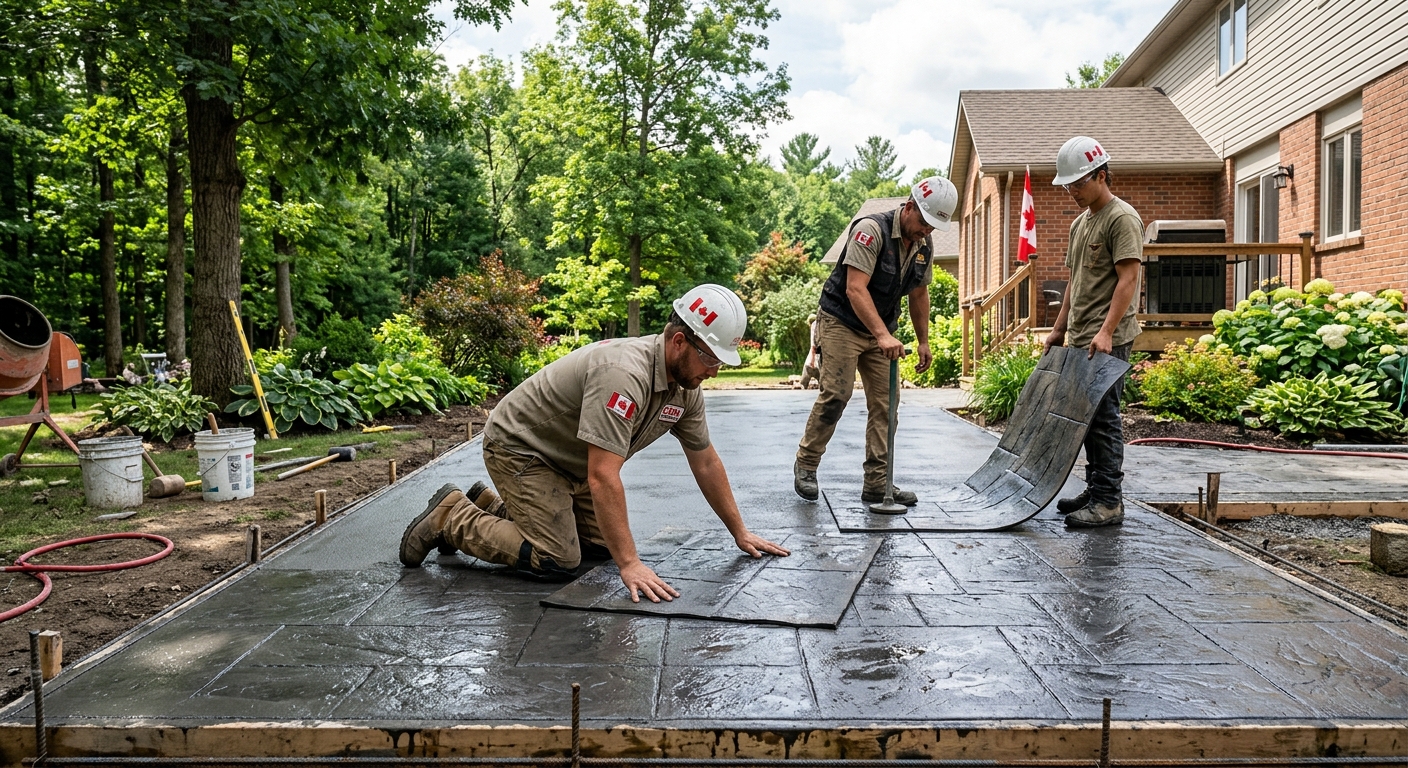
| Stamped concrete driveway or patio |
24 ft × 10 ft (240 sq. ft.) patio/drive |
Air-entrained mix; integral colour (where requested) |
Stamp mats + release agent + seal coat |
$18,000–$26,000 |
| Plain concrete patio or walkway |
200 sq. ft. patio (e.g., 20 ft × 10 ft) |
Air-entrained mix; compacted granular base |
Light broom finish, saw-cut joints |
$5,000–$9,000 |
| Garage floor (interior slab) |
22 ft × 20 ft (440 sq. ft.) |
Minimum 32 MPa concrete; fibre reinforcement optional |
Broom finish, control joints |
$11,500–$17,000 |
| Foundation footings (structural, below frost) |
Typical single-family build |
Excavate to undisturbed soil; reinforced footing steel; below frost bearing |
Structural concrete only (not a decorative finish) |
$28,000–$45,000 |
Prices are estimates only and vary by project scope, site access and material selection.
What affects the price of concrete work in Larkspur
In Larkspur, two quotes for what looks like the same concrete job can differ by 30–50% because our “base” cost isn’t actually a single thing here—it’s a stack of engineered steps. A driveway isn’t just the slab: it’s excavation, hauling, granular base compaction, drainage/grade adjustments, reinforcement decisions, winter-ready materials, finishing, jointing, and curing controls. When any one of those changes (or if the site makes them harder), your price moves quickly.
First, the frost line depth and freeze–thaw cycles dictate almost everything: in Alberta, footings and structural foundations are typically designed to bear below the design frost depth (about 1.2 m or roughly 4 ft in this area) to prevent frost heave and seasonal movement. Exterior slabs also need air-entrained concrete mixes to survive rapid temperature swings. Second, Calgary’s colder pour season is shorter, and winter-grade curing precautions (insulated blankets and sometimes heat) can add labour and equipment when you need to schedule close to fall freeze-up or early spring conditions.
Third, de-icing salt accelerates surface scaling if the concrete and finishing/sealing plan aren’t right—so sealing becomes a practical, not optional, step for longevity. In Larkspur, you’ll commonly see higher costs where excavation is deeper (looser fill, higher groundwater risk, or uneven yards) and lower costs when the site is already well-graded and truck access is straightforward. The finish also matters: standard broom-finish driveways typically land around the $12,000–$18,000 band, while stamped concrete often moves into the $15,000–$26,000 range depending on colour, detailing, and how much of the surface needs to be removed and reworked.
| Price Factor |
Why It Matters |
Cost Impact |
| Frost line depth — determines footing depth and form height |
Footings must bear below design frost to prevent heave and movement. |
Can drive major excavation and rebar quantities; higher depth increases cost. |
| Site preparation — excavation, grading, compacted granular base |
Accurate grading and compaction prevent settlement and cracking. |
Unfavourable soil, limited access, or extra haul-off raises labour and equipment time. |
| Reinforcement — rebar or wire mesh requirement |
Reinforcement controls cracking and increases slab durability. |
Mesh is often adequate for light slabs; rebar and tied steel cost more. |
| Mix design — air-entrainment and compressive strength spec |
Air entrainment resists freeze–thaw damage in Alberta winters. |
Specified higher performance mix can add per-yard cost but improves longevity. |
| Finish type — broom vs. stamped vs. exposed aggregate |
Finishes require different crews, stamps/plates, and curing/cleaning steps. |
Stamped/exposed aggregate typically increases cost over standard broom finish. |
| Pour size and concrete truck access to site |
Smaller pours can cost more per square foot; access affects pumping/handling. |
Limited access may require smaller loads, longer labour time, or a pump. |
| Cold-weather curing precautions — heating and blankets |
Proper curing prevents surface scaling and weak early strength gain. |
Blankets/heat and extra monitoring can add noticeable cost in late-season work. |
| Control joint pattern and sealing cost |
Joint spacing reduces random cracking; sealing helps repel de-icing salts. |
Better jointing and sealing adds line items but reduces future repairs. |
Permits & regulations in Alberta
In Alberta, structural concrete work generally requires a building permit. That includes concrete components like footings, foundation walls, grade beams, and other parts of the structural system. Many of these projects also rely on engineered drawings reviewed through the municipal permitting process. For concrete flatwork such as patios, walkways, and typical driveways, permits are often not required unless the work affects lot grading, drainage, impervious surface coverage limits, or the municipal right-of-way. Even when a permit isn’t triggered, your contractor should still verify requirements before excavation—because municipal expectations around drainage and access can affect how the job is scoped.
To protect yourself in Larkspur, verify contractor compliance step-by-step. First, confirm they carry liability insurance—ask for a current certificate of insurance (COI) and check that it lists the correct legal entity and coverage limits. Second, confirm WSIB/WCB coverage (or the equivalent clearance letter for the situation) and ask for proof; contractors should be able to provide it without hesitation. Third, check their Alberta licence/registration status through the relevant online registry for your trade category, then compare it to the name on their contract and invoice. Finally, request references on similar-scale Alberta flatwork or foundation projects, because freeze–thaw durability depends on how they’ve actually built before.
Getting concrete right in Larkspur's freeze-thaw climate
Concrete failures in Larkspur are usually tied to one of five things: weak base support, inadequate frost protection, poor mix design, wrong curing, or missing joints/sealing. In our freeze–thaw environment, the key spec is air-entrainment; if the mix doesn’t have the right air content for exterior exposure, water can freeze inside the paste and cause scaling or spalling. The second big spec is base preparation—compacted granular sub-base placed to the correct depth and grade so the slab doesn’t settle. Third is control joints: they give the slab a “planned crack path” so shrinkage and thermal movement don’t create random, unsightly fractures.
To keep the job durable, ask for a proper plan across the full build-up. Base first: compacted granular base sized to local soil and frost considerations (for many residential projects, that means building the slab system with enough granular depth and correct elevations). Mix design next: air-entrained concrete with target air content (for exterior flatwork, often around 5–7% air) and a minimum 32 MPa compressive strength. For joints, use a spacing strategy that limits random cracking, then cure properly—minimum 7 days under suitable conditions. After curing (commonly at or after 28 days), apply a penetrating sealer to repel de-icing salts.
Here’s where money is well-spent: if you’re deciding between a plain broom-finish patio around the $5,000–$9,000 band and stamped work (often higher, commonly in the $15,000–$26,000 range for driveway/patio scale), don’t cut corners on the base, air-entrainment, and curing just to “save the difference.” In Alberta winter conditions, that’s exactly what protects your surface investment.
| Spec |
Why It Matters in Larkspur |
What to Ask For |
Impact if Skipped |
| Compacted granular base (depth?) |
Correct depth and compaction resist settlement and frost-related movement. |
Confirm granular type, target compacted depth, and final grade elevations. |
Uneven support leads to cracking, spalling, and trip hazards. |
| Air-entrained concrete mix (target air %?) |
Air voids protect paste during freeze–thaw cycles. |
Ask for exterior-grade air entrainment (commonly 5–7% air for flatwork). |
Increased risk of surface scaling and spalling from salt and freeze–thaw. |
| Compressive strength (MPa rating) |
Strength gain supports durability and load performance in cold weather. |
Specify minimum 32 MPa compressive strength and verify mix design. |
Lower strength can cause early surface damage and joint deterioration. |
| Control joints (spacing per ACI guidelines) |
Joints manage thermal/shrinkage cracking patterns. |
Ask for proposed joint spacing, saw-cut timing, and layout. |
Random cracks appear, often wider and harder to repair cosmetically. |
| Minimum 7-day curing period |
Proper early curing is essential when temperatures drop in Calgary-area seasons. |
Confirm curing method and whether blankets/heating will be used if cold. |
Poor curing increases scaling risk and reduces long-term performance. |
| Penetrating sealer (when applied after cure) |
Sealer helps repel de-icing salts that accelerate spalling. |
Ask for a penetrating sealer applied after the cure window (commonly 28 days post-pour). |
Faster surface deterioration, especially where salt is used in winter. |
How to choose a concrete work contractor in Larkspur
Choosing the right concrete contractor matters in Larkspur because the “hidden” parts of the job—base compaction, air-entrainment, joint layout, and curing in cold weather—decide whether your slab lasts 10 years or 25+. Start by verifying Alberta compliance. Ask for their current Alberta trade licence/registration details for the work they’re doing, plus liability insurance—request a certificate of insurance (COI) and confirm the legal name matches the contract. Next, confirm WSIB/WCB coverage by asking for the clearance letter or proof of coverage relevant to their status. If they hesitate or can’t provide documents quickly, that’s a practical red flag.
Then get 2–3 itemised written quotes. You want labour and materials separated (concrete supply, reinforcement, granular base, excavation/hauling, forms, finishing, curing protection, sealer), not a single lump sum. Read exclusions carefully: is permit support included (if needed)? Is disposal/hauling included? Are driving surfaces protected during finishing and curing? Also ask about warranty coverage—workmanship warranty length, what it covers (cracking within reason, spalling, settlement), and whether product/manufacturer warranty is included and transferable.
For payment, don’t pay more than 10–15% upfront. Hold back payment until the job is complete and the curing/sealing steps are done. Finally, demand a written timeline with start date and completion estimate—especially if winter conditions are part of the schedule.
- Confirm Alberta licence/registration for the specific scope (flatwork vs. structural).
- Request COI (liability) and verify it matches the contractor’s legal name.
- Verify WSIB/WCB clearance letter or proof of coverage.
- Ask for recent photos of similar Larkspur-area freeze–thaw projects.
- Get itemised quotes: excavation, granular base, reinforcement, concrete supply, labour, finishing, curing protection, sealer.
- Confirm whether disposal/haul-off is included.
- Clarify exclusions (sub-base conditions, soft spots, groundwater management).
- Ask how they handle limited access (pump, smaller loads, extra labour).
- Require a specific finish scope (broom vs. stamped vs. exposed aggregate).
- Confirm air-entrainment and minimum 32 MPa spec for exterior flatwork.
- Ask for joint spacing and saw-cut timing plan to control cracking.
- Review warranty details and the trigger for service (what counts as workmanship failure).
Concrete contractor red flags in Larkspur include: vague specs (“regular concrete” with no air entrainment), no written cure plan for cold weather, quotes that ignore base depth/compaction, missing or outdated insurance/WSIB documents, and payment schedules that ask for large upfront deposits without milestones.
Frequently asked questions — concrete work in Larkspur
How do I seal concrete to protect it in Larkspur?
In Larkspur (Calgary region), sealing matters because winter de-icing salt plus freeze–thaw cycles can accelerate surface scaling if water and salt penetrate the concrete. For most exterior flatwork, use a penetrating sealer rather than a heavy film—so it repels moisture while still allowing the slab to breathe. Timing is key: wait until the concrete has properly cured, commonly around 28 days post-pour, and make sure the surface is clean and dry before application. Plan reapplication based on wear (often a few years for driveways where salt is used frequently). When you request a quote, ask whether sealing is included and confirm the product type (penetrating vs. topical) and number of coats, because that choice directly affects how well the driveway or patio holds up through Alberta winters (Statistics Canada, 2021 Census).
What is the difference between concrete and cement?
In everyday language people say “cement” when they mean “concrete,” but technically they’re different. Cement is the binder—an ingredient (usually Portland cement) that reacts with water. Concrete is the full engineered mixture: cement plus water, sand, gravel (aggregates), and sometimes admixtures like air-entrainment for freeze–thaw durability. In Alberta, that mix design is a big deal for exterior slabs; air-entrainment is used so the concrete can tolerate repeated freezing and thawing without spalling. When comparing quotes for a driveway or walkway in Larkspur, you’ll get better apples-to-apples pricing if the contractor states the concrete performance spec (air content for exposure and minimum strength such as 32 MPa) rather than only talking about “cement type.”
How much does concrete work cost in Larkspur?
Concrete pricing in Larkspur is driven by excavation/base prep, frost-related engineering, and how much winter protection is needed for curing. As a practical benchmark, a concrete driveway (standard broom finish) typically comes in around $12,000–$18,000 for the common residential size range, while a basic concrete patio or walkway often lands around $5,000–$9,000. If you add decorative work like stamping, costs climb—stamped driveway/patio scopes commonly land around $15,000–$26,000 depending on size, colour, and detailing. For foundations/footings that must bear below the design frost depth, homeowners often budget $28,000–$45,000 for a typical structural footing scope. Your exact total depends on site access, soil conditions, drainage needs, and finish selection—so ask for itemised quotes.
How deep must footings be for Larkspur's frost line?
For Larkspur and the broader Calgary area, local engineering practice generally targets a design frost depth of about 1.2 m (roughly 4 ft). In practical terms, that means structural footings and foundation elements should bear on undisturbed soil below that depth to reduce the risk of frost heave and seasonal movement. The exact depth and footing size still depend on your geotechnical recommendations and the engineered foundation design—especially if the site has fill, variable soil, or drainage concerns. When you’re budgeting, remember that deeper excavation and higher form/rebar volumes raise foundation costs compared to warmer regions. If your contractor is proposing footing depth “at grade” or without referencing design frost considerations, ask questions and request the engineered details.
Why does concrete crack in Larkspur and how is it prevented?
Concrete cracks mainly because it moves—shrinks as it cures, expands/contracts with temperature, and settles if the base isn’t properly prepared. In Larkspur’s cold winters, freeze–thaw exposure adds stress, and de-icing salts can worsen surface damage if the concrete is not air-entrained and sealed appropriately. The best prevention is a proper system: compacted granular base to the right depth, correct exterior mix design (including air entrainment), and a control joint plan that limits where cracking happens. Contractors should place control joints with appropriate spacing and cut timing, then use proper curing (often at least 7 days; additional winter protection if needed). A common mistake is skipping joints or cutting them too late, which encourages random cracking. If your contractor mentions joints but can’t talk about spacing/timing and curing, that’s a warning sign.
Stamped vs broom-finish concrete — cost difference?
Stamped concrete costs more because it requires additional materials and labour: stamp mats/plates, release agent, integral colour or overlays (if included), and a more careful finishing and cleaning process. In Larkspur, you’ll typically see broom-finish driveways priced around $12,000–$18,000, while stamped concrete driveway/patio projects commonly sit around $15,000–$26,000 depending on surface area and how complex the pattern and edges are. The cost difference can be justified when you’re improving a high-visibility area and staying consistent on the important durability specs—base prep, air-entrainment, control joints, and curing—because decorative finishes don’t prevent freeze–thaw damage on their own. Ask for the same engineering and mix spec across both options; otherwise you may pay more for looks but lose longevity.