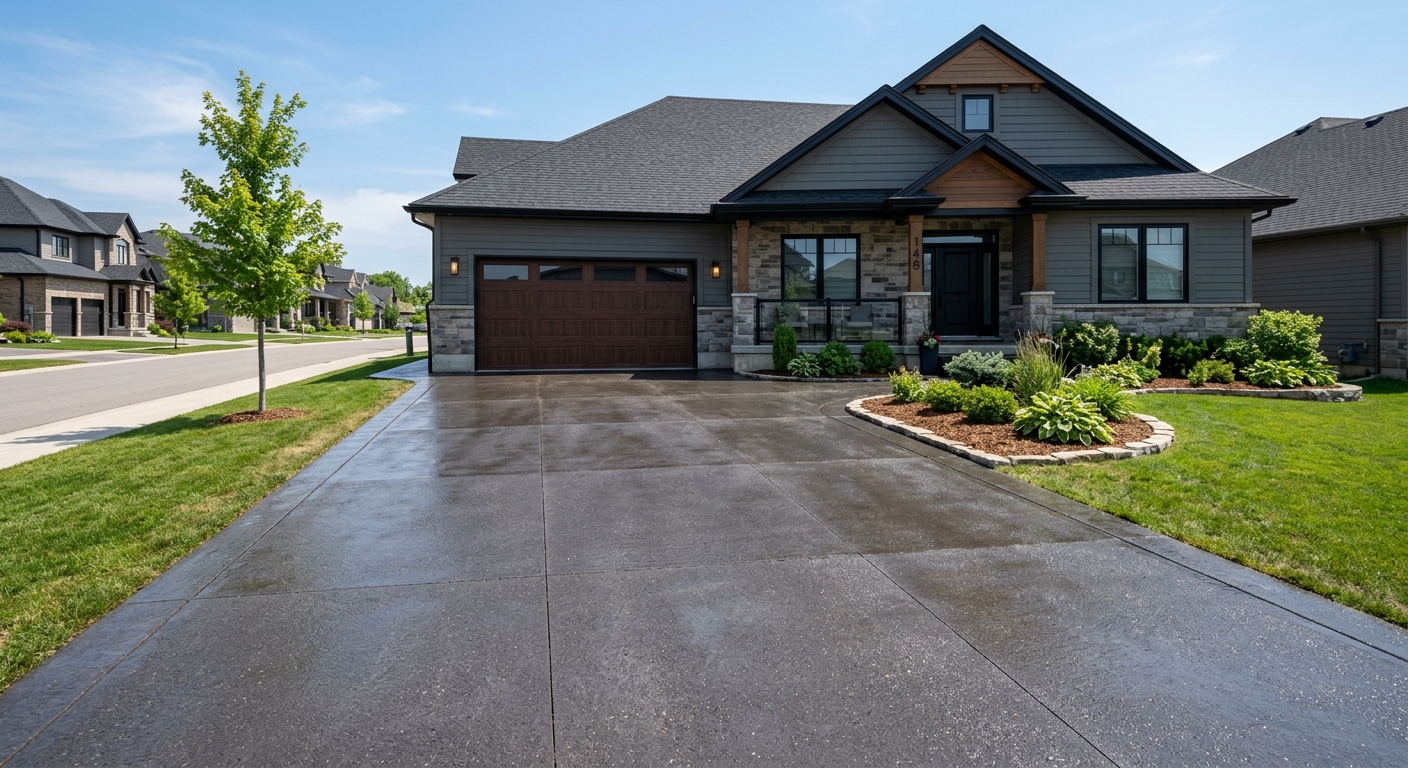
Concrete work options and costs in Hanna
Concrete work is a big part of home upkeep in Hanna, especially for homeowners with driveways, patios, and walkways. In a community where single-detached houses make up 87.7% of dwellings and 74.1% of households are owner-occupied (Statistics Canada, 2021 Census), most concrete demand is tied to exterior flatwork—simple projects that still need the right spec for Alberta’s winters.
In the Camrose–Drumheller area, cold continental winters and frequent freeze–thaw cycles strongly affect pricing. Contractors typically place structural footings below the frost depth (around 1.2 m / 4 ft in this region) to prevent frost heave, which increases excavation, forming, and concrete volume compared to milder climates. Exterior slabs and driveways also require air-entrained concrete mixes to resist scaling and spalling, plus deliberate control joints to manage temperature movement. The short pour season (late spring to early fall) compresses demand, so labour and scheduling can cost more when the weather window is tight.
In Hanna, trades are often busiest around residential pockets with steady turnover and renovations, including the downtown residential core and surrounding neighbourhoods where older homes—67.7% built before 1981—frequently need repairs to steps, drainage improvements, and replacement flatwork. That older housing stock also means more “unknowns” during demo: soft subgrade, uneven grades, and drainage issues that must be corrected before new concrete is poured. With all that in mind, the options below will help you compare apples to apples before you request quotes, including the trade-offs between standard broom-finish concrete and decorative work.
| Application |
Typical Size |
Key Spec |
Finish Option |
Price Range |
| Concrete driveway (standard broom finish) |
24 ft x 10 ft (240 sq ft) |
Air-entrained mix, compacted granular base |
Broom finish, control joints |
$14,000–$22,000 |
| Exposed aggregate driveway |
24 ft x 10 ft (240 sq ft) |
Air-entrained mix, proper curing for durability |
Exposed aggregate |
$18,000–$30,000 |
| Stamped concrete driveway or patio |
20 ft x 12 ft (240 sq ft) driveway/patio area |
Air-entrained mix, joint pattern for movement |
Stamped pattern + sealer |
$20,000–$40,000 |
| Plain concrete patio or walkway |
12 ft x 12 ft (144 sq ft) |
Air-entrained mix, drainage-friendly base |
Light broom or smooth trowel edge |
$3,000–$6,000 |
| Garage floor (interior slab) |
22 ft x 20 ft (440 sq ft) |
Vapour barrier where required, fibre or mesh |
Float-finish, minimal joints as needed |
$7,000–$13,000 |
| Foundation footings (structural, below frost) |
Per typical home application |
Excavation to frost depth, rebar, engineered dimensions |
Structural concrete/formed walls as required |
$180,000–$260,000 |
Prices are estimates only and vary by project scope, site access and material selection.
What affects the price of concrete work in Hanna
In Hanna and the broader Camrose–Drumheller economic region, it’s common to see quotes for “the same” concrete job swing by 30–50%. A big reason is that the climate and frost requirements don’t scale with your budget—contractors have to build for Alberta’s freeze–thaw cycle every time. Where some homeowners compare a 30 ft driveway, others are actually comparing different base thicknesses, different drainage details, and different joint patterns. Those choices directly change labour hours, trucking weight, and the amount of concrete needed.
Frost line depth dictates every structural detail. Exterior footings and foundations must be set below the local frost depth (about 1.2 m / 4 ft in this region) to prevent frost heave. That means deeper excavation, more forming, and more concrete volume. For slabs, air-entrainment is also non-negotiable here—cold conditions and repeated freeze–thaw cycles demand a mix that won’t scale or spall. The short pour season late spring to early fall also tightens scheduling; winter work can require heating, insulated blankets, and slower placement/finishing, pushing costs higher.
De-icing salts accelerate surface damage, so sealing becomes more than “cosmetic” for driveways and patios. In practice, an inexpensive broom-finish driveway may look like $14–$22 per sq ft on paper, but if drainage is poor or the base isn’t prepared correctly, you’ll pay later for repairs. Conversely, spending on control joints and correct curing helps protect an exposed aggregate driveway or a stamped option. For example, upgrading from standard broom finish to stamped concrete often adds labour-intensive finishing and pattern work; that’s typically where the $20–$35 decorative band is justified—especially on visible areas—while plain patios and walkways can remain closer to the base concrete pricing.
Housing age matters too: with 67.7% of homes built before 1981 (Statistics Canada, 2021 Census), you often see older subgrades and drainage paths that need correction. That “extras” portion is one of the main drivers behind higher bids.
| Price Factor |
Why It Matters |
Cost Impact |
| Frost line depth |
Determines footing depth and form height |
Higher excavation and concrete volume; can add significant labour and truckloads for structural work |
| Site preparation |
Excavation, grading, compacted granular base |
Soft or uneven subgrade increases base depth and compaction time |
| Reinforcement |
Rebar or wire mesh requirement |
Materials plus labour to place steel accurately; affects slab stiffness and crack control |
| Mix design |
Air-entrainment and compressive strength spec |
Exterior durability costs more upfront but reduces scaling/spalling risk over winters |
| Finish type |
Broom vs. stamped vs. exposed aggregate |
Stamped/exposed work adds finishing time, set-up, and often sealer |
| Pour size and concrete truck access to site |
Delays and extra pumping/placement labour |
Poor access can increase crew time and equipment rental |
| Cold-weather curing precautions |
Heating and blankets |
Extra materials and slower scheduling can raise total cost |
| Control joint pattern and sealing cost |
Manages cracking and surface durability |
More saw cuts and sealer add line-item cost but reduce long-term maintenance |
Permits & regulations in Alberta
In Alberta, structural concrete work generally needs proper permitting. That includes footings, foundation walls, grade beams, and any structural foundation elements tied to the stability of the house. In many cases, the municipality will expect engineered drawings for structural changes. For exterior flatwork like patios, walkways, and typical driveways, a permit is often not required—unless the work affects lot grading, changes how water drains on the property, or triggers impervious surface and drainage considerations. Even when a permit isn’t required, contractors still need to follow municipal-by-law rules on drainage, setbacks, and right-of-way conditions if there’s any impact near the boulevard.
For a Hanna homeowner, the practical step-by-step approach is to verify the contractor can legally and safely do the job. First, request the contractor’s proof of liability insurance and confirm the coverage limits are appropriate for concrete construction activities. Second, ask for WSIB/WCB clearance (or the proper Alberta equivalent documentation) and confirm it’s current. Third, verify licensing status through the relevant provincial registry and ensure the company name matches the documents you receive. Finally, ask for references on similar-scale flatwork or foundation work (especially projects in similar freeze–thaw conditions).
Before breaking ground, ask the contractor in writing whether they will pull any required permits, or whether you will. Clear responsibility prevents delays and prevents “surprise” costs after excavation starts.
Getting concrete right in Hanna's freeze-thaw climate
Concrete failures in Hanna almost always trace back to predictable freeze–thaw risks: poor base support, inadequate air-entrainment, weak curing, or joints and sealing that weren’t planned for temperature movement. Alberta’s inland winter conditions drive expansion and contraction, and any trapped moisture can magnify damage—especially on driveways and walkways that see snow melt and de-icing salts.
To spec the job correctly, start with base preparation. You need a compacted granular sub-base to the right depth and grade so water drains away and the slab isn’t left sitting on unstable material. Next, the mix design matters: for exterior flatwork, air-entrainment (commonly in the 5–7% air range) helps resist scaling and spalling during repeated freezing cycles, and contractors should target a minimum 32 MPa compressive strength. Then control joints: you’ll still get cracking in concrete, but you want it to happen at planned joints rather than randomly. Finally, curing and sealing: minimum 7-day curing under proper conditions is critical, and a penetrating sealer is typically applied after cure completion (often around 28 days post-pour) to help repel de-icing salts and reduce surface breakdown.
Here’s a simple cost example: if a contractor offers to pour a plain broom-finish patio closer to the lower end of the $12–$20 band but skips air-entrainment or rushes curing, you may be looking at early scaling repairs after just a couple seasons. Spending properly on the mix and curing is usually cheaper than redoing the slab.
When you review proposals, ask direct technical questions: “What air content are you specifying?”, “What is the curing plan if temperatures drop?”, and “How are you spacing joints for this slab length and exposure?” Those answers are the fastest way to avoid spalling from inadequate air-entrainment—one of the most common problems in this part of Alberta.
| Spec |
Why It Matters in Hanna |
What to Ask For |
Impact if Skipped |
| Compacted granular base (depth?) |
Prevents pumping and settlement under freeze–thaw movement |
Base depth tied to your soil and slab type; proof of compaction |
Uneven support, cracking, and premature slab failure |
| Air-entrained concrete mix (target air %?) |
Resists scaling/spalling during repeated winter freeze cycles |
Air content target for exterior flatwork (commonly 5–7%) |
Surface deterioration and flaking within a few winters |
| Compressive strength (MPa rating) |
Controls durability and strength gain in cold conditions |
Minimum 32 MPa and how they achieve it in winter/early season |
Higher risk of cracking and reduced long-term performance |
| Control joints (spacing per ACI guidelines) |
Directs cracking where movement is expected |
Joint spacing plan for the slab dimensions and exposure |
Random cracking through the field and costly patching |
| Minimum 7-day curing period |
Ensures proper strength development during cold snaps |
Curing method and protection plan if temperatures fall |
Weaker slab surface, increased damage susceptibility |
| Penetrating sealer (when applied after cure) |
Helps repel de-icing salts and reduces moisture intrusion |
Sealer type and timing after full cure (often around 28 days) |
More rapid surface wear and scaling in salt-heavy winters |
How to choose a concrete work contractor in Hanna
Choosing the right contractor in Hanna is less about flashy photos and more about proving they build correctly for Alberta’s freeze–thaw winters. Start by verifying Alberta licensing requirements for the work being done, then request proof of liability insurance and current WSIB/WCB coverage. How to check: (1) confirm the contractor’s company name matches the insurance certificate; (2) verify the clearance/document date is current; (3) ask for a clearance letter or policy summary and keep a copy for your records; and (4) check references on similar projects—driveways, patios, or structural footings—especially where cold-weather curing was managed.
Next, get 2–3 itemised written quotes. You want labour and materials broken out (excavation, granular base, rebar/mesh, concrete supply, finish work, joints, sealing, disposal). Avoid lump sums that don’t explain what’s included. Ask specifically: what’s excluded (old concrete removal, hauling, permitting if needed, subgrade repairs)? Is permit pull included for structural work? Is disposal and clean-up included? These details often explain 30–50% differences in bids.
Warranty matters. Ask about workmanship warranty length and whether any product/manufacturer warranties apply to finish materials like sealer (and whether they’re transferable to you). For payment schedule, don’t put more than about 10–15% upfront—hold the remainder until the job is completed and reviewed. Finally, insist on a start date and completion estimate in writing.
- Show air-entrained mix spec for exterior flatwork and confirm curing plan.
- Provide joint layout: spacing and where joints will be saw-cut/formed.
- Explain base thickness and compaction method (not just “we’ll prep it”).
- State reinforcement plan (wire mesh vs rebar) for your slab and loading.
- Include disposal/haul-away for removed concrete (demo is usually the messiest part).
- Confirm drainage approach (grade away from foundation; no ponding).
- Clarify if sealing is included and when it will be applied.
- Detail cold-weather precautions (blankets/heating if work is pushed early/late).
- Provide an itemised materials and labour breakdown—avoid “lump sum magic”.
- Ask how they protect edges and transitions (step-downs, garage thresholds, basement doorsills).
- Get proof of liability insurance and WSIB/WCB clearance before signing.
- Put timeline in writing, including cure protection time, not just pour day.
Concrete contractor red flags I see in Hanna include: quotes that omit the base preparation details, promising “no joints” on driveways, skipping air-entrainment on exterior slabs, rushing curing during cooler stretches, and refusing to provide insurance/WSIB/WCB documentation or a written scope with exclusions.
Frequently asked questions — concrete work in Hanna
How do I seal concrete to protect it in Hanna?
Sealing helps in Hanna because freeze–thaw cycles and de-icing salts can wear down the surface over time. For most exterior flatwork (driveways, patios, walkways), the typical approach is: pour, protect and cure for at least 7 days, and then apply a penetrating sealer after the concrete has fully cured—often around 28 days post-pour—so the product can soak in properly. You should also make sure the slab is clean and dry before sealing and avoid sealing over dust, laitance, or standing moisture. When you request a quote in Alberta, ask what sealer type is being used (penetrating vs film-forming) and whether the contractor includes application labour and protection/curing timing.
What is the difference between concrete and cement?
In everyday conversation, people often say “cement” when they mean the finished concrete slab. Cement is one component—usually Portland cement—mixed with water and aggregates to make concrete. Concrete is the whole mix: cement + sand + gravel (or crushed stone) + water, and sometimes admixtures like air-entrainers for freeze–thaw resistance. That’s why you’ll hear contractors specify “air-entrained concrete” rather than “cement”—the air content is engineered into the full concrete mixture so exterior surfaces resist scaling and spalling. In Hanna’s climate, that difference matters because the performance comes from the complete mix and curing plan, not just the presence of cement.
How much does concrete work cost in Hanna?
Concrete pricing in Hanna generally follows the regional Alberta bands, with scope and site conditions doing most of the heavy lifting. For a driveway or slab, typical concrete driveway work is commonly estimated around $14–$22 per sq ft depending on thickness, base prep, and finish. Patios and walkways often land around $12–$20 per sq ft for plain concrete. Decorative options cost more: stamped concrete driveways or patios typically fall in the $20–$35 band because they require extra finishing time, pattern work, and usually sealer. If your project needs extensive excavation or drainage corrections—common with older homes, since 67.7% were built before 1981 (Statistics Canada, 2021 Census)—you can also see upward pressure on total cost. Always request an itemised quote so you can compare preparation and spec choices.
How deep must footings be for Hanna's frost line?
For Hanna in the Camrose–Drumheller region, a practical reference is a frost line around 1.2 m / 4 ft. Footings and structural foundation elements need to extend below the design frost depth to help prevent frost heave. In the field, the exact required depth can still depend on the engineering design, soil conditions, and local assumptions used for your particular structure. That’s why reputable contractors will coordinate with the right drawings for foundation work and won’t “guess” footing depth. If you’re planning structural concrete (footings, foundation walls, grade beams), confirm the design and permit requirements, then ask your contractor how they will excavate and form to the specified depth and how they’ll protect the excavation from weather delays.
Why does concrete crack in Hanna and how is it prevented?
Concrete cracking is normal, especially in Hanna where temperatures swing and freeze–thaw cycles create movement. Concrete expands and contracts with heat and cold, and moisture changes can add additional stress—so even well-built slabs can crack if movement isn’t controlled. Prevention is about directing cracking and reducing random failure: use the right granular base and compaction, specify air-entrained exterior concrete, and install control joints on a planned pattern (spacing depends on slab dimensions and design guidance). Proper curing also matters; low temperatures can slow strength gain and increase early damage if curing protection isn’t followed. Sealing helps protect the surface from de-icing salts, reducing deterioration that can make cracks appear worse over time. When you review a quote, ask for joint spacing and curing protection details, not just “we’ll pour it and hope.”
Stamped vs broom-finish concrete — cost difference?
Stamped concrete generally costs more than broom-finish because it takes additional labour and materials—pattern mats or forms, colour work (depending on the system), and careful finishing to avoid tearing or defects. In Hanna, that difference aligns with the regional price bands: plain broom-finish driveway concrete is often estimated in the $14–$22 range, while stamped concrete driveways or patios commonly fall around $20–$35 due to the decorative process and typically added sealing. A stamped finish can be worth it for high-visibility areas—like a front driveway or main entry pad—where appearance matters and the surface will still be protected for winter use with correct curing and jointing. If the slab has drainage problems or inadequate base prep, even stamped concrete won’t prevent long-term issues, so pay for the correct structure first, then choose the look.