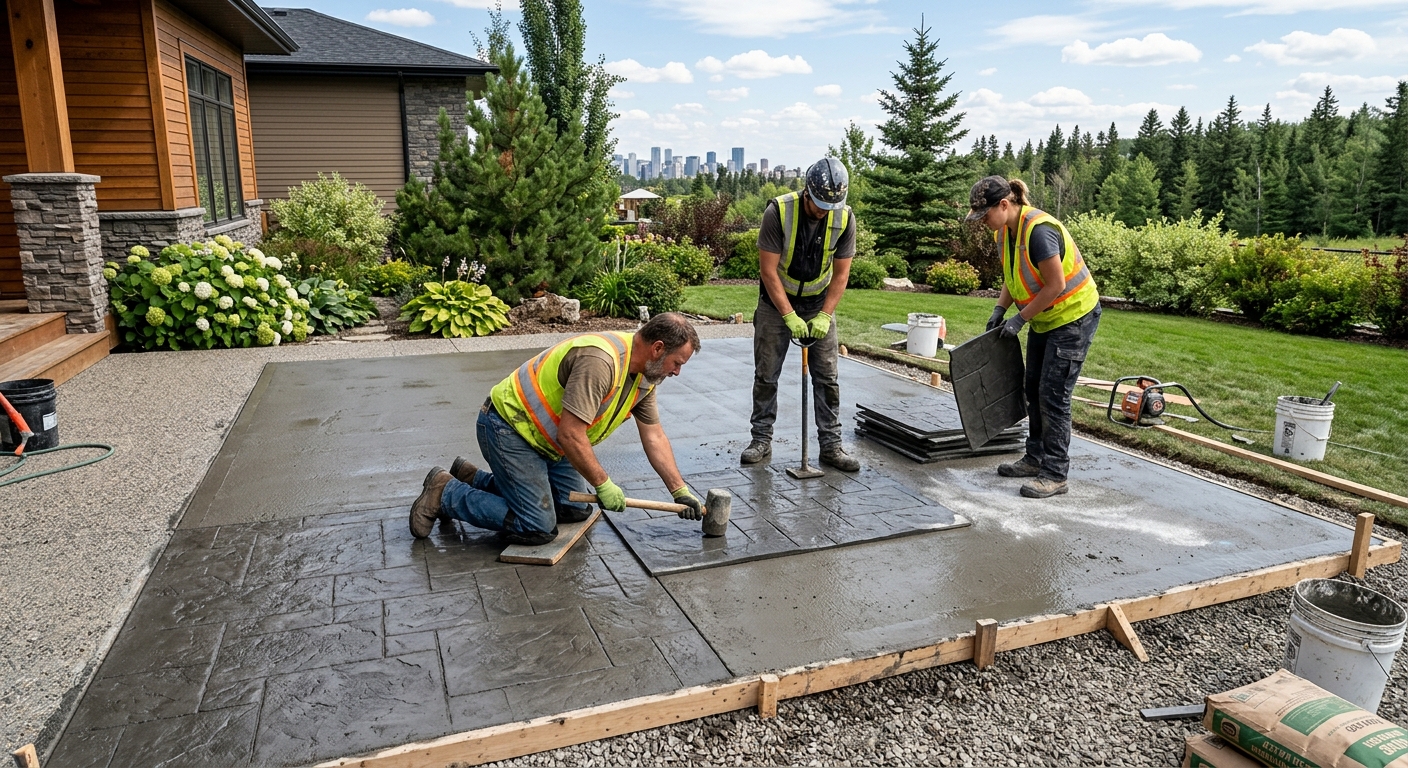
Concrete work options and costs in Ambleside
Ambleside, Alberta is a strong market for concrete flatwork—driveways, patios, and walkways—because homeowners want long-lasting, low-maintenance surfaces that can handle Calgary’s freeze–thaw seasons. With a population of 6,173 (Statistics Canada, 2021 Census), demand tends to cluster in established pockets where infill and renovations are common. In this area, you’ll typically see a lot of one- and two-storey homes and attached garages, which directly increases the frequency of driveway replacements and garage slab upgrades. A big reason costs run higher than people expect is Calgary’s cold continental climate: the design frost depth is engineered around frost and seasonal movement, so foundation and footing work requires deeper, larger excavations than in milder provinces. On exterior slabs, we plan for freeze–thaw by specifying air-entrained concrete and placing control joints correctly to reduce cracking and surface spalling. Another local cost driver is the shorter practical exterior pour season—when crews are working through colder weeks, winter-grade mixes, curing blankets, and temperature monitoring can add labour and material time.
For Ambleside homeowners, we often see the most demand around the busier residential streets near the larger retail and service corridors, where older driveways are replaced as part of driveway-and-landscaping rebuilds. If you’re budgeting, the fastest way to compare contractors is to align scope, thickness, base prep, reinforcement, finish, and whether the pour is planned for warmer weather or requires winter precautions. The table below gives realistic “typical project” price bands you can use as a starting point for quotes.
| Application |
Typical Size |
Key Spec |
Finish Option |
Price Range |
| Concrete driveway (standard broom finish) |
20 ft x 10 ft (200 sq. ft.) |
Air-entrained exterior mix, compacted base, control joints |
Broom finish |
$12,000–$18,000 |
| Exposed aggregate driveway |
20 ft x 10 ft (200 sq. ft.) |
Air-entrained exterior mix, proper curing, aggregate selection |
Exposed aggregate |
$16,000–$22,000 |
| Stamped concrete driveway or patio |
20 ft x 10 ft (200 sq. ft.) |
Air-entrained mix, integral colour, base and joints |
Stamped + sealed |
$15,000–$26,000 |
| Plain concrete patio or walkway |
12 ft x 16 ft (192 sq. ft.) |
Air-entrained exterior mix, compacted base, edges and joints |
Plain broom or smooth trowel edges |
$5,000–$9,000 |
| Garage floor (interior slab) |
20 ft x 20 ft (400 sq. ft.) |
Vapour barrier (as applicable), reinforcement, minimum strength spec |
Broom finish |
$6,500–$14,000 |
| Foundation footings (structural, below frost) |
Typical house perimeter (engineered) |
Below design frost depth bearing, rebar, concrete volume engineered |
Structural (no decorative finish) |
$28,000–$45,000 |
Prices are estimates only and vary by project scope, site access and material selection.
What affects the price of concrete work in Ambleside
In Ambleside and the broader Calgary region, it’s common to see quotes for the “same” concrete job swing by 30–50% once you look beyond the square footage. Contractors can price very differently depending on how much excavation is needed, how deep the frost-protected structure must go, whether the base is built to spec, and how the finish is handled. Calgary’s cold continental climate is the baseline reason: concrete flatwork and foundations are engineered around frost and freeze–thaw cycles, and those requirements change the volume of concrete, the depth of excavation, and the curing precautions. Practically, footings for houses and structural elements must extend below the design frost depth (up to around 2.4 m in Alberta) to prevent frost heave and seasonal movement. For exterior slabs like driveways and patios, air-entrained mixes are essential; without them, freeze–thaw accelerates scaling and spalling. The shorter pour season also matters—cold-weather placement may require insulation blankets, heated enclosures, and temperature monitoring to protect the curing process, which increases labour and sometimes equipment rental time.
Local conditions can push pricing up or down fast. Example one: if your driveway site has poor drainage or needs regrading, the “standard” broom-finish driveway band of $12,000–$18,000 can climb because additional granular base prep and subdrain work add cost. Example two: a stamped driveway or patio at $15,000–$26,000 may be worth it when your goal is aesthetics and you’re already replacing the slab—stamping costs more, but it’s not a separate mobilization if excavation and forms are already scheduled. Example three: if you’re pouring in late fall, winter-grade curing protection can raise costs even for plain patios in the $5,000–$9,000 band, because the contractor needs to maintain curing temperatures. Finally, housing stock age plays a role: older driveways often have heavier base failures (soft spots, settlement, or organic debris), which increases excavation and disposal, not just concrete.
| Price Factor |
Why It Matters |
Cost Impact |
| Frost line depth — determines footing depth and form height |
Footings must bear on undisturbed soil below design frost depth to reduce frost heave and movement |
Higher excavation and concrete volume can materially increase foundation pricing |
| Site preparation — excavation, grading, compacted granular base |
Proper sub-base depth and compaction protect against settlement and slab movement |
Soft soils, regrading, or poor access can add significant labour and material |
| Reinforcement — rebar or wire mesh requirement |
Reinforcement improves crack resistance and load capacity for slabs |
More steel and labour tie-in can raise cost, especially for larger slabs |
| Mix design — air-entrainment and compressive strength spec |
Air entrainment and strength targets are crucial for Calgary’s freeze–thaw durability |
Upgraded mixes cost more, but they reduce long-term scaling/spalling risk |
| Finish type — broom vs. stamped vs. exposed aggregate |
Labour intensity and materials vary by finish system |
Stamped/exposed finishes typically add cost versus broom-finish |
| Pour size and concrete truck access to site |
Smaller access constraints can require extra handling or multiple pours |
Tight lanes, long hose runs, or staging delays increase labour time |
| Cold-weather curing precautions — heating and blankets |
Maintains proper curing when temperatures drop and delays can occur |
Blankets, heaters, and monitoring add overhead and labour |
| Control joint pattern and sealing cost |
Joints manage cracking; sealing helps repel de-icing salt for exterior surfaces |
Good jointing and sealing add line items but improve durability |
Permits & regulations in Alberta
In Alberta, structural concrete work—footings, foundation walls, grade beams and any engineered foundation elements—generally requires a building permit, and municipal review often involves engineered drawings. For concrete flatwork like patios, walkways, and driveways, a permit is usually not required by default; however, permits may be needed if your project changes lot grading, affects drainage plans, or touches impervious surface or right-of-way considerations. In practical terms for Ambleside homeowners: if you’re replacing a driveway slab with similar dimensions and you’re not altering the building envelope or lot drainage direction, it often proceeds as an improvement. If you’re adding retaining walls, modifying drainage, or changing how water routes away from your foundation, confirm first.
Before breaking ground, verify the contractor is set up properly. Step-by-step, I recommend: (1) ask for their certificate of insurance (general liability) showing coverage active for your project; (2) confirm WSIB/WCB clearance or coverage for their workers—requests should be handled by email so you can keep records; (3) verify their licensing/registration in the province through the relevant public registry information available online, and ensure the listed business name matches the quote; (4) ask for references on similar-scale work in the Calgary area; (5) keep a signed scope that lists excavation, forms, concrete supply, reinforcement, finishing, disposal, and any permit-related responsibilities.
When in doubt, contact your local authority first—better clarity up front prevents delays when you’re scheduling exterior pours in Calgary’s tighter seasonal window.
Getting concrete right in Ambleside's freeze-thaw climate
Concrete failures in Ambleside are usually about water management and freeze–thaw durability, not “bad luck.” The most common issues I see are spalling and scaling on driveways and patios, settlement cracks from inadequate base prep, and random cracking when control joints aren’t placed or sealed correctly. To spec the job correctly, start with base preparation: the granular sub-base must be compacted to the right depth for local soil conditions and frost protection so the slab doesn’t move seasonally. Next is mix design: for exterior flatwork, specify air-entrained concrete with about 5–7% air content and a minimum compressive strength target of 32 MPa so the paste can tolerate freeze–thaw expansion without surface damage. Then control joints: place joints to guide cracking and keep them at the correct spacing for the slab thickness and expected shrinkage behaviour. Curing matters just as much—plan for proper curing conditions; as a baseline, minimum 7 days of curing under favourable conditions is typical, and in cold weather the contractor may need blankets or temperature control to protect early-age strength. Finally, sealing: apply a penetrating sealer after the cure period (commonly around 28 days post-pour) to help repel de-icing salts that accelerate deterioration.
Use these questions to prevent the biggest risk: inadequate air-entrainment. If a quote is “cheap” but doesn’t mention air content and curing protection for exterior work, it’s a red flag. As a dollar example, paying for a correctly air-entrained broom-finish driveway in the $12,000–$18,000 range is typically far cheaper than repairing spalled sections later—patching an exterior slab after freeze-thaw damage often costs more per square foot than building it right the first time. Stamped or exposed finishes cost more upfront—often $15,000–$26,000—but they’re still durable when the underlying base, joints, and air-entrained mix are done to spec.
| Spec |
Why It Matters in Ambleside |
What to Ask For |
Impact if Skipped |
| Compacted granular base (depth?) |
Prevents settlement and frost-related movement during Calgary-area freeze–thaw cycles |
Base depth and compaction method, including geotextile use if needed |
Uneven settlement, cracking, and early failure of edges |
| Air-entrained concrete mix (target air %?) |
Improves durability against scaling and spalling in cold weather |
Documented air content target (typically about 5–7% for exterior flatwork) |
Surface scaling, spalling, and faster deterioration |
| Compressive strength (MPa rating) |
Ensures early-age and long-term performance under loads and freeze–thaw stresses |
Minimum strength spec (commonly 32 MPa for exterior flatwork) |
Lower durability and higher cracking risk |
| Control joints (spacing per ACI guidelines) |
Controls where cracking happens to reduce random cracking |
Joint spacing plan based on slab thickness and layout |
Random cracks and difficult-to-repair damage |
| Minimum 7-day curing period |
Cold nights can slow strength gain; curing quality affects final performance |
How curing will be protected, including blankets/heaters if needed |
Reduced strength and increased surface defects |
| Penetrating sealer (when applied after cure) |
Helps repel de-icing salts that drive deterioration in Alberta winters |
Application timing (commonly around 28 days post-pour) and sealer type |
Faster salt attack, staining, and potential surface breakdown |
How to choose a concrete work contractor in Ambleside
Choosing the right concrete contractor in Ambleside is mostly about verifying documentation and matching the quote to the engineering specs your slab needs. First, confirm Alberta coverage basics: ask for proof of general liability insurance (certificate of insurance with your job listed if possible) and request WSIB/WCB clearance or coverage documentation for their workers. Next, verify the contractor’s licensing/registration using the relevant online registry so the legal business name on their paperwork matches the quote and invoice. If they can’t provide clear proof promptly, that’s usually a sign the job management isn’t tight.
Then, don’t accept a “lump sum” without breakdown. Get 2–3 itemised written quotes that separate excavation/site prep, granular base, reinforcement, concrete supply, finishing (including stamping/exposed aggregate if applicable), and cleanup/disposal. Ask what’s excluded: for instance, is removal of existing concrete included, are cartage and trucking distance accounted for, and is permit work included if your project affects grading or drainage? Also check warranty language. You want a workmanship warranty length in writing, plus clarity on product/manufacturer warranty for any sealers or decorative systems—and whether the warranty is transferable to future owners.
Finally, align payment to progress. A good rule: never pay more than 10–15% upfront, and use a holdback until completion and final inspection. Request a start date and completion estimate in writing, especially if weather could compress the pour schedule.
- Ask for itemised pricing (labour, materials, disposal, and finishing line items).
- Confirm they will use air-entrained exterior concrete and provide mix specs.
- Require a written plan for granular base thickness and compaction.
- Check whether reinforcement is included based on slab design and loading.
- Ensure control joint layout and spacing is described (not “we’ll figure it out”).
- Ask how they handle cold weather curing (blankets/heaters/temperature checks).
- Clarify if sealing is included and when it will be applied after cure.
- Verify disposal is included for removed concrete and excess materials.
- Confirm site access plan for concrete trucks and whether pumps are required.
- Review warranty length and what it covers (labour vs materials; cracks vs spalling).
- Use a payment schedule with a final holdback until complete and inspected.
- Get start and finish dates (or weather-conditional wording) in writing.
Ambleside-specific red flags I watch for: quotes that don’t mention air-entrainment for exterior slabs, missing details on base depth/compaction, no plan for control joints or sealing, vague curing language in late-season pours, and contractors who ask for large upfront payments without a signed scope and schedule.
Frequently asked questions — concrete work in Ambleside
How deep must footings be for Ambleside's frost line?
For Ambleside projects in Alberta, footing depth is governed by local design requirements and the design frost depth used for the house or engineered foundation. In Calgary-area practice, you should expect frost-protected footings to extend to roughly the Alberta design frost depth (often up to around 2.4 m in the region), which is why excavation volume—and foundation cost—tends to be higher here than in milder climates. The exact depth should come from your engineered drawings or the geotechnical report for your specific soil conditions; don’t rely on “neighbour references.” When you’re comparing quotes, ask what frost depth they are building to, and whether the contractor is referencing the engineer’s detail for bearing elevation.
Why does concrete crack in Ambleside and how is it prevented?
Concrete cracking in Ambleside is usually manageable, but it’s still a common concern because Alberta freeze–thaw cycles stress slabs and because concrete shrinks as it cures. The main prevention is correct base prep (so the slab doesn’t settle), a proper air-entrained exterior mix for durability, and a control joint plan that guides where cracks are allowed to form. In Calgary-area flatwork, joints should be spaced and detailed to suit the slab thickness and layout, and joints should be sealed at the right time to help keep water and de-icing salts out. If you’re quoted a driveway around $12,000–$18,000, confirm the scope includes base compaction, control joints, and a joint/edge sealing plan—those details affect cracking far more than the finish alone.
Stamped vs broom-finish concrete — cost difference?
Stamped concrete typically costs more than broom-finish because it adds labour-intensive steps: colour system, stamping mats, release agents, and more careful curing and finishing. In Ambleside and the Calgary market, a standard broom-finish driveway commonly falls around $12,000–$18,000 depending on size and site conditions, while stamped driveway or patio work often sits in the $15,000–$26,000 band. The key is that the underlying “engineered” work should be the same—air-entrained mix, base prep, reinforcement if required, and correct control joints. If a contractor offers stamping but cuts those durability steps to keep the price low, you may get the look without the longevity you’re paying for.
When is the best time to pour concrete in Ambleside?
For Ambleside exterior concrete, the best window is typically late spring through summer when temperatures support proper curing without extensive protection. In Calgary’s cold continental climate, late-season pours (fall into early winter) can still be done, but the contractor must plan for cold-weather curing—often using insulated blankets, heaters, and temperature monitoring. That adds cost and scheduling complexity, but it’s how you protect early-age strength and reduce scaling risk. If you’re trying to keep pricing closer to the normal bands (for example, patios around $5,000–$9,000), aim for warmer, stable weather. If timing is tight, ask your contractor to provide the cold-weather cure plan as part of the written quote—not after the pour is booked.
How long does concrete take to cure?
Concrete “cures” in stages. For everyday planning in Ambleside, contractors typically aim for at least 7 days of curing under proper conditions, because early-age strength development is critical in Calgary-area weather. Full design performance continues beyond that, and for many durability tasks like sealing, the recommended timing is around 28 days post-pour so the concrete has dried sufficiently and the sealer can bond and penetrate correctly. If you pour in colder weeks, the curing period may require additional protection (blankets/heating) to maintain adequate temperatures during early strength gain. When reviewing quotes, confirm how long the contractor expects to protect the pour and when they will return for sealing if included.
Do I need a permit for concrete work in Alberta?
In Alberta, structural concrete—footings, foundation walls, and grade beams—typically requires a building permit and often engineered drawings reviewed by the municipality. For concrete flatwork such as patios, walkways, and driveways, a permit is commonly not required when you’re replacing like-for-like and not materially changing lot grading or drainage patterns. However, a permit may be triggered if your work affects lot grading, impervious surface rules, or water routing toward/away from the foundation, or if you’re doing related grading or retaining features. For Ambleside homeowners, the safe approach is to confirm with your local authority before starting. Also verify your contractor carries liability insurance and appropriate WSIB/WCB coverage and that their documentation matches the scope you’re signing.