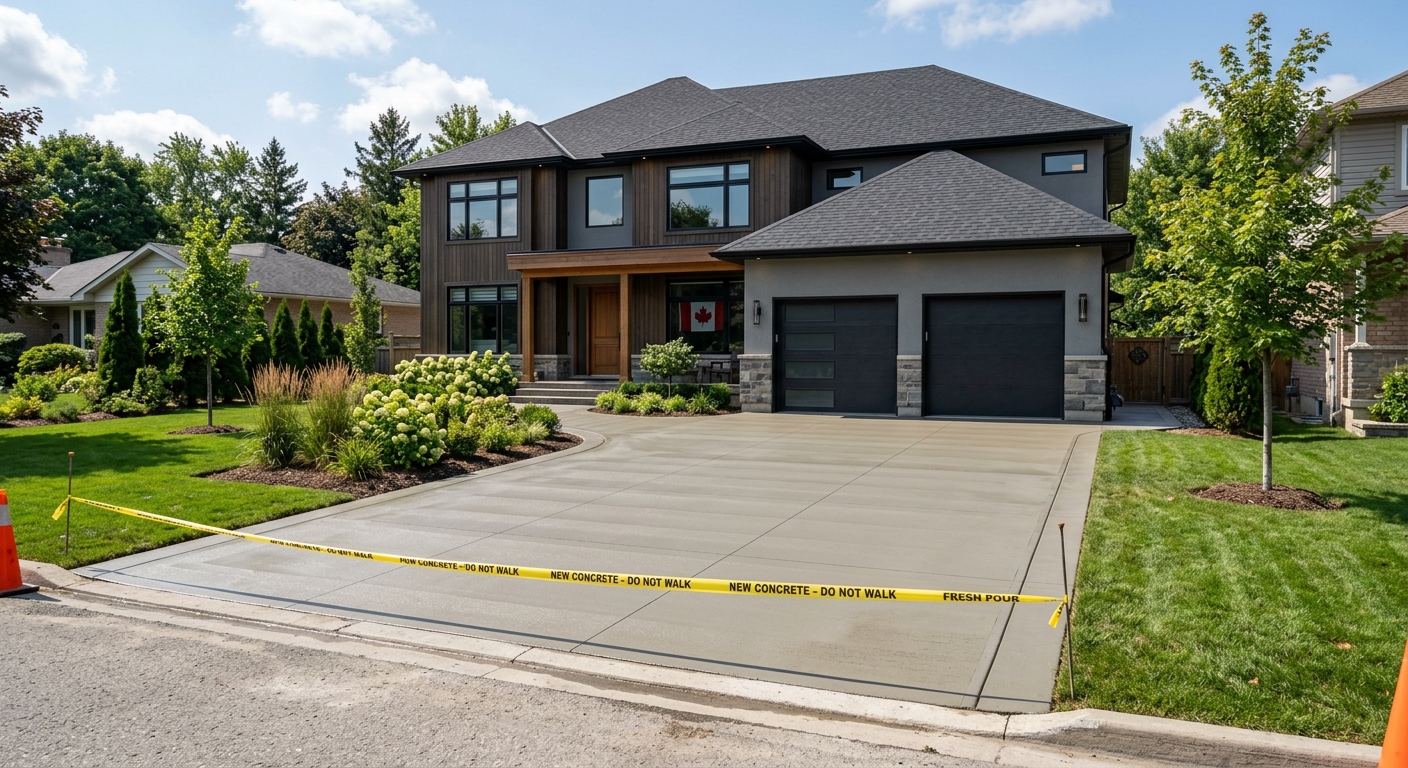
Concrete work options and costs in Greenview
Concrete work in Greenview, Alberta is built around one big reality: the ground freezes deeply and then heaves with repeated freeze–thaw cycles. Greenview’s population is small—2,923 people as of the 2021 Census (Statistics Canada, 2021 Census)—so contractors often schedule work tightly, especially for exterior flatwork during the short pour window. In this area, most homeowners are dealing with detached housing and typical property layouts, and concrete driveways, patios, and walkway slabs are among the most common upgrades. With 2,923 residents locally, many projects are timed around Calgary-area crew availability, delivery routes, and weather.
Because the design frost depth in Alberta is roughly 1.2 m (about 4 ft) for typical residential support conditions, footings and foundation elements require excavation and engineered placement below that zone. For exterior slabs, the freeze–thaw cycles push the specs toward air-entrained mixes, granular base prep, and properly spaced control joints to reduce cracking, scaling, and spalling. In late fall and early spring, cold-weather placement adds cost through winter-grade concrete, curing blankets, and sometimes temporary heat so the surface cures without damage. On top of that, de-icing salt in winter accelerates surface deterioration unless the slab is sealed correctly.
Demand tends to be especially strong for driveways and garage approaches around the Greenview County hamlets and serviced residential corridors (where access for trucks and forms is straightforward). Below is a practical cost comparison for the most requested concrete options in Greenview, Alberta.
| Application |
Typical Size |
Key Spec |
Finish Option |
Price Range |
| Concrete driveway (standard broom finish) |
10 m x 3 m (30 m²) to match typical single-car approach |
Air-entrained mix for exterior; compacted granular base; control joints |
Broom finished, saw-cut joints |
$12,000–$18,000 |
| Exposed aggregate driveway |
10 m x 3 m (30 m²) |
Air-entrained mix; finishing plan for freeze–thaw durability |
Exposed aggregate with proper curing/cleaning |
$14,000–$20,000 |
| Stamped concrete driveway or patio |
20 m² driveway extension or 30 m² patio |
Air-entrained mix; integral colour or dry-shake; jointing strategy |
Stamped pattern with release powder/colour |
$15,000–$26,000 |
| Plain concrete patio or walkway |
3 m x 5 m (15 m²) to 2 m x 10 m (20 m²) |
Air-entrained exterior concrete; compacted base; edges properly formed |
Float and broom finish |
$5,000–$9,000 |
| Garage floor (interior slab) |
6 m x 9 m (54 m²) |
Vapour/insulation considerations; proper base and reinforcement as required |
Steel trowel or broom-sanded finish |
$10,000–$16,000 |
| Foundation footings (structural, below frost) |
Typical home footings and grade beam scope (engineered) |
Excavate below design frost; reinforced concrete; engineered reinforcement |
Structural concrete only (no decorative finish) |
$28,000–$45,000 |
Prices are estimates only and vary by project scope, site access and material selection.
What affects the price of concrete work in Greenview
In Greenview and the Calgary economic region, it’s common to see quotes for the “same” concrete job swing by 30–50%. The big drivers are engineering depth requirements, how the contractor builds the granular base, the reinforcement and mix design, and how much cold-weather curing and crew logistics are needed. Two contractors can offer different totals because one includes a proper foundation-style excavation and frost-safe build-up, while another assumes easier conditions or omits items that affect durability.
Frost depth and freeze–thaw cycles dictate every exterior spec in this region. Footings and foundational elements must extend below the design frost depth (about 1.2 m here) to prevent frost heave and seasonal movement. For slabs, the same climate reality means air-entrained concrete and a well-compacted granular base to resist scaling and spalling. Calgary’s colder, longer shoulder seasons also shorten the practical pour window for exterior work. Cold-weather curing precautions—insulated blankets, winter-grade mixes, and sometimes temporary heat—can add meaningful cost, especially when timing pushes you into late fall or early spring. Finally, de-icing salt accelerates surface wear; sealing is often the difference between a slab that holds up and one that deteriorates faster.
Here are a few real-world examples that push costs up or down in Greenview: a driveway replacement on clayey or frost-susceptible soil can require deeper excavation and imported base to stabilize the sub-grade; a stamped driveway typically costs more than plain concrete because of colour system, labour intensity, and higher material handling (often aligning with the $15,000–$26,000 band for stamped work). A straightforward broom-finished patio may stay in the $5,000–$9,000 range when access is easy and the base is already at correct grade. If your home dates back several decades, older drainage patterns can also increase washout risk around foundations, which then affects how deep and how much base we need to rebuild.
| Price Factor |
Why It Matters |
Cost Impact |
| Frost line depth — determines footing depth and form height |
Deeper excavation and more concrete are required to bear below the frost zone |
High: can move foundation scopes within the $28,000–$45,000 band |
| Site preparation — excavation, grading, compacted granular base |
Correct base depth reduces settlement and frost heave risk |
Medium to High: soil type and haul distance can swing labour and material costs |
| Reinforcement — rebar or wire mesh requirement |
Controls cracking under loads and freeze–thaw movement |
Medium: materials and placement time |
| Mix design — air-entrainment and compressive strength spec |
Air-entrainment is critical to survive freeze–thaw without scaling/spalling |
Medium: higher-spec mix and testing/quality controls |
| Finish type — broom vs. stamped vs. exposed aggregate |
Labour intensity and finishing steps increase with decorative work |
Low to High: stamped typically aligns with the $15,000–$26,000 band |
| Pour size and concrete truck access to site |
Long pours need extra labour and sometimes smaller trucks, pump schedules, or line-watering plans |
Medium: access constraints can add additional mobilization and labour |
| Cold-weather curing precautions — heating and blankets |
Protects strength gain and reduces surface damage when temperatures drop |
Medium to High: commonly increases exterior slab totals |
| Control joint pattern and sealing cost |
Limits random cracking and reduces salt-driven surface deterioration |
Low to Medium: usually small compared to repair costs later |
Permits & regulations in Alberta
In Alberta, the permitting pathway depends on what concrete work you’re doing. Structural concrete—such as footings, foundation walls, and grade beams—normally requires a building permit, and it’s often reviewed with engineered drawings by the municipality. For concrete flatwork (driveways, patios, and walkways), a permit is usually not required in the same way, but it can be triggered if the work affects lot grading, changes impervious surface coverage limits, impacts drainage, or touches municipal right-of-way features. In Greenview, the safest approach is to check with the local authority before you break ground—especially if you’re changing drainage slopes or adding a new driveway tie-in.
To verify a contractor in Alberta, homeowners should work through three steps: (1) confirm any relevant business licence (where applicable for your contractor’s scope) and confirm the company is active; (2) request a certificate of liability insurance showing adequate coverage and that your project is included; and (3) verify WSIB/WCB coverage for the contractor’s workers (clearance or up-to-date account confirmation). Ask for these before signing. For references, request examples similar in size and exposure—exterior slabs in a freeze–thaw climate, not just interior projects.
Getting concrete right in Greenview's freeze-thaw climate
Concrete fails in Greenview most often due to a predictable chain: water gets into the wrong places, the slab or base isn’t built to handle frost movement, and then freeze–thaw cycles do the rest. In practice, that shows up as spalling, scaling, and cracked joints that widen over winters. The fix is to spec the job correctly from the ground up: base prep, the right mix, control joints, proper curing, and sealing.
1) Base preparation: you need a compacted granular sub-base to the correct depth for your soil and to keep the slab bearing stable beneath frost-susceptible layers. Over-excavation and import of suitable granular material is common when original fill is soft or poorly drained. 2) Mix design: for exterior flatwork in this Calgary-area cold continental climate, I recommend 5–7% air content in the mix (target varies by design and exposure) and at least 32 MPa compressive strength for typical residential slabs. 3) Control joints: these are not optional cosmetics—they manage where cracking occurs. 4) Curing: plan for a minimum 7-day curing period under appropriate conditions; cold-weather curing means blankets and/or heat so strength gain isn’t interrupted. 5) Sealing: apply a penetrating sealer after the slab has cured (commonly around 28 days) to repel de-icing salt and reduce surface deterioration.
If you’re choosing between finishes, understand where the money goes. For example, a plain patio may land around $5,000–$9,000. A stamped option typically costs more (often $15,000–$26,000) because of colour system, pattern labour, and more careful finishing. The best “value” decision is usually: don’t cut corners on base, air entrainment, or curing—decorate if you want, but don’t compromise the durability specs.
| Spec |
Why It Matters in Greenview |
What to Ask For |
Impact if Skipped |
| Compacted granular base (depth?) |
Creates a frost-stable support layer so the slab doesn’t heave or settle |
Confirm base depth for your soil and frost exposure; request compaction testing approach if offered |
Higher risk of settlement cracking, uneven slab movement, and premature failure |
| Air-entrained concrete mix (target air %?) |
Lets concrete tolerate freeze–thaw cycles without damaging the paste |
Ask for target air content (commonly 5–7% for exterior flatwork) and that the mix is winter-rated if cold |
Spalling and scaling can appear after a few winters |
| Compressive strength (MPa rating) |
Controls durability and long-term performance under load and temperature swings |
Ask for minimum 32 MPa and whether it changes for cold-weather placements |
Surface wear and structural concerns become more likely |
| Control joints (spacing per ACI guidelines) |
Limits random cracking from shrinkage and temperature movement |
Ask for joint spacing plan and timing for saw-cut (or alternative) in your weather conditions |
Random cracks, moisture intrusion, and accelerated deterioration |
| Minimum 7-day curing period |
Strength gain must occur before the slab is exposed to cold and freeze cycles |
Ask how they protect curing concrete (blankets/heating) when overnight temps drop |
Reduced strength and higher risk of scaling/spalling |
| Penetrating sealer (when applied after cure) |
Helps resist de-icing salts and reduces moisture uptake |
Ask when sealer is applied (commonly around 28 days post-pour) and confirm product type |
Salt damage and surface degradation progress faster |
How to choose a concrete work contractor in Greenview
Choosing a concrete contractor in Greenview comes down to verification and documentation. First, confirm Alberta licensing/eligibility for the scope they’re offering, then request proof of liability insurance and WSIB/WCB coverage. The practical checks are straightforward: ask for a recent certificate of insurance (or COI) with your project listed as applicable, and request clearance/account documentation for workers’ compensation. If they can’t provide it promptly, that’s a red flag.
Next, get 2–3 itemised written quotes. Don’t accept a single “lump sum” with no breakdown. Ask for separate line items that show labour, materials (including air-entrained mix and reinforcement), excavation/base prep, forms, finishing, joints, and any sealing. Confirm whether permit pulling is included if the job is structural (footings/foundations) or if exclusions apply. Disposal matters too—ask whether they include debris removal and disposal fees.
Warranty also needs to be clear. Ask for a workmanship warranty length, whether there’s a separate manufacturer/product warranty for materials, and whether the warranty transfers if you sell the home. For payments, a safe schedule is to avoid large upfront deposits; never pay more than 10–15% upfront, and consider a holdback until all finishing, joints, and cleanup are complete. Finally, get a start date and realistic completion estimate in writing—cold weather can change timelines fast in the Calgary-area freeze–thaw cycle.
- Provide proof of liability insurance before work starts (COI request)
- Provide WSIB/WCB clearance or up-to-date account documentation
- Use written scope with base depth, reinforcement notes, and finishing method
- Confirm air-entrained mix and winter-grade/cold-weather plan if needed
- Specify joint spacing and when saw-cut (or alternative) will occur
- Ask about curing protection (blankets/heat) for overnight lows
- Request an itemised quote—labour vs materials vs disposal
- Confirm whether de-icing salt exposure and sealing are addressed
- Verify equipment access: forms, rebar placement, and concrete truck/pump logistics
- Get the payment schedule in writing (limit upfront to 10–15%)
- Ask for similar local project photos in a cold climate (exterior slabs)
- Confirm cleanup and reinstatement of landscaping/edges
Concrete red flags in Greenview include: contractors who won’t discuss air entrainment and curing, quotes that ignore base preparation depth and reinforcement, vague “lump sum” pricing with no joint/sealing details, crews that insist on finishing without adequate curing protection in cold snaps, and payment requests that ask for a large upfront amount before any materials are staged.
Frequently asked questions — concrete work in Greenview
What is air-entrained concrete and why does it matter here?
Air-entrained concrete is made with tiny, evenly distributed air bubbles that give water a place to expand when it freezes. In Greenview, that matters because the freeze–thaw cycle is frequent and the frost line and seasonal temperature swings stress the slab surface. If a concrete mix isn’t designed for exterior freeze–thaw exposure, you’ll see scaling and spalling sooner—often after a couple of winters instead of over many years. When you request an exterior mix, ask for a target air content commonly around 5–7% for flatwork and confirm it’s specified as air-entrained rather than “regular” mix. If your quote is for a driveway in the $12,000–$18,000 range, verify the mix spec is included, not just the finish.
How do I prepare the base for a concrete slab?
Base prep is where durability is won or lost. For Greenview in the Calgary region, you generally need excavation to remove unsuitable soil, then placement of a compacted granular sub-base sized for frost exposure and your soil conditions. The goal is a stable, uniformly compacted layer that reduces settlement and prevents frost heave from lifting the slab. Ask your contractor to include base depth and compaction approach in the quote, and confirm how they handle drainage or soft spots. For exterior slabs like patios and walkways, a properly compacted granular base helps keep the slab level so water doesn’t pool—pooling increases freeze damage. Even if your budget is focused on a patio budget around $5,000–$9,000, you should never cut base depth or compaction to hit the number.
How do I compare concrete quotes?
When comparing quotes in Alberta, treat every line item like a spec, not just a price. Ask for itemised breakdowns for excavation and disposal, granular base prep, reinforcement (if included), the concrete mix design (air entrainment and compressive strength), finishing method, and protection during curing. For exterior slabs in Greenview, confirm cold-weather measures if the schedule slips into cooler nights—heating or insulated blankets can be the difference between proper strength gain and future surface scaling. Also compare scope details: who supplies and installs forms, who does saw-cut timing, and whether sealing is included (commonly applied around 28 days after pour). A decorative driveway quote might fall into the $15,000–$26,000 band, but if it omits air entrainment or proper curing, it’s not truly comparable to a higher-priced but better-specified option.
Can concrete be poured in cold weather in Greenview?
Yes, concrete can be poured in Greenview in cold weather, but it shouldn’t be done “business as usual.” The Calgary-area freeze–thaw reality means you must protect the concrete so it reaches adequate strength before repeated freezing occurs. Contractors may use winter-grade mixes, insulated curing blankets, temporary heating, and careful temperature monitoring. The key is not only the day-of pour temperature, but also overnight lows and wind exposure, plus how long the slab needs curing protection. Ask your contractor what their winter pour plan is and whether the mix and curing method meet the cold-weather conditions. A cold-weather pour can add cost, but it’s usually cheaper than repairing scaled or weakened surfaces later. If the weather window is too tight, reputable crews will schedule for better conditions rather than rushing the cure.
How do I maintain concrete in Greenview's freeze-thaw climate?
Maintenance in Greenview is mostly about controlling moisture and salt exposure. Start with sealing: a penetrating sealer applied after the slab fully cures (commonly around 28 days post-pour) helps repel de-icing salts and reduces surface water uptake. Use de-icers appropriately—avoid aggressive chemicals where possible, and don’t let brine sit on the slab for long periods. Keep landscaping drainage directed away from the concrete; standing water increases freeze stress. For driveways and patios, clean off debris and sand so you’re not trapping moisture against the surface. During the winter, remove snow promptly but avoid chipping or metal scraping that damages the top layer. Proper jointing also matters—if joints crack open or settle, address it early to prevent water intrusion that can lead to spalling over time.
What causes concrete to spall in Greenview winters?
Spalling in Greenview is usually caused by water getting into the concrete near the surface and then freezing repeatedly. If the concrete mix isn’t adequately air-entrained, the freeze–thaw cycle can rupture the paste and the surface scales or flakes off (spalls). Poor base prep can also contribute by allowing slab movement, which opens micro-cracks and lets moisture move into the concrete. Another common cause is inadequate or rushed curing—especially when a pour is made close to cold snaps without proper winter protection. De-icing salt accelerates the damage once the surface is already vulnerable. If you’re budgeting for a driveway and you’re comparing options around $12,000–$18,000, make sure the quote includes exterior mix specs, curing protection, and a sealing plan—those items directly reduce the odds of spalling in Calgary-area winters.