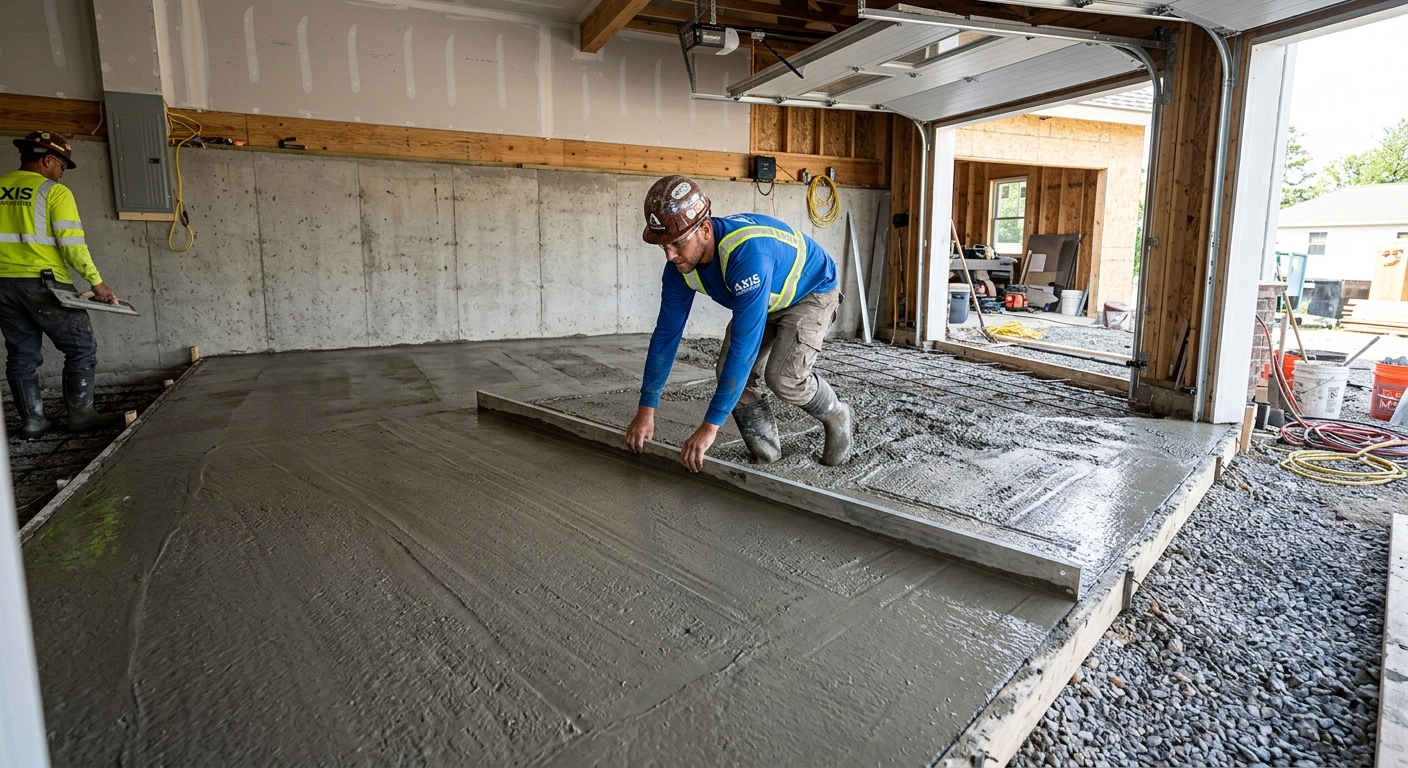
Concrete work options and costs in Holyrood
Holyrood is a growing community, and in practical terms it’s the kind of place where good concrete flatwork—driveways, patios, and walkways—shows up on almost every homeowner’s to-do list. With a population of 3,320 (Statistics Canada, 2021 Census), the market is smaller than Calgary proper, so the contractors who do foundation and exterior slabs well tend to get scheduled early when weather windows open. On the housing side, the area’s predominant single-detached lifestyle means concrete is commonly used for full driveways and rear yard patios that handle Alberta winters and summer heat swings.
Calgary’s cold continental climate is what drives the numbers. In Holyrood, contractors plan around a deeper design frost depth (about 1.2 m, roughly 4 ft), so exterior footings and structural foundations require more excavation and concrete volume than in milder regions. Frequent freeze–thaw cycles also mean air-entrained concrete and tighter attention to control joints, especially on driveways and walkways where surface scaling can become a long-term problem. Finally, the practical pour season for exterior work is shorter, so cold-weather placement can require winter-grade mixes, insulated blankets, and sometimes temporary heat—costs that affect bids directly.
If you’re in an area with heavy winter street activity and lots of salt exposure—like the residential pockets near centres and cul-de-sacs off major routes—driveways and garage floors are especially in demand because homeowners want durable, seal-ready surfaces that won’t flake after the first few winters. Below is a side-by-side comparison of typical options and budget ranges for Holyrood, Calgary’s surrounding market being the benchmark.
| Application |
Typical Size |
Key Spec |
Finish Option |
Price Range |
| Concrete driveway (standard broom finish) |
24 ft x 10 ft (240 sq. ft.) |
Air-entrained mix for exterior; control joints; compacted granular base |
Broom finish |
$12,000–$18,000 |
| Exposed aggregate driveway |
24 ft x 10 ft (240 sq. ft.) |
Air-entrained mix; properly cured to support wash/exposure |
Exposed aggregate with sealer-ready surface |
$14,500–$20,500 |
| Stamped concrete driveway or patio |
300 sq. ft. (driveway section or patio) |
Air-entrained mix; release agent; joint plan to control cracking |
Stamp + texture (slip-resistant) |
$15,000–$26,000 |
| Plain concrete patio or walkway |
200 sq. ft. patio / 100 sq. ft walkway |
Air-entrained mix; compacted sub-base; edge restraints |
Float and broom (or light broom) |
$5,000–$9,000 |
| Garage floor (interior slab) |
24 ft x 22 ft (528 sq. ft.) |
Vapour protection as needed; typical wire mesh or rebar grid |
Broom finish |
$12,000–$20,000 |
| Foundation footings (structural, below frost) |
Typical single-detached home footprint (varies by design) |
Excavate to undisturbed soil below design frost; reinforced concrete |
Structural concrete (not decorative) |
$28,000–$45,000 |
Prices are estimates only and vary by project scope, site access and material selection.
What affects the price of concrete work in Holyrood
In Holyrood and across the Calgary region, it’s common to see quotes for the “same” concrete job land 30–50% apart. That spread usually comes from differences in excavation depth, granular base prep, reinforcement choices, mix design, and—most importantly—how contractors protect concrete during cold nights. In a climate where freezing and thawing happens repeatedly, the cheapest quote often shows up as a missing specification: shallow base, no air-entrainment proof, or limited winter curing measures.
Frost depth is the driver. Alberta projects are built around a deeper design frost depth of about 1.2 m (roughly 4 ft), meaning footings for houses, garages, decks, and retaining structures must bear on undisturbed soil below that depth to reduce frost heave risk. Exterior slabs and walks also need air-entrained concrete so the mix can tolerate freeze–thaw cycles without spalling. On top of that, the pour season is shorter; cold-weather curing precautions—insulated blankets, controlled temperature, and curing time management—add labour and material costs. Lastly, de-icing salts accelerate deterioration on poorly prepared or unsealed surfaces, so sealing becomes a practical requirement in driveways and patios.
Here are a few real-world examples of how local conditions change cost in Holyrood. First, adding 6–12 in. of compacted granular base can raise the ticket, but it often prevents settlement that would otherwise crack a broom-finished driveway. Second, a stamped patio that looks “just cosmetic” can cost near the stamped band because it requires more process control and curing attention; you’re paying for consistency, not only the stamp mat. Third, late-season pours can move a standard slab toward cold-weather pricing—pushing it toward the higher end of the concrete patio/walkway band (while a well-timed summer pour can come in closer to the lower end). For foundations/footings, frost-depth excavation alone can push projects toward the higher end of $28,000–$45,000 when access is tight and over-excavation is required.
| Price Factor |
Why It Matters |
Cost Impact |
| Frost line depth — determines footing depth and form height |
Controls how far down excavation and structural concrete must go |
Higher excavation and more concrete volume (major cost driver) |
| Site preparation — excavation, grading, compacted granular base |
Prevents settlement and frost-related movement |
Adds labour + disposal; can change base thickness |
| Reinforcement — rebar or wire mesh requirement |
Improves crack control and structural capacity |
Material + labour time; required in many slabs/footings |
| Mix design — air-entrainment and compressive strength spec |
Protects exterior concrete through freeze–thaw cycles |
Higher material cost; must be specified correctly |
| Finish type — broom vs. stamped vs. exposed aggregate |
Different labour steps, curing discipline, and finishing tools |
Stamped/exposed can push projects toward higher bands |
| Pour size and concrete truck access to site |
Limits how much concrete can be placed efficiently in one go |
Smaller access can increase labour or require pump/extra logistics |
| Cold-weather curing precautions — heating and blankets |
Ensures strength gain and durability when temperatures drop |
Seasonal adders in late fall/early spring |
| Control joint pattern and sealing cost |
Controls where cracking happens and protects against salt scaling |
Often modest per sq. ft., but prevents costly rework |
Permits & regulations in Alberta
In Alberta, structural concrete work generally needs a building permit, and it’s very common for projects to involve engineered drawings reviewed through the municipal process. That includes footings, foundation walls, grade beams, and other below-grade structural elements. Concrete flatwork—like patios, walkways, and typical driveways—often does not require a separate permit unless the scope affects lot grading, changes drainage patterns, or triggers municipal impervious surface/lot coverage rules, or work occurs within or impacts a municipal right-of-way. In Holyrood, don’t assume: confirm with the local authority before breaking ground, especially if you’re changing elevations near landscaping or drainage features.
Step-by-step, here’s how a homeowner can verify a contractor before they sign anything:
- Check the contractor’s trade licensing using the Alberta online registry relevant to the contractor’s business category.
- Request a certificate of liability insurance and confirm the coverage limits are current and match the project scope.
- Verify WSIB/WCB coverage (clearance/coverage letter where applicable) so you’re not left holding the bag if someone is injured on site.
- Ask for references on jobs comparable in size and climate exposure (driveways and exterior slabs are ideal examples).
- Confirm permit responsibility in the contract: who pulls the permit, what the timeline is, and what happens if approvals delay the pour.
Concrete flatwork usually doesn’t require a permit by default, but structural foundation work almost always does—so you’re protecting yourself when the paperwork aligns with the job type.
Getting concrete right in Holyrood's freeze-thaw climate
Concrete failure in Holyrood’s winter usually isn’t mysterious; it’s predictable. The biggest culprits are inadequate base preparation, insufficient air-entrainment (which leads to spalling during freeze–thaw cycles), poor jointing, and rushed curing in cold weather. When concrete is placed without the right granular sub-base depth and compaction, the slab can settle unevenly, concentrating stress at joints and edges. If the mix isn’t properly air-entrained and the curing is shortened, the surface can scale under de-icing salts—especially after the first couple of winters.
To spec the job correctly in Calgary’s market conditions, insist on five fundamentals. (1) Base preparation: compacted granular sub-base built to suit local soil conditions and the frost-related performance you need. (2) Mix design: air-entrained concrete for exterior work—commonly targeting about 5–7% air content for freeze–thaw durability—and a minimum 32 MPa compressive strength spec. (3) Control joints: a planned joint spacing pattern so random cracking is minimized. (4) Curing: a minimum 7-day curing period under suitable conditions; in cold weather, contractors often need insulation blankets or temporary heating. (5) Sealing: apply a penetrating sealer after the slab has cured—typically 28 days post-pour—to help repel salt and reduce surface deterioration.
Where price differences make sense: if a stamped driveway is quoted closer to $15,000–$26,000 versus a standard broom driveway in $12,000–$18,000, the difference is justified when the contractor also includes the right air-entrainment, joint plan, and curing/blanketing steps. A stamp without proper freeze–thaw specs is a false economy—pretty today, rough in a few winters.
| Spec |
Why It Matters in Holyrood |
What to Ask For |
Impact if Skipped |
| Compacted granular base (depth?) |
Prevents settlement and frost-related movement on exterior slabs |
State base thickness and compaction method; confirm it matches soil conditions |
Cracking, uneven slab, faster deterioration |
| Air-entrained concrete mix (target air %?) |
Critical for resisting freeze–thaw cycles and spalling |
Provide air content target and confirm air-entrained mix is used for exterior |
Surface scaling and spalling within a few seasons |
| Compressive strength (MPa rating) |
Ensures strength gain and durability in cold-weather placement |
Minimum 32 MPa (or higher if design requires) and test documentation plan |
Lower durability and higher long-term repair risk |
| Control joints (spacing per ACI guidelines) |
Controls where cracking occurs as concrete shrinks |
Joint spacing and type; sealing plan for joints if applicable |
Random cracks, moisture ingress, freeze damage |
| Minimum 7-day curing period |
Cold nights can slow strength development |
Curing approach; confirm blankets/heating in cold weather |
Reduced strength, scaling risk, compromised surface |
| Penetrating sealer (when applied after cure) |
Salt exposure in Alberta needs added protection |
Confirm sealer type and timing (commonly around 28 days post-pour) |
Faster salt scaling and staining |
How to choose a concrete work contractor in Holyrood
Choosing the right contractor in Holyrood is mostly about protecting yourself from shortcuts that show up after the first freeze–thaw cycles. Start with Alberta compliance. Ask for the contractor’s trade licensing information, their liability insurance certificate, and proof of WSIB/WCB coverage (or the relevant clearance documentation). If they can’t provide these promptly, that’s your first red flag—concrete work is labour-intensive and site risks are real.
Next, get 2–3 itemised written quotes that break labour and materials out clearly. You want to see base prep depth, rebar/wire specification, mix design (air-entrainment), curing/blanket plan, joint layout, and whether disposal and site restoration are included. Avoid “lump sum only” quotes without an explanation, because you can’t compare apples to apples.
Review warranty too: confirm the workmanship warranty length, whether it covers spalling and cracking, and whether the product/manufacturer warranty is included and transferable to you. For payment scheduling, never pay more than about 10–15% upfront; use a holdback until the job is complete and finalized. Finally, demand a timeline: a written start date, pour date assumptions (weather window), and estimated completion time so you aren’t stuck waiting through seasonal shifts.
- Confirm they include air-entrained mix for exterior work.
- Ask for base thickness and compaction spec, not just “properly prepared.”
- Require a joint plan (spacing and locations) in the scope.
- Check if winter curing precautions (blankets/heating) are priced and scheduled.
- Verify concrete truck access and placement method for your lot layout.
- Ensure reinforcement type (wire mesh vs. rebar) is specified by thickness/spacing.
- Ask whether disposal of excavated material is included.
- Confirm edge restraints and forms are included (not “assumed”).
- Get the sealer product and timing included if it’s part of the scope.
- Read the exclusions list: what’s not included (grading, landscaping patching, re-leveling)?
- Request test/ticket approach for mix delivery and strength documentation.
- Use a written contract with start date, completion date, and weather contingencies.
Concrete contractor red flags in Holyrood: they won’t discuss air-entrainment specs, they skip asking about frost-depth excavation and granular base depth, they offer unusually low pricing without itemizing disposal or reinforcement, they refuse to show insurance/WSIB/WCB clearance, or they pressure you into paying a large deposit before any work is mobilized.
Frequently asked questions — concrete work in Holyrood
How long does a concrete project take in Holyrood?
In Holyrood, timeline depends on whether you’re placing an interior slab, an exterior driveway, or structural footings. For exterior flatwork like a broom-finished driveway, the active placement day might be 1 day, but the full schedule typically stretches over about 1–2 weeks once you include excavation, base prep, forming, curing time, and finishing steps. Driveways and patios often need at least a 7-day curing period under suitable conditions before heavy loads are applied, and colder nights can extend timelines due to blanket/heating requirements.
Foundation/footings take longer because excavation to undisturbed soil below the frost depth and reinforcement setup are labour-heavy. If your pour is scheduled late in the season, the cold-weather curing precautions can add extra days to ensure durability. As a practical budgeting anchor, driveway options usually price within the broader $12,000–$18,000 band, but timing is one reason bids can differ between contractors who plan for winter curing versus those who don’t.
What is a concrete overlay and is it suited to Holyrood?
A concrete overlay is a new layer of concrete—often placed over an existing slab after surface prep—aimed at improving appearance and correcting minor wear without fully removing the original driveway or walkway. In Holyrood and the wider Calgary region, overlays can be suited to select situations: when the existing slab isn’t severely heaved, when there’s not widespread settlement, and when proper bonding and drainage considerations are addressed. Because the area experiences frequent freeze–thaw cycles, overlays also need a well-engineered approach to prevent moisture entrapment, which can accelerate failure at the interface.
Overlay work must be planned with durability specs, including air-entrainment and a joint/edge strategy that acknowledges the original slab’s movement. If your existing surface is already spalling or shifting, a full replacement can cost more up front but often makes better long-term sense.
For a homeowner comparing options, a broom-finish replacement driveway commonly sits in $12,000–$18,000, while a stamped replacement can be closer to $15,000–$26,000. An overlay may look cheaper, but only choose it when the underlying slab condition supports freeze–thaw performance.
How do I seal concrete to protect it in Holyrood?
Sealing concrete in Holyrood is about repelling moisture and reducing damage from de-icing salts. The key is timing and product choice. For exterior slabs, wait until the concrete has properly cured—commonly around 28 days post-pour—before applying a penetrating sealer. If you seal too early, trapped moisture can interfere with penetration and adhesion, which can reduce the protection you’re paying for.
Before sealing, the surface should be clean and dry. This usually means removing dirt, salts, and any loose surface material and letting it dry thoroughly before application. Ask your contractor which sealer they use and whether it’s designed specifically for salt exposure in freeze–thaw climates.
Sealing is not a substitute for correct construction specs (air-entrainment, base prep, and control joints), but it can significantly slow spalling and staining on driveways and patios. If you’re budgeting, sealing may not be the biggest line item compared to the overall driveway band of $12,000–$18,000, but it’s one of the most cost-effective long-term protections.
What is the difference between concrete and cement?
In everyday conversation people say “concrete” and “cement” like they’re interchangeable, but technically they’re not. Cement is one ingredient inside concrete. Concrete is the final engineered material made from cement, water, sand, gravel (or other aggregates), and sometimes admixtures like air-entrainers for freeze–thaw durability. In Alberta, the practical difference you should care about is the total concrete mix design—especially for exterior work—because that’s what determines performance in cold cycles.
For example, when contractors quote an exterior driveway in Holyrood, they should be specifying that the concrete is air-entrained and engineered to handle repeated freezing and thawing. Cement alone doesn’t tell you if the mix has the right air content or compressive strength. That’s why you should ask for the mix spec (including air-entrainment) and minimum strength rating, not only the cement brand.
When you’re comparing quotes in Calgary and nearby communities, focus on whether the contractor is building the full system: proper granular base, air-entrained mix, control joints, and curing precautions. Those are the factors that determine whether you land closer to the lower or higher ends of the $12,000–$18,000 driveway range.
How much does concrete work cost in Holyrood?
Concrete costs in Holyrood depend on scope, access, and—because of Alberta’s deep frost depth and freeze–thaw cycles—how much engineering and winter protection goes into the pour. For a typical exterior driveway (about 240 sq. ft.) with broom finish, you’ll commonly see budgets around $12,000–$18,000. If you want exposed aggregate, expect to pay more for extra finishing steps and curing discipline, often pushing toward the upper end of driveway pricing. For decorative stamped concrete driveways or patios, budgets frequently land in the $15,000–$26,000 range depending on size and design complexity.
Plain patios and walkways usually sit around $5,000–$9,000 for typical residential sizes, but excavation, base depth, and joint/edge detail can move the number. For structural foundation footings, budgets commonly fall into $28,000–$45,000, especially when excavation is deeper to support below-frost performance.
The best way to price accurately is to get itemised quotes that show base prep, mix design, reinforcement, curing precautions, and sealing plan where applicable.
How deep must footings be for Holyrood's frost line?
In Holyrood and the Calgary region, footing depth is determined by the local design frost depth used in engineering and municipal requirements. Practically, contractors plan around a design frost depth of about 1.2 m (roughly 4 ft). That means structural footings should extend down below that depth to bear on undisturbed soil and reduce the risk of frost heave and seasonal movement.
However, the final depth can vary by engineered drawings, soil conditions, and how the foundation is designed (for example, the type of foundation, local site grading, and drainage). A good contractor will confirm the excavation depth based on geotechnical recommendations where available and follow engineered requirements for reinforcement and concrete placement.
If you’re comparing quotes for foundation work in Alberta, ask what depth they’re excavating to and whether the estimate includes reinforcement and below-frost bearing conditions. Foundation/footings budgets commonly fall in $28,000–$45,000, and depth-related excavation is one of the biggest reasons numbers differ between contractors.