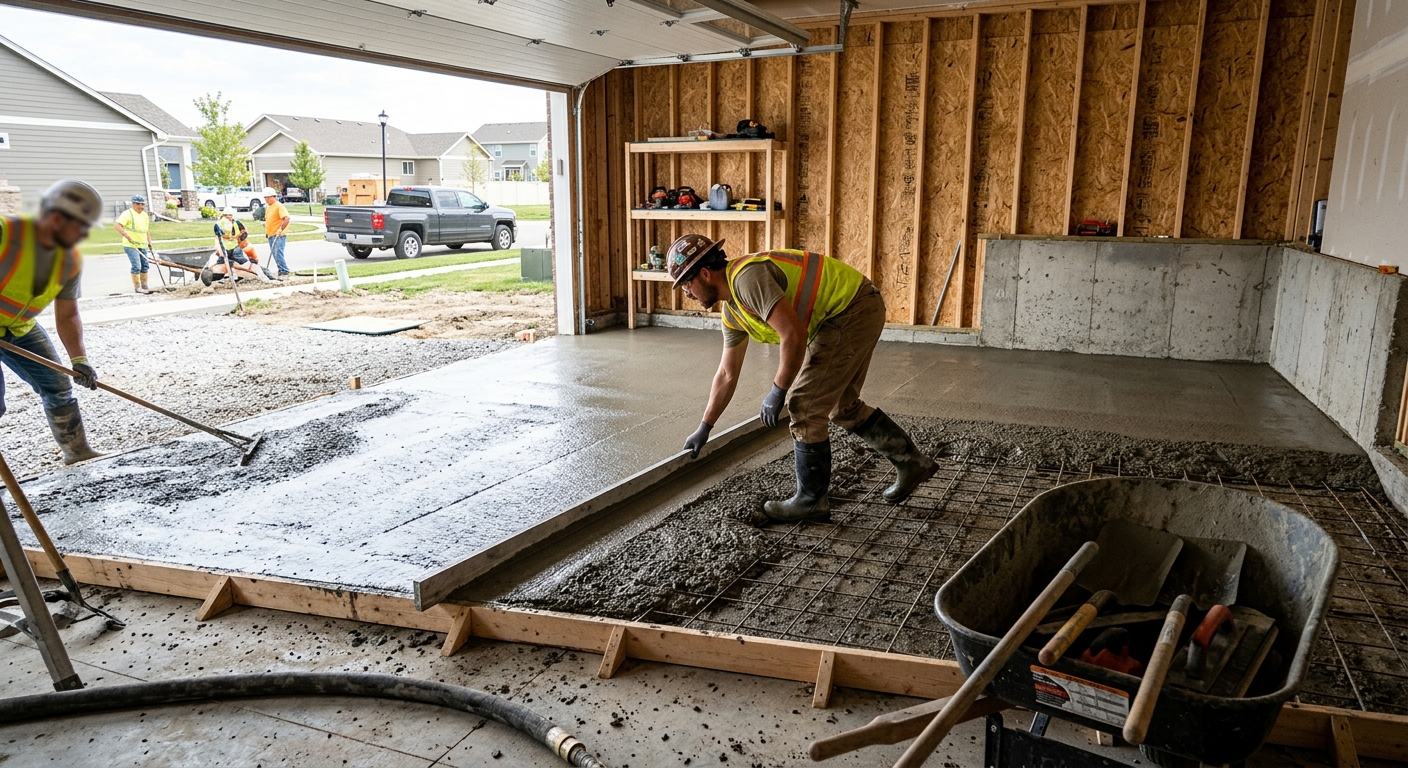
Concrete work options and costs in Fort McMurray
Fort McMurray is a tough place for concrete—deep frost and frequent freeze–thaw cycles mean your driveway, patio, walkways and foundation need to be built for movement control, not just a nice surface. With a population of 66,573 (Statistics Canada, 2021 Census), demand for exterior concrete is steady year-round, especially as households renew older lots and expand parking and garages in neighbourhoods like Beacon Hill.
Most homeowners in this market want practical, long-lasting flatwork: concrete driveways, garage slabs and patios that can handle winter traffic, sand, and de-icing salt. In Wood Buffalo–Cold Lake, that climate pressure shows up in the quote: contractors typically use air-entrained mixes, specify deeper excavation, and tighten control joint spacing to reduce cracking. The short pour window also matters—when crews are compressing schedules between cold snaps, cold-weather protection (heaters, blankets, sometimes accelerators) can add labour and material cost.
That’s why “same-size” jobs can land in different price bands. A broom-finished driveway may stay closer to the lower end, while exposed aggregate or stamping usually reflects extra formwork, finishing time and finish materials. Use the table below as a budgeting starting point, then compare itemized quotes that match the same thickness, base depth and concrete specification.
| Application |
Typical Size |
Key Spec |
Finish Option |
Price Range |
| Concrete driveway (standard broom finish) |
12 ft x 24 ft (288 sq ft) |
Reinforcement as needed, air-entrained exterior mix |
Broom finish, sealed (optional) |
$5,800 – $8,000 |
| Exposed aggregate driveway |
12 ft x 24 ft (288 sq ft) |
Proper base prep + air-entrained mix for freeze–thaw durability |
Exposed aggregate surface |
$7,000 – $10,500 |
| Stamped concrete driveway or patio |
12 ft x 20 ft (240 sq ft) |
Air-entrained mix, tight joint layout |
Stamp mats + color hardener/antique release |
$6,000 – $10,800 |
| Plain concrete patio or walkway |
10 ft x 16 ft (160 sq ft) |
Compacted granular base with good drainage |
Float/trowel with light broom |
$2,400 – $4,000 |
| Garage floor (interior slab) |
22 ft x 22 ft (484 sq ft) |
Vapour barrier, reinforcement, proper curing |
Light broom (or smooth finish) |
$7,000 – $12,500 |
| Foundation footings (structural, below frost) |
Varies by home size |
Excavation to design frost depth, rebar, engineered specs |
Plain structural concrete |
$2,000 – $5,500 |
Prices are estimates only and vary by project scope, site access and material selection.
What affects the price of concrete work in Fort McMurray
In Fort McMurray and across the Wood Buffalo–Cold Lake region, it’s common to see quotes for the “same” concrete project swing by 30–50%. The reason usually isn’t the concrete price—it’s that frost depth, freeze–thaw exposure, and access constraints force different excavation depths, base preparation, forming and reinforcement decisions. Even when two contractors quote the same square footage, the thickness, base depth, curing protection and joint layout can differ materially.
Frost line depth and freeze–thaw cycles dictate every spec here. Exterior work needs footings set below design frost depth to reduce frost heave and structural movement, which means deeper excavation and more forming/rebar than in milder markets. Contractors also specify air-entrained concrete mixes to resist freeze–thaw damage, especially for driveways and exterior slabs. The shorter warm season compresses the pour window—so crews may schedule more manpower, use heated enclosures or insulating blankets, and sometimes add accelerators to keep the pour on track. De-icing salt is another cost driver: it can accelerate surface wear and spalling if the mix and finishing aren’t right, so sealing is often recommended.
Two quick local examples: (1) a driveway poured near a cold snap typically costs more because curing protection is needed—this can push a standard broom job closer to the $18–$28 per sq ft band instead of the low end; (2) going from plain concrete to exposed aggregate or stamping adds finishing labour and materials, commonly moving you toward the $22–$35 per sq ft range for decorative work. If your home is older (more common in established areas of Fort McMurray) and the site has settlement issues, you may also pay extra for excavation and base rebuild—often hundreds to a few thousand dollars depending on how much material has to be removed and replaced.
| Price Factor |
Why It Matters |
Cost Impact |
| Frost line depth — determines footing depth and form height |
Deeper footings reduce frost heave and structural movement |
Higher excavation, forming and rebar; can add thousands |
| Site preparation — excavation, grading, compacted granular base |
Good base and drainage manage frost and slab movement |
More truckloads and compaction time; moderate-to-high impact |
| Reinforcement — rebar or wire mesh requirement |
Controls cracking in exterior slabs and garage floors |
Material + labour; can shift the quote noticeably |
| Mix design — air-entrainment and compressive strength spec |
Freeze–thaw durability depends on correct air and strength |
Increased material cost, but often worth it to avoid failures |
| Finish type — broom vs. stamped vs. exposed aggregate |
Finishing affects durability, slip resistance and appearance |
Stamped/exposed includes extra labour and finishing consumables |
| Pour size and concrete truck access to site |
Long hauls, limited access and pumping change workflow |
Mobilization and logistics fees; can be significant on tight lots |
| Cold-weather curing precautions — heating and blankets |
Short season requires protection to reach design strength |
Heaters/blankets + skilled labour time; often a major swing factor |
| Control joint pattern and sealing cost |
Joints manage cracking; sealing helps resist de-icing salt wear |
More layout time and sealant/material costs |
Permits & regulations in Alberta
In Alberta, structural concrete work typically requires a building permit and often engineered drawings reviewed by the municipality. That generally includes items like foundation footings, foundation walls, grade beams and other structural elements that affect load paths and overall building performance. Concrete flatwork—such as patios, walkways and standard driveways—usually does not require a permit unless it affects lot grading, drainage, impervious surface coverage limits, or the municipal right-of-way. Even when a permit isn’t usually required, it’s smart to confirm with the local authority before breaking ground, especially if you’re changing drainage patterns toward a sidewalk or neighbouring property.
Step-by-step verification for a homeowner in Fort McMurray:
- Confirm the contractor’s Alberta business registration status (and the specific licence category if applicable) through the appropriate online registry resources.
- Request a current Certificate of Liability Insurance showing the policy limits and coverage term.
- Verify they have WSIB/WCB coverage and ask for a clearance letter or proof of account coverage.
- Ask for references on similar-scale work (exterior slabs/driveways in cold climates, not just interior pours).
- Have them put all scope details in writing: thickness, reinforcement, base preparation, curing measures, and sealing.
These checks protect you when excavation and concrete work are impacted by deep frost requirements and compressed pour timelines in northern Alberta.
Getting concrete right in Fort McMurray's freeze-thaw climate
Concrete fails here for predictable reasons: inadequate base preparation, wrong mix design, weak curing, and poor joint planning. In Fort McMurray’s freeze–thaw climate, the most common symptom is spalling and surface breakdown caused by inadequate air-entrainment, plus random cracking from poor control joint spacing. To spec the job correctly, start with three foundations: base, mix and joints—then lock in curing and sealing.
1) Base preparation: build a compacted granular sub-base to the right depth for your soil and frost conditions, with drainage that prevents water from sitting under the slab. 2) Mix design: require an exterior air-entrained mix (target air content typically around 5% to 7% for many exterior applications) and a minimum 32 MPa compressive strength. 3) Control joints: plan joint spacing to limit random cracking and ensure the weakest planes are where you expect them. 4) Curing: aim for at least 7 days of proper curing conditions; in cold weather, that often means blankets and/or heaters so the concrete can reach design strength. 5) Sealing: apply a penetrating sealer only after the slab has cured (often at 28 days post-pour) to better repel de-icing salt and reduce surface deterioration.
Ask the contractor how they’ll prevent freeze–thaw damage—not just how they’ll “finish it nice.” For example, if you’re choosing between a standard broom driveway and stamped concrete, the stamped option might cost closer to the $22–$35 per sq ft decorative band (because of materials and finishing time). That premium is justified when the contractor still maintains the same exterior durability specs (air-entrainment, correct base, proper joints). If they cut corners to save money on the foundation of the slab, the look won’t matter after one harsh winter.
| Spec |
Why It Matters in Fort McMurray |
What to Ask For |
Impact if Skipped |
| Compacted granular base (depth?) |
Controls frost movement and slab settlement under repeated freeze–thaw cycles |
Base depth for your soil + proof of compaction + drainage plan |
More cracking, uneven slabs, and premature edge deterioration |
| Air-entrained concrete mix (target air %?) |
Air bubbles give freeze–thaw resistance and reduce spalling risk in exterior exposure |
Specify air content (typically 5% to 7%) and verify exterior mix design |
Surface scaling/spalling and faster winter damage |
| Compressive strength (MPa rating) |
Ensures durability and structural capacity after curing in cold conditions |
Minimum 32 MPa and how curing temps will be maintained |
Under-strength concrete and reduced service life |
| Control joints (spacing per ACI guidelines) |
Directs shrinkage and thermal cracking to predictable locations |
Joint layout plan with spacing and saw-cut timing |
Random cracks that widen and trap moisture/salt |
| Minimum 7-day curing period |
Cold-weather curing is critical to reach design strength and durability |
Protection plan (blankets/heaters if needed) and curing verification |
Weaker surface, scaling, and reduced freeze–thaw performance |
| Penetrating sealer (when applied after cure) |
Helps limit de-icing salt penetration and surface wear from winter maintenance |
Apply after cure (often 28 days post-pour) and confirm product type |
Faster surface breakdown and higher maintenance over time |
How to choose a concrete work contractor in Fort McMurray
Choosing the right contractor in Fort McMurray comes down to verifying credentials, comparing like-for-like scopes, and protecting yourself on payment and schedule. Start with Alberta compliance: ask for their current business licence/registration status (as applicable), a Certificate of Liability Insurance, and proof of WSIB/WCB coverage (often provided as a clearance letter or account proof). You should also confirm they carry coverage that fits the scope—excavation, forming, truck access, and any cold-weather protection they’ll use.
Next, get 2–3 itemised written quotes. Look for a breakdown that shows labour and materials separately (concrete supply, rebar/wire mesh, granular base, forming, finishing, saw cutting, disposal). Avoid lump-sum quotes that don’t state thickness or base depth—those are where pricing differences hide.
Read exclusions carefully: is disposal included for excavated material? Is permit work included where required for structural concrete? What’s the plan for cold weather curing—blankets, heaters, or scheduling around temperature targets?
Finally, protect workmanship and your cash flow. A solid contractor will provide a workmanship warranty (length and terms in writing) and clarify any product/manufacturer warranty. Payment should typically be staged so you never pay more than 10–15% upfront; use a holdback until the job is complete and cleaned up. Insist on a written start date and completion estimate.
- Ask for proof of insurance and WSIB/WCB clearance before work begins.
- Confirm concrete specification: air-entrained mix and minimum strength target (not just “proper mix”).
- Require written thickness for slab/driveway and the granular base depth.
- Check reinforcement details (rebar/wire mesh placement and spacing where used).
- Ask about control joint spacing and when joints are cut/sawn.
- Confirm cold-weather measures (heaters/blankets/temperature monitoring) in writing.
- Verify whether sealing is included (and when it’s applied after cure).
- Clarify disposal/hauling of excavated soil and sweep-up/cleanup scope.
- Ensure the quote includes site protection to prevent damage to landscaping/grades.
- Confirm concrete truck access logistics and whether pumping is needed.
- Review warranty length and what “warranty service” actually covers.
- Use a staged payment schedule with a holdback until completion.
Concrete red flags in Fort McMurray: contractors who won’t specify air-entrainment and strength, who refuse to discuss curing in cold weather, who propose cutting corners on base prep depth, who give only vague lump-sum numbers without thickness and reinforcement details, or who demand large upfront payments before any work starts.
Frequently asked questions — concrete work in Fort McMurray
Concrete vs pavers for a patio in Fort McMurray?
In Fort McMurray, concrete often wins for longevity when it’s built with the right base and exterior mix. Pavers can look great, but they’re more sensitive to base drainage and compaction; any settlement can cause uneven movement, and freeze–thaw can work up through weak joints. A broom-finished plain concrete patio typically sits in the $15–$25 per sq ft range, while stamped options climb higher because of finishing labour and materials. If you want a uniform, low-maintenance surface that tolerates de-icing salt and repeated winter cycles, ask your concrete contractor for air-entrained exterior mix, a compacted granular base, and a control joint plan. If you love the paver look and you have stable base conditions, pavers can work—but ensure the installer treats the base like a frost-management system, not just a bed of sand.
How long does a concrete driveway last?
A well-built concrete driveway in Alberta’s freeze–thaw climate can last 20 to 30 years or more, but “build quality” matters more than the calendar. The biggest drivers are air-entrainment, proper base preparation, correct thickness, reinforcement where needed, and joint spacing that controls where cracks appear. In Fort McMurray, drivers also affect wear: sand, ploughing, and de-icing salt can accelerate scaling if the surface isn’t protected. That’s why sealing (often a penetrating sealer) is commonly recommended after the slab has cured. Budget-wise, standard broom driveways generally fall around the $18–$28 per sq ft band, and more decorative finishes can shift higher. If your quote is the cheapest, compare specs line-by-line—especially base depth and air content—to judge whether it’s likely to last.
What is air-entrained concrete and why does it matter here?
Air-entrained concrete is formulated to include microscopic air bubbles that provide a pressure-relief space when water freezes inside the cement paste. In Fort McMurray and the Wood Buffalo–Cold Lake region, freeze–thaw cycling is intense, so this isn’t optional—it’s part of surviving winter exposure. Without adequate air entrainment, exterior slabs are at higher risk of spalling and surface scaling after repeated winters. When you compare quotes in Alberta, ask for the mix design to be air-entrained and for an exterior target air content (often roughly 5% to 7% for many exterior placements). Also ask how the contractor controls curing in cold conditions—heaters/blankets and proper temperature protection can be the difference between achieving design strength and under-curing the slab.
How do I prepare the base for a concrete slab?
Base preparation is where strong slabs are won in Fort McMurray. The goal is a compacted granular sub-base with drainage so water doesn’t sit under the slab and expand during freezing. Ask for the granular material type, the required base depth for your soil conditions, and confirmation that compaction testing (or at least a documented compaction method) is used. The contractor should also address grading so exterior runoff won’t undermine the edges. For driveways and patios, good base prep typically means more excavation and truckloads than homeowners expect—especially because frost depth and movement control require robust design. If your project is in an older area with potential past settlement, you may need additional base rebuild. A concrete contractor quoting only a finish description without explaining base depth should be treated cautiously.
How do I compare concrete quotes?
To compare concrete quotes fairly in Fort McMurray, don’t start with the lowest number—start with like-for-like specs. Ask each contractor to show: slab/driveway thickness, reinforcement (if included), compacted granular base depth, air-entrainment and minimum strength target, and the control joint pattern and sealing plan. Confirm whether cold-weather measures (blankets/heaters/accelerators) are included if temperatures are low during your pour window. Also compare logistics: disposal, truck access, and whether pumping is required. A driveway quote that lands near the $18–$28 per sq ft band may be reasonable, while a decorative stamped quote closer to the $22–$35 per sq ft band may be accurate—only if both match durability specs. If one quote is far cheaper, it’s usually because a key durability item is missing or excluded.
Can concrete be poured in cold weather in Fort McMurray?
Yes, concrete can be poured in cold weather in Fort McMurray, but it has to be done with proper cold-weather controls to achieve design strength and durability. The contractor should use measures like heated enclosures or insulating blankets, manage placement and curing temperatures, and follow a plan for achieving the minimum strength in the required time. In this region, the shorter warm season often compresses the pour window, so crews may schedule earlier or use accelerators—these steps add cost and should be clearly itemized. Ask the contractor what temperature triggers the use of blankets/heaters, how long the protection stays in place, and how curing will be maintained to hit the design compressive strength (commonly 32 MPa minimum for exterior placements). If a contractor says they’ll pour “no matter what” without a curing protection plan, that’s a major risk.